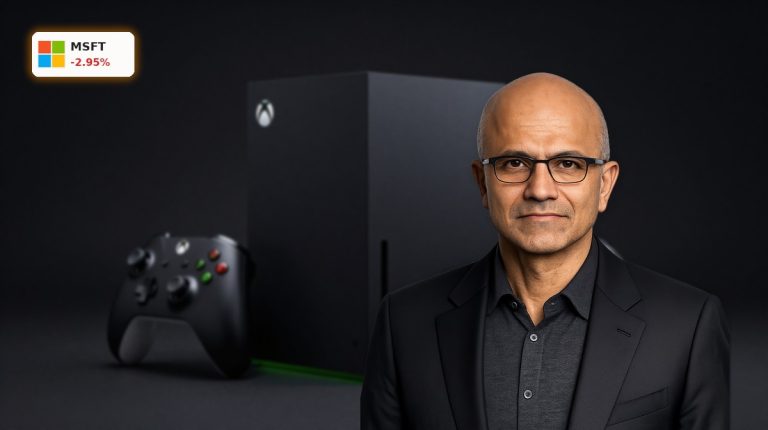

Can the massive Microsoft AI Investment wave justify today’s share price drop and reignite long-term growth expectations for MSFT?

How is Microsoft stock positioned before results?
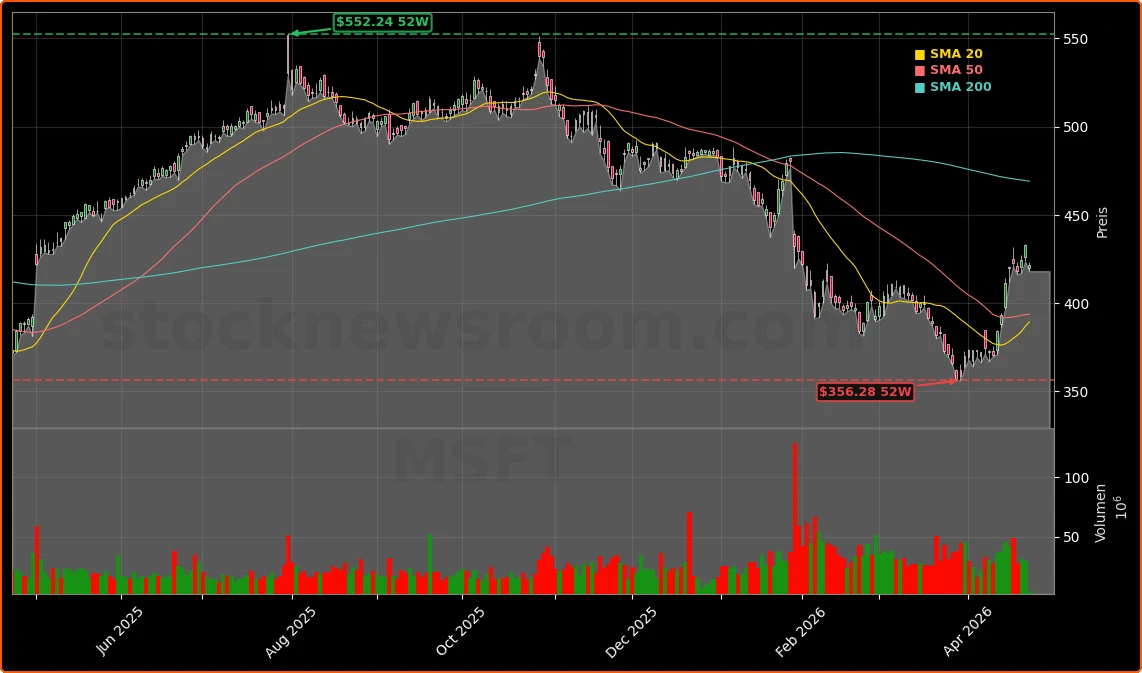
Microsoft Corporation (MSFT) has staged a modest rebound with the rest of the “Magnificent Seven”, but it remains well below its 52‑week high near $500. The share price recently fell from above $500 to roughly $360 at the lows, a move many institutional investors viewed as a rare opportunity to buy a high‑quality compounder at a discount. At about $421.45 today versus a prior close of $427.44, the stock is off 2.66% in Thursday trading, leaving it down mid‑teens from its peak over the last six months.
Despite the drawdown, valuation is no longer stretched by recent standards. Microsoft trades at roughly 24–27 times forward earnings, similar to the multiple it commanded before the generative AI boom in late 2022. With earnings growth running about two to three times the average S&P 500 constituent, many long‑only managers still see it as a core AI and cloud holding rather than a trade.
Short term, however, sentiment is mixed. Growth in Azure decelerated to the high‑30% range in the last reported quarter, missing some bullish expectations as capacity constraints limited how fast AI workloads could scale. Investors will focus intensely on next week’s earnings to see whether fresh AI infrastructure spending is starting to ease those bottlenecks.
Is Microsoft AI Investment changing the growth outlook?
The core of the bull case rests on the current Microsoft AI Investment wave. Management has committed to tens of billions of dollars in AI‑focused capex, from GPU clusters to custom data centers optimized for large language models and inference at scale. Like Alphabet and Amazon.com, Microsoft is effectively front‑loading a new infrastructure cycle in the hope that AI workloads will drive decades of high‑margin cloud revenue.
A flagship piece of this strategy is the plan to invest A$25 billion (about $18 billion) in Australia by 2029 to expand AI supercomputing, cloud and cybersecurity infrastructure. This is Microsoft’s largest commitment to that market and follows a prior A$5 billion cloud and AI build‑out announced in 2023. The intent is clear: lock in enterprise AI demand region by region by owning the underlying compute and platform stack.
On a global basis, capital intensity has surged, but so has customer interest. Enterprises increasingly want to deploy copilots, domain‑specific agents and AI‑enhanced applications on a trusted hyperscale platform. If Microsoft can convert its Microsoft AI Investment into durable Azure contracts, the near‑term margin compression could set up a stronger multi‑year earnings trajectory.
Can Copilot catch up with AI rivals?
The weak spot in the narrative today is Copilot. Despite an early lead through its OpenAI partnership, Microsoft’s generative AI assistants have not fully met investor expectations. GitHub Copilot has 4.7 million paid users, and corporate Copilot products count around 15 million paying customers, but that still represents only a small fraction of Microsoft’s massive Office 365 and commercial cloud user base.
Copilot’s adoption pace looks modest when stacked against fast‑growing rivals such as Anthropic’s Claude and OpenAI’s ChatGPT, which boast higher daily active users. That has sparked frustration among some shareholders, prompting CEO Satya Nadella to launch an internal “Copilot code red” effort aimed at speeding feature rollouts and improving user experience.
At the same time, Microsoft has become more pragmatic and multimodal in its AI strategy. The company is integrating Anthropic models, including the Claude Cowork suite, into its own offerings, even though it remains tightly aligned with OpenAI. It also chose not to bid for AI coding startup Cursor, which later attracted a massive option deal from SpaceX, signaling that management is prioritizing platform breadth and infrastructure over every potential acquisition target.
How strong is Microsoft versus software peers?
Fundamentally, Microsoft’s financial profile still stands out in the software universe. With a price‑to‑earnings ratio of about 27, a price‑to‑book of 8.2 and a price‑to‑sales near 10.6, the stock actually screens as undervalued versus many high‑growth software names when adjusted for scale, profitability and balance sheet strength. Return on equity sits just above 10%, and EBITDA of roughly $58 billion dwarfs most rivals.
Revenue growth around 17% edges out the broader software peer group, helped by momentum in cloud and recurring SaaS revenues. A debt‑to‑equity ratio of only 0.15 underscores how little leverage the company needs to fund its current Microsoft AI Investment cycle. That low gearing gives management flexibility to keep spending heavily on data centers and GPUs while still returning cash via buybacks and dividends.
By contrast, many smaller software and infrastructure firms lack the cash flow to both invest and buy back stock, forcing trade‑offs that Microsoft can largely avoid. That is why some analysts continue to list Microsoft as a top large‑cap pick for AI exposure, even after the recent drawdown.
What does this mean for mega‑cap tech on Wall Street?
For U.S. investors, Microsoft’s next earnings print is about more than one stock. Alongside Alphabet and Amazon, Microsoft now anchors the AI trade in the S&P 500 and NASDAQ 100. The “Magnificent Seven” have been a key driver of index performance, and Microsoft’s commentary on Azure demand, AI infrastructure capex and Copilot monetization will help set the tone for the entire group, including hardware beneficiaries like NVIDIA and ecosystem players such as Apple and Tesla.
Many on Wall Street expect strong Azure numbers in coming quarters as newly built capacity comes online. Evercore ISI, for example, has argued that a re‑acceleration in Azure could emerge in the second half of the year once supply constraints ease. Institutional flows remain active: some firms like MBL Wealth LLC have recently increased their holdings, while others have trimmed positions to manage risk after the volatile AI run‑up.
If Microsoft can show that its Microsoft AI Investment is translating into faster cloud growth and rising Copilot attach rates, the stock could reclaim its leadership status among AI winners. If not, investors may continue rotating toward leaner, faster‑growing names in the AI ecosystem.
Related coverage
For a deeper dive into whether the current infrastructure build‑out is creating a durable moat or an overbuilt, low‑return cycle, readers can explore this detailed analysis of Microsoft’s AI strategy and recent share price moves. That piece examines how hyperscale capex, model partnerships and enterprise demand could shape the company’s long‑term position in the AI stack.