

Can upbeat Thermo Fisher earnings and a higher 2026 outlook really justify a double-digit stock plunge on weak organic growth?

How did Thermo Fisher Earnings compare to expectations?
In the first quarter ended March 28, 2026, Thermo Fisher Scientific Inc. posted revenue of $11.01 billion, up 6% year over year and above consensus estimates of roughly $10.9 billion. Growth was composed of about 1% organic expansion, 3% from acquisitions, and 2% from favorable currency effects. Adjusted operating income rose 6% to $2.4 billion, with an adjusted operating margin of 21.8% versus 21.9% a year earlier, as higher tariffs and foreign‑exchange headwinds weighed on profitability.
Adjusted EPS came in at $5.44, up 6% from the prior year and around $0.15–$0.20 ahead of typical analyst models. GAAP EPS climbed 11% to $4.43. The company highlighted strong productivity across segments, which helped offset mix headwinds. However, the modest 1% organic sales growth in the quarter underscored a still‑cautious demand environment from biopharma clients and ongoing weakness in academic and government spending, especially in the U.S. and China.
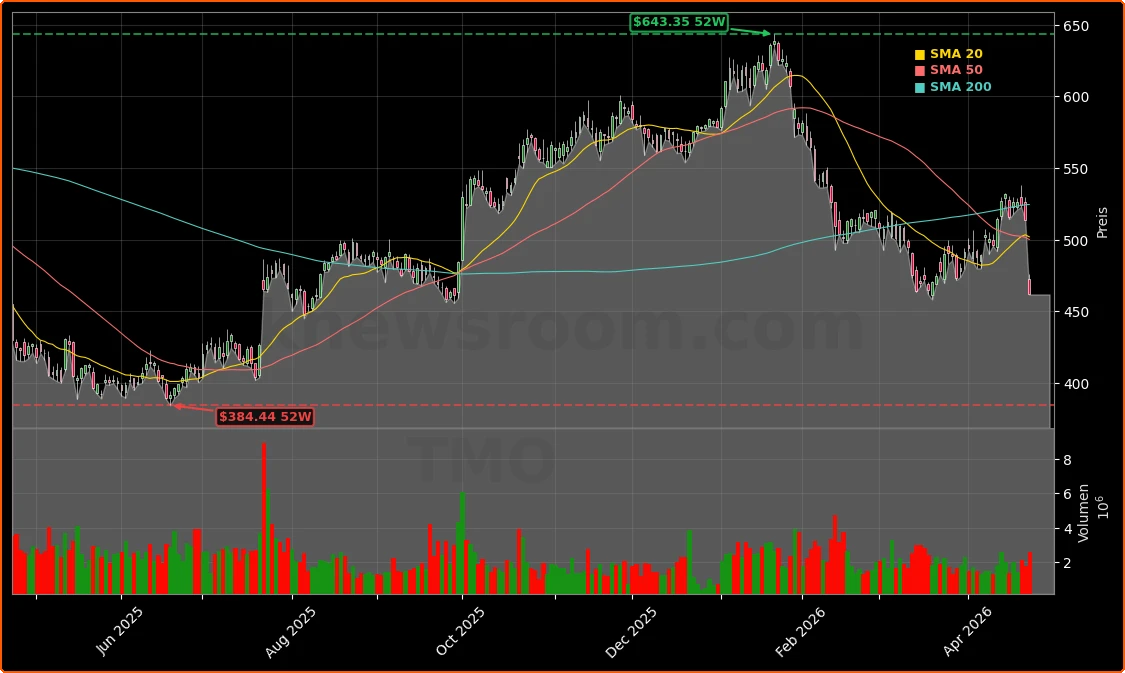
Despite the beat, the stock traded sharply lower on Thursday, extending a pullback from levels near its 52‑week high and leaving shares well below their previous all‑time peak, reflecting concerns that earnings upside is increasingly dependent on acquisitions and cost controls rather than a robust end‑market recovery.
What did the new 2026 outlook signal for investors?
On the back of the solid Thermo Fisher Earnings report, management raised its full‑year 2026 guidance. The company now expects revenue between $47.3 billion and $48.1 billion, implying 6%–8% reported growth and 3%–4% organic growth for the year. The updated outlook includes roughly $900 million of additional revenue from the recently closed Clario acquisition, which enhances Thermo Fisher’s clinical research and digital data capabilities.
Adjusted EPS guidance moved up to a range of $24.64 to $25.12, representing 8%–10% growth versus 2025. At the midpoint, Clario is expected to add about $0.32 of accretion to adjusted EPS in 2026, with a further $0.37 per share driven by operational performance above the prior plan. Management also indicated that Q2 adjusted EPS should be $0.25–$0.30 higher than Q1, suggesting sequential momentum as revenue phasing in biopharma services normalizes.
Even so, several Wall Street firms see the stock as a hold rather than an outright bargain. TD Cowen, for example, recently trimmed its price target on Thermo Fisher from $683 to $625 but maintained a Buy rating, arguing that Q1 should mark the trough for EPS growth and that organic trends could accelerate in the second half of 2026 as pharma and preclinical activity improve. Quant‑driven services have TMO ranked mid‑pack among life science tools peers, reflecting strong profitability but more average near‑term growth.
How do the segments and AI partnerships shape the story?
Under the hood of the latest Thermo Fisher Earnings, performance varied widely by segment. Life Sciences Solutions revenue grew 13% on a reported basis, helped by acquisitions, but only 1% organically. Analytical Instruments was flat reported and down 2% organically as customers delayed capital purchases. Specialty Diagnostics slipped 1% reported and 3% organically, while Laboratory Products and Biopharma Services rose 7% reported and 4% organically, driven by bioproduction and clinical research demand.
The Clario acquisition, which closed in late March, contributed about $30 million of revenue and $0.01 to adjusted EPS in Q1 and is central to Thermo Fisher’s push into digital clinical endpoints. Management reported strong early customer interest in the technology, which should help integrate data streams across the company’s biopharma services platform.
Thermo Fisher is also leaning into data and AI partnerships to maintain an edge over larger technology names that are encroaching on healthcare analytics. Recent collaborations with NVIDIA and OpenAI aim to embed advanced analytics and automation across lab workflows, complementing the company’s own R&D spending of roughly $340 million in the quarter. These initiatives indicate that Thermo Fisher is positioning itself at the intersection of hardware, software, and data in life sciences — a space also being targeted by big tech players such as Apple in digital health and research tools, even if not head‑to‑head today.
What do Thermo Fisher Earnings mean for valuation and peers?
At around $462 per share after Thursday’s sell‑off, Thermo Fisher still trades at a premium multiple to many S&P 500 healthcare names, reflecting its long‑term track record of compounding earnings and cash flow. Long‑term returns have been impressive: a $100 investment 20 years ago would be worth well over $1,000 today, underscoring the company’s status as a core holding in many diversified portfolios.
Yet some analysts argue the stock remains priced for a faster organic growth profile than the current 3%–4% outlook. Research shops that model intrinsic value using discounted cash flow and P/E peer comparisons generally see the shares as close to fairly valued or slightly rich after the big run‑up from the 2022–2023 lows, even following this week’s pullback.
Relative to other large‑cap life science tools and diagnostics players on the NYSE and NASDAQ, Thermo Fisher currently offers steadier earnings growth than more cyclical names but less explosive upside than high‑beta innovators. For investors comparing it with high‑growth tech leaders like Tesla or NVIDIA, the trade‑off is clear: lower volatility and durable cash flows, but not the same double‑digit growth rates that can justify very high multiples.
We are raising our full-year revenue and adjusted EPS guidance, reflecting confidence in our execution and the benefits of recent investments.— Marc N. Casper, Chairman and CEO of Thermo Fisher Scientific Inc.
In the end, the latest Thermo Fisher Earnings confirm that the business is executing well and that 2026 should bring mid‑single‑digit organic growth with rising EPS, but the sharp stock reaction shows how sensitive Wall Street remains to any sign that growth will stay in that moderate lane.