
Can a “Legendary February” of Olympics and Super Bowl really turn Comcast’s challenged broadband story into a renewed growth narrative?

How did Comcast Earnings move the stock today?
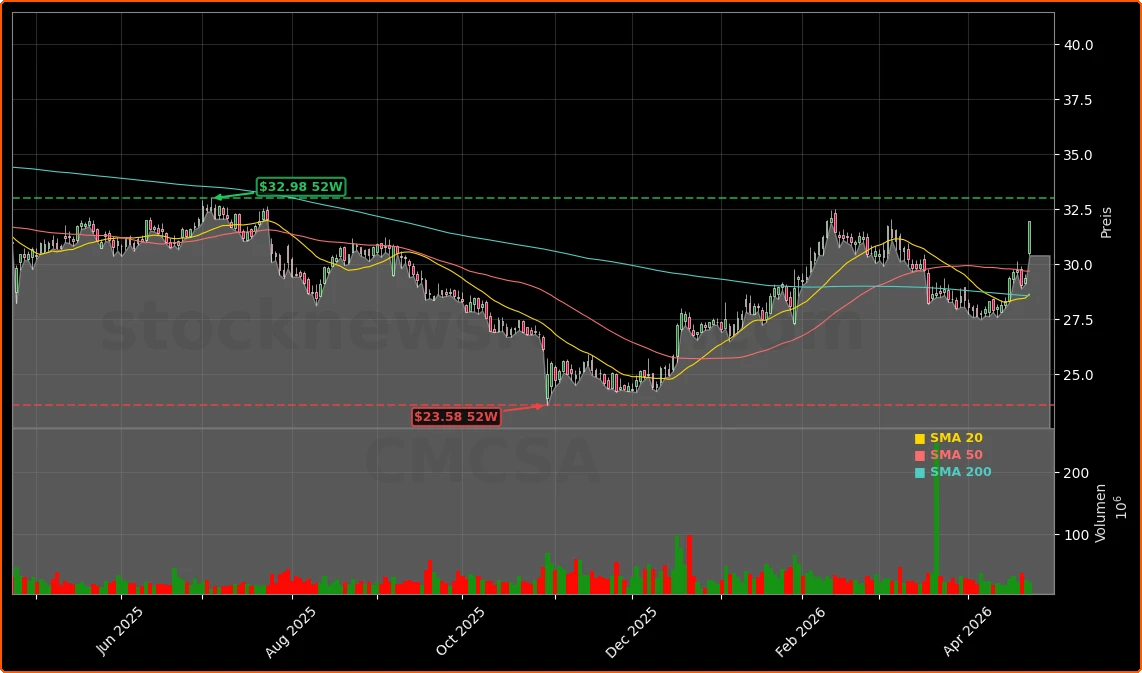
Comcast Corporation (CMCSA) shares jumped roughly 8.8% to about $31.95, extending a rebound that keeps the stock below typical analyst targets but above recent lows. The move followed a Q1 2026 report in which adjusted EPS of $0.79 beat expectations around $0.72–$0.73, while revenue of $31.46 billion comfortably cleared forecasts near $30.4 billion. The strong print arrived against a backdrop of mixed sentiment: Morgan Stanley only recently initiated coverage with an Equal Weight rating and a $31 price target, arguing that broadband challenges limit near‑term upside despite attractive valuation and solid free cash flow.
The price reaction suggests investors were positioned cautiously heading into the release, especially after earnings previews on Wall Street had framed the quarter as one in which profits could fall year over year. With CMCSA still trading at a single‑digit forward earnings multiple and offering a meaningful dividend, the earnings surprise has re‑ignited debate over whether the stock belongs alongside steady cash generators such as Apple or remains a structurally challenged cable name facing streaming and connectivity disruption.
What is behind the Comcast Corporation revenue beat?
The headline beat in the latest Comcast Earnings was overwhelmingly driven by NBCUniversal’s media segment, which enjoyed a rare “perfect storm” of premium sporting events. Segment revenue surged to about $7.28 billion, up nearly 61% year over year, as the Milan Cortina Winter Olympics and Super Bowl LX delivered record audiences and advertising demand. Ad sales in media jumped roughly 135% to $3.45 billion; stripping out the two marquee February events, underlying ad growth cooled to a more modest 4.7% and overall media revenue growth to about 13%.
Super Bowl LX averaged around 125 million viewers, becoming NBCUniversal’s most‑watched program ever, with 30‑second spots reportedly clearing about $8 million. The Winter Games averaged 23.5 million viewers, the strongest Winter Olympics performance since 2014. Management branded the month “Legendary February” and used the massive reach not just to sell ads but to cross‑promote its Xfinity and Peacock offerings, echoing how sports programming has become an audience engine for streamers from NVIDIA‑powered gaming broadcasts to competitors like Tesla‑sponsored events.
How healthy is Comcast Corporation’s core connectivity business?
Behind the headline strength, the latest Comcast Earnings highlight that connectivity remains a grind. Connectivity revenue grew just 1.6% to $11.6 billion, as Comcast continued to lose residential broadband subscribers in an environment of intense fiber and fixed‑wireless competition. The good news: net broadband losses narrowed sharply to 65,000 customers, an improvement of 117,000 versus the same quarter a year ago, marking the first year‑over‑year improvement in broadband net adds since 2020.
Management credits roughly half of that improvement to “Legendary February” promotions tied to the Olympics and Super Bowl, with the remainder coming from a revamped go‑to‑market strategy and operational changes. However, there was a cost: broadband ARPU fell 3.1% amid fewer price increases, migration into simpler pricing plans, and heavy use of bundled free mobile lines. Convergence revenue, which blends broadband and wireless economics, dipped 2.8%, and management cautioned that ARPU pressure should persist near term.
Wireless remains the bright spot. Comcast added a record 435,000 wireless lines in the quarter, taking its mobile base to 9.7 million lines and reaching about 16% penetration of its domestic broadband customers. Nearly half of new lines were offered as “free” in promotional bundles, but early cohorts show a majority converting to paid plans over time, which should provide a tailwind to revenue in the back half of the year. Premium wireless plans now represent about 30% of postpaid phone connects, supported by offerings such as Mobile Plus. For investors comparing CMCSA to U.S. telecom peers, this wireless traction is central to the convergence thesis that Comcast can offset broadband churn with higher‑value bundled relationships.
What do Comcast Earnings say about streaming, parks and profits?
On the content side, Peacock continued to scale. Paid subscribers rose 12% year over year to 46 million, and revenue crossed the $2 billion mark for the first time, surging to about $2.1 billion—roughly double the prior year. The trade‑off is profitability: Peacock posted a quarterly EBITDA loss of $432 million, wider than the $215 million loss a year earlier. Management, however, signaled that Q2 should mark an inflection, with the service expected to approach breakeven as sports‑driven subscriber cohorts mature and content amortization normalizes, broadly in line with how streaming platforms at rivals like Apple have sought scale first and margins later.
Theme parks were another standout. Revenue climbed 24% to roughly $2.33 billion, with EBITDA up about 33%, helped by robust demand in Orlando and contributions from the new Epic Universe complex. Studios also performed well, highlighted by “The Super Mario Galaxy” generating over $750 million at the global box office and driving franchise revenue to around $2 billion.
Despite the revenue beat, profitability at the group level compressed. Net income dropped to $2.17 billion from $3.38 billion a year earlier, a decline of about 36%, and adjusted EBITDA fell 17% to $7.93 billion. Management pointed to higher sports rights expenses, including the first‑year impact of the new NBA contract, and elevated spending on broadband marketing and simplification initiatives. Even so, Comcast produced $3.9 billion in free cash flow and returned $2.5 billion to shareholders via $1.2 billion in dividends and $1.25–$1.3 billion in buybacks, maintaining the shareholder‑return profile that many U.S. dividend and value investors prioritize.
We are starting to see signs that our efforts are working and we are shifting the businesses in the right direction.— Brian L. Roberts, Chairman and CEO, Comcast Corporation
For portfolio managers benchmarking against the S&P 500 and NASDAQ, the latest Comcast Earnings frame CMCSA as a hybrid: part legacy cable, part media‑and‑parks growth story, and increasingly a wireless and streaming bundler. The stock’s post‑earnings jump above Morgan Stanley’s $31 target, while still below the roughly $34–$35 average target cited by MarketBeat’s surveyed analysts, suggests room for further repricing if broadband losses continue to narrow and Peacock pivots toward profitability. With net leverage at about 2.3x and management reiterating a disciplined capital allocation stance, the next few quarters will show whether Legendary February was a one‑off windfall or the blueprint for sustainably linking content, connectivity and cash flow.