Can the massive Applied Digital Hyperscaler Deal really justify today’s double-digit stock surge, or is AI euphoria running ahead of fundamentals?

What is behind the Applied Digital Hyperscaler Deal?
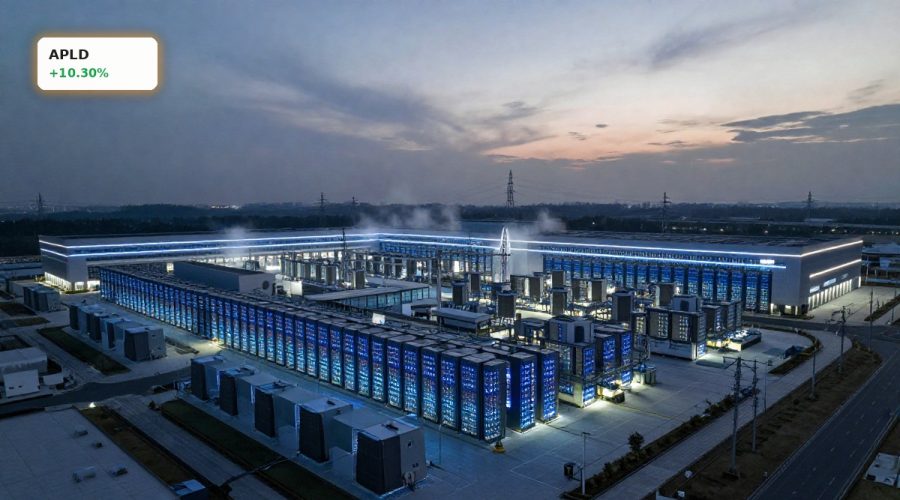
The headline **Applied Digital Hyperscaler Deal** covers 300 megawatts (MW) of critical IT load at Delta Forge 1, a 430 MW campus designed for large-scale AI and high-performance computing workloads. The site spans more than 500 acres, with initial operations slated to begin in mid-2027, giving the company a multi-year build and ramp timeline.
The new tenant is Applied Digital’s second U.S.-based investment-grade hyperscale customer and its third hyperscale tenant overall. With this agreement, more than 50% of the company’s total contracted revenue is now backed by investment-grade customers, a key de-risking milestone for a business that relies on long-term leases to support heavy upfront capital spending.
Management has previously highlighted over $16 billion in contracted revenue across three major sites. The additional $7.5 billion from the **Applied Digital Hyperscaler Deal** further cements that backlog and supports the market’s decision to treat APLD not as a traditional data center REIT, but as a hyper-growth AI infrastructure platform.
How does this change Applied Digital’s growth and risk profile?
Investor focus now shifts toward execution and financing. The company plans to enter two new credit facilities: up to a $300 million senior secured bridge facility to keep building out a 150 MW building at its Polaris Forge 1 campus, and up to a $300 million senior secured revolving credit facility for development across the platform and general working capital. Both would be provided by a bank syndicate and are expected to close promptly.
These lines come on top of an already leverage-heavy growth plan, which has drawn scrutiny from traders and contributed to recent volatility. Skeptics argue that APLD’s model puts shareholders behind lenders and large customers in the cash flow waterfall, especially if AI demand ever normalizes. Bulls counter that long-dated, investment-grade contracts like the **Applied Digital Hyperscaler Deal** meaningfully reduce demand risk and can support non-dilutive financing at acceptable rates.
Valuation remains front and center. Recent analysis pegs APLD at more than 25x trailing sales, far above traditional data center peers and even many high-growth AI infrastructure names. Simply Wall St’s discounted cash flow work suggests upside to roughly $50 per share, but also flags the company’s price-to-sales multiple—near 28x versus an industry average under 2x—as a source of vulnerability if execution wobbles.
How does Applied Digital stack up to hyperscale peers?
The **Applied Digital Hyperscaler Deal** fits into a broader trend of large cloud and AI players racing to lock in power and data center capacity. Hyperscalers such as NVIDIA’s largest cloud partners, as well as Apple and Tesla with their own AI ambitions, are competing for scarce megawatts amid U.S. grid constraints. That has boosted pricing power for specialized hosts that can deliver high-density power and advanced cooling at scale.
Applied Digital has secured 1 GW of grid power and is developing another 1.2 GW, positioning itself as a key landlord for AI training and inference clusters. Its successful pivot from crypto mining and hosting toward AI and high-performance computing mirrors a broader re-rating across the AI infrastructure complex, where investors now view data center capacity as a strategic bottleneck comparable to high-end GPU supply from NVIDIA.
Yet the company is not in the S&P 500 and remains a small-cap, highly volatile stock, which makes it more speculative than mega-cap AI beneficiaries like Apple or Tesla. Institutions own roughly two-thirds of the float, but insider selling in recent weeks has tempered enthusiasm even as new funds, such as TFR Capital LLC., have taken positions.
What are options and analysts signaling on APLD?
Options activity around APLD has been unusually heavy, underscoring the stock’s speculative appeal. On April 20, more than 108,000 options contracts traded, with total open interest above 860,000 contracts—well above normal levels. That positions APLD as a frequent target for short-term traders betting on both sharp rallies and pullbacks.
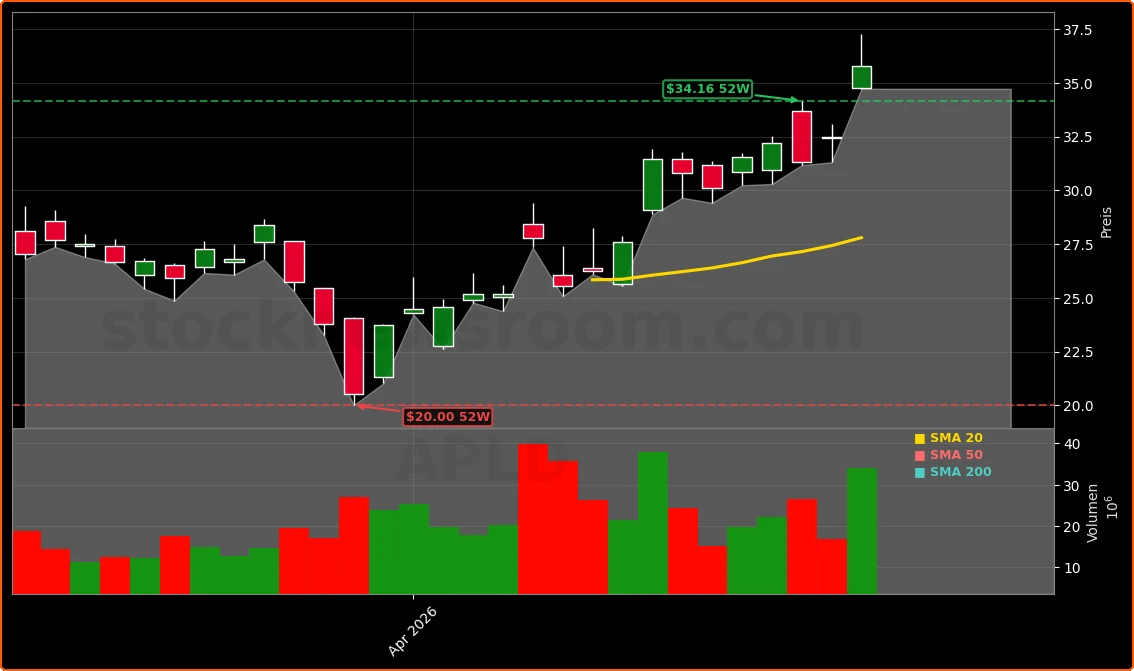
On the fundamental side, recent quarterly results showed triple-digit year-over-year revenue growth driven by AI data center hosting, even as the company remains unprofitable and continues to miss consensus EPS expectations. Wall Street currently carries a “Moderate Buy” consensus with an average price target in the low $40s, implying upside from today’s $35.77 level but well below the most bullish scenarios.
Commentary from firms such as MarketBeat emphasizes the trade-off between explosive top-line growth and ongoing cash burn, while more cautious voices highlight customer concentration and execution risk around mega-projects like Delta Forge 1. The **Applied Digital Hyperscaler Deal** reduces uncertainty around future occupancy, but it also raises the stakes for on-time delivery and disciplined capital allocation over the next several years.
“We now have two U.S. based investment-grade hyperscalers across our portfolio, marking an important step in the continued diversification of our customer base and strengthening the overall quality and visibility of our contracted revenue.”— Wes Cummins, CEO of Applied Digital, Inc.
For U.S. investors, APLD now sits squarely in the high-beta AI infrastructure bucket: a potentially compelling satellite position for aggressive portfolios, but one whose fortunes are tightly linked to the pace and durability of AI compute demand.