Can blockbuster Microsoft Earnings really offset a $190 billion AI capex wave that is starting to rattle even bullish investors?

How did Microsoft Earnings surprise Wall Street?
Microsoft Corporation reported fiscal Q3 results for the quarter ended March 31 that comfortably cleared analyst expectations. Revenue climbed 18% year over year to $82.9 billion, versus estimates around $81.4 billion. Net income reached $31.8 billion, and earnings per share came in at $4.27, well ahead of the roughly $4.05–$4.06 consensus range. Microsoft also highlighted that its AI-related business has reached an annualized revenue run rate of about $37 billion, up roughly 123% from a year earlier, underlining how deeply AI is now embedded across Azure, Microsoft 365 and developer tools.
Within the cloud stack, overall Microsoft Cloud revenue rose close to 29% to the mid-$50 billion range, while the Intelligent Cloud segment generated about $34.7 billion, slightly above market expectations. That performance helped Microsoft Earnings land solidly ahead of most models and reinforced the perception that the company remains one of the key AI and cloud anchors of the S&P 500 and NASDAQ 100.
Is Azure growth enough to justify the AI bill?
The focal point of Microsoft Earnings was once again Azure. Management reported that Azure and other cloud services grew 40% year over year, beating estimates that hovered around 38% and topping some earlier fears of a sharper deceleration. For the current quarter ending in June, Microsoft is guiding Azure growth to roughly 39%–40%, still ahead of Wall Street’s prior expectations in the mid-30s.
Even so, investor reaction has been mixed. Google Cloud, part of Alphabet’s portfolio, has posted growth rates north of 60% in some recent periods, and Amazon Web Services continues to regain momentum. That comparison has fueled concerns that Microsoft may no longer be the clear growth standout, even if its cloud platform is expanding from a higher base and remains the main infrastructure backbone for OpenAI and a widening ecosystem of AI workloads.
On the AI application side, the company said its Copilot products now have about 20 million paid seats, up from 15 million a quarter ago. That acceleration is encouraging, but many institutional investors still question whether Copilot’s revenue contribution can catch up with the scale of the AI infrastructure spending Microsoft has committed to.
Why is $190 billion in capex rattling investors?
The real shock embedded in the latest Microsoft Earnings update is capital expenditure. Management now expects total capex to approach $190 billion in calendar 2026, roughly 61% above 2025 levels and materially above prior Street forecasts around $160 billion. In the March quarter alone, capex hit about $31.9 billion, up 49% year over year. As a direct result, free cash flow dropped 22% to $15.8 billion, despite higher profits.
CFO Amy Hood argues that “broad and growing customer demand continues to exceed supply” and that Microsoft remains confident in the long-term return on these investments. She also pointed to near-term supply chain and component constraints—especially higher prices for advanced AI chips and storage—as drivers of the spending spike, with management estimating roughly $25 billion of the 2026 capex budget is tied to component price inflation.
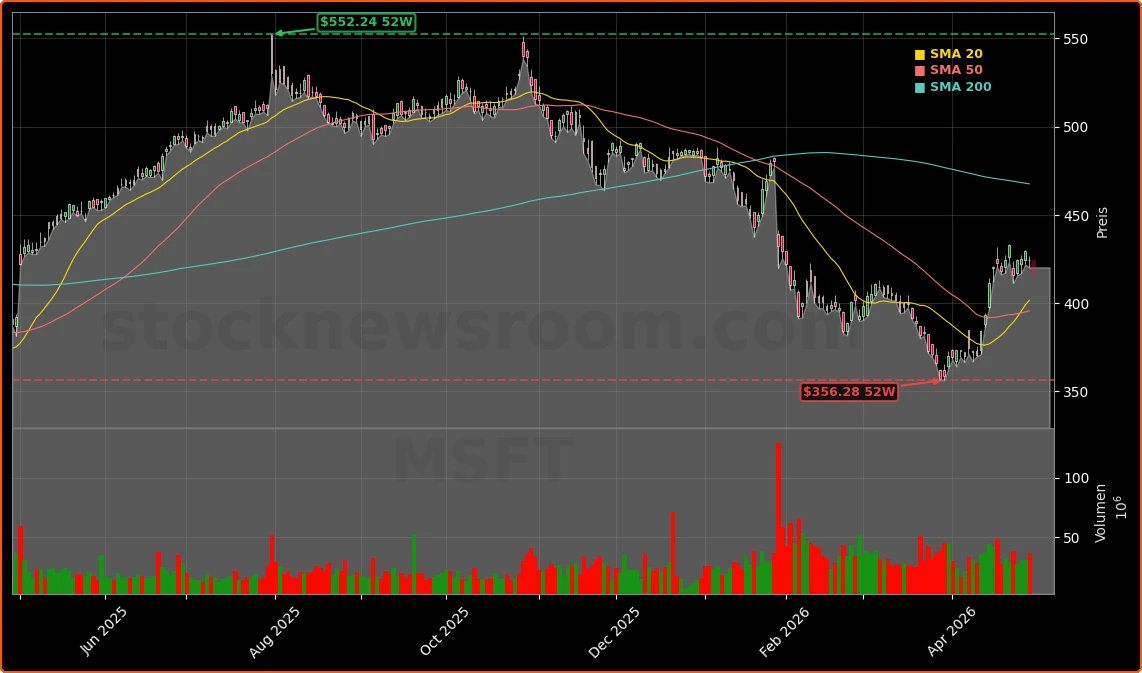
Still, with Microsoft shares down about 12% year-to-date from a 52-week high near $555 to the $420s, many portfolio managers see the capex trajectory as the central risk. The stock trades around 21x–22x forward earnings, its lowest multiple since 2023, but the market wants clearer evidence that these investments will translate into durable margin expansion rather than a prolonged squeeze on free cash flow.
How are analysts positioning on Microsoft after these Earnings?
Despite the volatile reaction around Microsoft Earnings, the analyst community remains broadly constructive. Data aggregated from major brokerages show most of the roughly 90–100 covering analysts rate MSFT as “Buy” or “Strong Buy.” Many highlight that operating margins around the mid‑40s remain impressive even with heavy AI build‑out, and that Microsoft’s commercial backlog—tied to long-term cloud and AI contracts—has roughly doubled over the past year to the mid‑hundreds of billions of dollars.
Multiple Wall Street firms have recently lifted their price targets on MSFT. RBC Capital Markets rates the stock “Outperform” and has flagged a target around $640, citing robust Azure and AI momentum. At the same time, Morgan Stanley has raised its own target to about $650 and continues to call Microsoft a top pick in large-cap technology. Benchmark analysts initiated coverage with a Buy rating, framing the recent pullback as a long-term entry point, while Wedbush’s Dan Ives reiterated an “Outperform” rating with a $625 target, arguing that Wall Street still underestimates Azure’s multi‑year growth potential.
Yet, there are important caveats. Bears question whether Copilot can scale revenue fast enough—its current estimated range of roughly $1.4–$3.2 billion in annual sales remains tiny compared with Microsoft’s more than $300 billion in projected full‑year revenue. Others worry about Microsoft’s deep financial ties to OpenAI, which is planning aggressive capex of its own and faces an uncertain profitability path, even as Microsoft recently revised the partnership agreement to allow OpenAI more flexibility to work with rivals while locking in a revenue-sharing arrangement through 2030.
What does this mean for tech portfolios and AI peers?
For U.S. investors, the latest Microsoft Earnings are a stress test for the entire AI trade. Microsoft, Alphabet, Meta and Amazon together are on track to pour roughly $650–$750 billion into AI infrastructure over the coming years. That build‑out underpins demand for data center chips from players like NVIDIA and memory suppliers, and it shapes expectations for software monetization from productivity ecosystems at Microsoft and Apple.
In the near term, the guidance shock around Microsoft’s $190 billion capex plan may weigh not only on MSFT but also on hyperscaler‑adjacent names if investors fear overspending or slower payback. On the other hand, the confirmation of 40% Azure growth and accelerating AI run rates reinforces the idea that demand for cloud compute is structural, not cyclical. Long‑term holders who can tolerate volatility may see the current pullback as a chance to build or add to positions in core AI infrastructure beneficiaries, while more cautious investors might wait for clearer signs that Copilot and other AI services are scaling profitably.
Related Coverage
Investors who want a deeper dive into the capex debate can look at “Microsoft AI Investment -2.7%: Boom or Market Warning for MSFT?”, which analyzes whether the massive AI build‑out can justify recent share price weakness. That piece explores scenarios in which Microsoft’s infrastructure wave either reignites long-term growth expectations or becomes a drag on returns if monetization lags.
Broad and growing customer demand continues to exceed supply.— Amy Hood, Chief Financial Officer of Microsoft Corporation
In summary, Microsoft Earnings delivered strong top- and bottom-line beats, but the ambitious $190 billion AI infrastructure plan has shifted the conversation toward cash flow, margins and execution risk. For investors, Microsoft remains a cornerstone of the global AI story, yet the next few quarters will be critical in proving that Azure growth, Copilot adoption and OpenAI‑driven demand can validate this unprecedented capex cycle. As long as that equation trends in Microsoft’s favor, MSFT is likely to stay a core holding in many tech‑heavy portfolios.