Will the Apple CEO Transition from Tim Cook to John Ternus unlock a new phase of AI-driven growth for the $4.3 trillion giant?

How is Apple trading into the CEO change?
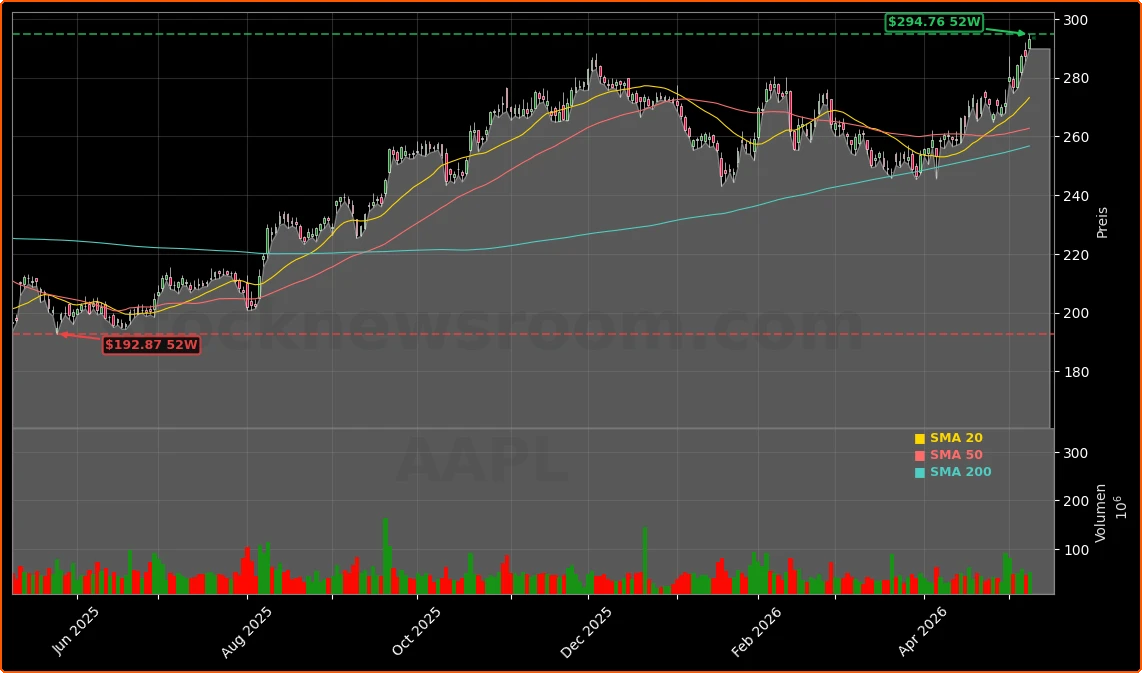
Apple Inc. (AAPL) ended Friday’s session on the NASDAQ at $293.32, up about 2.1% on the day, before ticking higher to $293.86 after the close, leaving the stock within a whisker of its recent all‑time high near $294.76. That puts year‑to‑date gains at roughly 6%, a modest advance compared with the broader S&P 500 but enough to keep the company among the better‑performing “Magnificent 7” names alongside NVIDIA and Alphabet. At a market capitalization above $4.3 trillion, Apple Inc. remains a heavy anchor in major U.S. index funds and tech ETFs, including the Fidelity MSCI Information Technology Index ETF, where it represents more than 14% of assets.
Fundamentals have started to justify the renewed momentum. In its latest reported quarter, Apple Inc. delivered revenue of $111.18 billion and earnings per share of $2.01, both ahead of Wall Street expectations. iPhone sales grew 22% year over year and services revenue climbed 17%, pushing overall top‑line growth back into double‑digit territory after a sluggish stretch. The company also raised its quarterly dividend to $0.27 per share, underlining robust free‑cash‑flow generation even as it invests in next‑generation hardware and AI‑related software.
What does the Apple CEO Transition change?
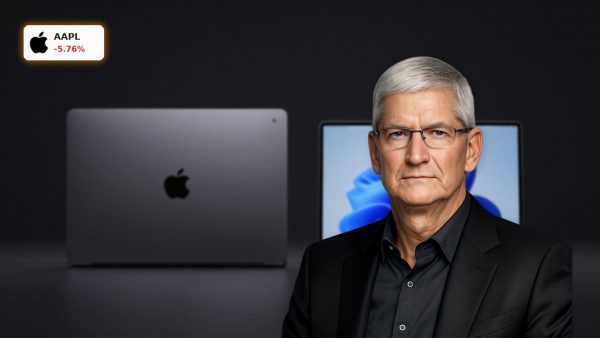
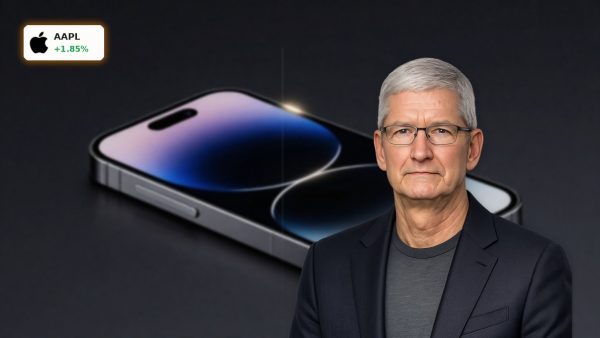
The Apple CEO Transition formally begins on September 1, when Tim Cook moves into the role of executive chairman and John Ternus becomes CEO. Ternus, currently senior vice president of hardware engineering, has been central to recent product cycles, including the latest iPhone line and the new 13‑inch MacBook Neo, which management describes as seeing “extremely strong” demand. Apple has emphasized continuity in its leadership messaging, indicating that Cook will remain influential on strategy while Ternus is expected to lean more aggressively into hardware innovation.
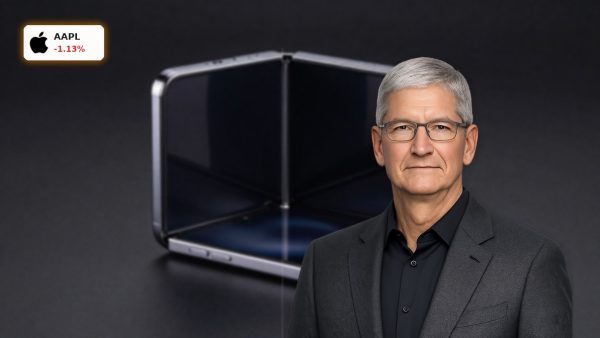
On the product side, investors now expect Ternus to champion devices that could open new revenue streams, such as a potential foldable iPhone and more affordable mixed‑reality headsets and smart glasses. Analysts argue that a hardware‑first mindset, paired with a more clearly articulated AI strategy, could extend replacement cycles and deepen ecosystem lock‑in. The Apple CEO Transition therefore is being framed on Wall Street as an evolution rather than a revolution — but one that could still shift capital allocation between hardware, services and AI partnerships.
Is AI really the next profit engine for Apple?
Artificial intelligence sits at the center of the latest bull case. Wedbush analyst Dan Ives, one of the Street’s most vocal optimists on Apple, recently reiterated his “Outperform” rating and hiked his 12‑month price target from $350 to $400, implying roughly 36% upside from current levels. Ives views the upcoming Worldwide Developers Conference (WWDC), starting June 8, as a “major inflection point” where Apple is expected to unveil a substantially upgraded Apple Intelligence platform and a heavily AI‑enhanced iOS 27.
Instead of spending tens of billions to build hyperscale AI infrastructure like NVIDIA’s largest cloud customers, Apple has so far pursued a partnership model, including integrating Google’s Gemini models to upgrade Siri and on‑device experiences. Ives estimates that as AI features roll out across the installed base, up to 20% of the world’s population could gain access to consumer‑grade AI via an Apple device. He projects as much as $15 billion in incremental annual services revenue tied to AI‑powered apps in health, fitness, finance and lifestyle categories — a meaningful boost to an already high‑margin segment.
Not all the AI headlines are positive. Apple recently agreed to a proposed $250 million class‑action settlement with iPhone 15 and 16 customers who alleged that the company overstated the readiness of certain AI features in marketing for its “Apple Intelligence” system. The settlement, which Apple is funding without admitting wrongdoing, underscores both the high expectations around AI and the legal scrutiny that can follow aggressive product claims.
How are institutional investors reacting?
Despite valuation concerns — the stock trades at roughly 35 times trailing earnings and about 33 times forward estimates — institutional appetite remains strong. Nations Financial Group Inc. IA ADV has increased its position, making Apple Inc. its third‑largest holding at around $44.1 million. Sonata Capital Group also lifted its stake by 18.7% in the latest quarter, while KBC Group NV boosted holdings to more than 7 million shares, worth about $1.92 billion, making Apple one of its top positions.
Other investors are trimming but not exiting. Means Investment Co. and Peoples Financial Services have marginally reduced their stakes yet still rank the iPhone maker among their largest holdings, reflecting a rebalancing rather than a fundamental downgrade. Across Wall Street, the consensus rating stands at “Moderate Buy,” with an average price target near $305–$306 from brokerages including Morgan Stanley, JPMorgan and Goldman Sachs, suggesting mid‑single‑digit upside from Friday’s close. By contrast, more cautious voices point to cheaper, faster‑growing software and AI infrastructure names, arguing that Apple’s premium multiple limits potential returns even with the Apple CEO Transition and AI catalysts.
Related Coverage
For a deeper dive into how Apple’s semiconductor strategy fits into its broader AI ambitions and leadership change, investors can review our earlier analysis, “Apple Chip Deal +2.0% Surge: Intel Pact Fuels AI Hype”. That piece examines whether Apple’s emerging chip deals, including its pact with Intel, can materially accelerate its on‑device AI roadmap and support ambitious price targets around $400, adding context to how the Apple CEO Transition might reshape long‑term capital spending.
The Apple CEO Transition arrives as the company’s stock hovers near record highs, AI finally moves to the center of the product story and institutions continue to treat the name as a core holding. For investors in U.S. and global equity indices, how smoothly John Ternus executes on hardware innovation and AI monetization will be crucial in determining whether Apple can justify its premium valuation. With WWDC in June and the leadership hand‑off in September, the next few months will show whether the Apple CEO Transition becomes a new growth chapter or merely a changing of the guard.