
Can the Apple Chip Deal with Intel really reshape its AI roadmap and justify Wall Street’s new $400 price targets?

How is Apple trading after fresh records?
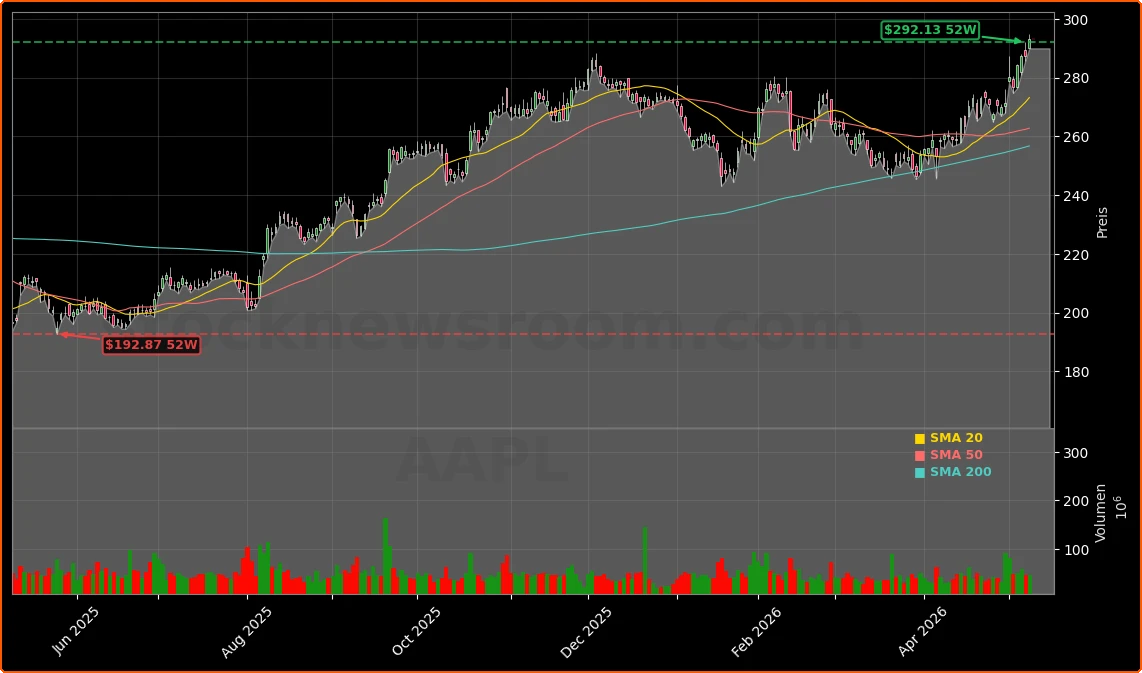
Apple Inc. (AAPL) finished Friday at $293.26, up 2.03% on the day, before slipping marginally to $293.11 in after‑hours trading. The stock recently hit a new all‑time closing high near $292 and set a fresh intraday peak around $294, bringing the $300 psychological threshold clearly into view. On a one‑year view, shares are up roughly 48%, outpacing the broader S&P 500 and reinforcing Apple’s status as one of the key mega‑cap drivers of NASDAQ performance.
The move caps a strong run since Apple’s March‑quarter earnings on April 30, when the company posted Q2 FY26 revenue of $111.18 billion, up 17% year over year, and diluted EPS of $2.01, beating consensus estimates for the eighth consecutive quarter. iPhone revenue climbed 22% to about $57 billion, while high‑margin Services revenue hit a record near $31 billion, with segment gross margin around 77%. Those results, combined with the board’s $100 billion buyback authorization and a 4% dividend increase to $0.27 per share, have helped pull in fresh institutional capital.
What does the Apple Chip Deal with Intel change?
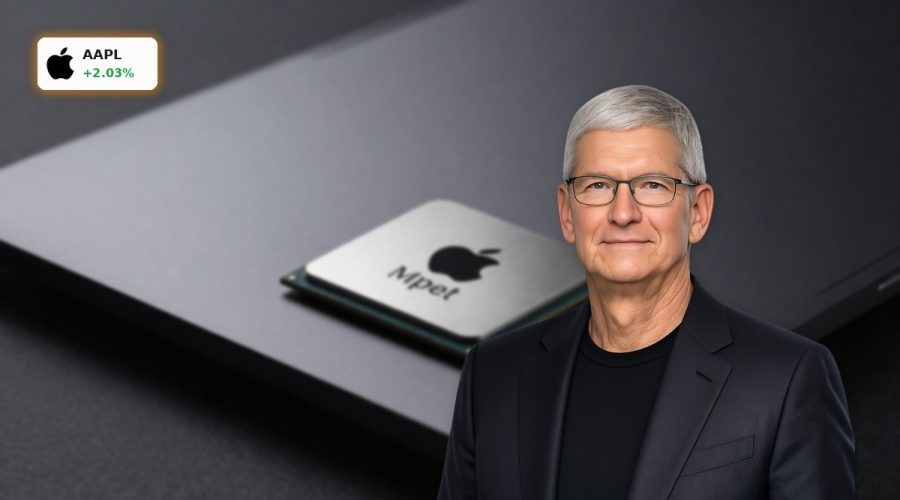
The reported Apple Chip Deal with Intel marks a notable shift in the semiconductor landscape. After moving away from Intel CPUs in 2020 and relying heavily on Taiwan Semiconductor Manufacturing for A‑series and M‑series chips, Apple has now reached a preliminary agreement for Intel to manufacture some processors for Apple devices. Intel stock surged more than 10%–15% on the news, underscoring how important a customer Apple can be for any foundry strategy.
Details remain limited. It is not yet clear which product lines the Apple Chip Deal covers, though prior industry chatter has pointed to potential manufacturing of certain M‑series chips used in Mac computers, high‑end iPads, and the Vision Pro headset. There is also speculation that Intel may initially produce chips for established models rather than Apple’s cutting‑edge designs. For Cupertino, the benefits are strategic: a diversified supply chain, reduced dependence on a single Asian foundry, and more room to secure advanced capacity as demand from AI chip leaders like NVIDIA and others tightens the market.
The reported government push behind the Apple Chip Deal, with U.S. officials encouraging large tech platforms to support domestic manufacturing, adds a geopolitical angle for investors. For Apple shareholders, the key question is execution: Intel’s foundry technology still lags TSMC at the very front end, and Apple will likely balance supply security against performance and yield considerations.
How does AI and the Intel pact fit Apple’s strategy?
Despite early criticism that Apple was late to the AI race, the company is increasingly being framed as a distribution powerhouse rather than an AI model champion. Wedbush analyst Daniel Ives, well known for his bullish calls on NVIDIA and Tesla, reiterated his Outperform rating and lifted his Apple target from $350 to a Street‑high $400. He argues that as Apple rolls out its AI strategy at WWDC 2026 and beyond, the installed base of more than 2.5 billion active devices could allow roughly 20% of the world’s population to access AI through Apple hardware.
This narrative dovetails with Apple’s on‑device AI push in its latest A‑series and M‑series chips, which feature upgraded neural accelerators designed to run AI models locally. CEO Tim Cook has emphasized that Mac is becoming a preferred platform for AI developers, highlighting examples of AI startups and enterprise software vendors standardizing on MacBook Pro and MacBook Air for AI workloads. The Intel partnership could give Apple additional manufacturing headroom to scale these AI‑optimized chips without supply bottlenecks.
At the same time, Apple is facing the legal and reputational costs of its AI marketing. The company agreed to a $250 million settlement of a class action alleging that certain iPhone 16 and iPhone 15 Pro buyers were misled about Siri‑related AI features that were not yet available. Payouts of $25 to $95 per device are modest relative to Apple’s $4.3 trillion market cap, but the case underscores regulatory and consumer scrutiny around AI claims.
Is Wall Street fully pricing the upside?
Wedbush’s $400 target for Apple sits well above the roughly $303 average analyst target, signaling how divided Wall Street remains on the stock’s valuation. At about $293, Apple trades around the mid‑30s on trailing earnings—rich versus traditional hardware peers but easier to justify if investors treat it as an AI and services compounder rather than a pure device maker. Many large funds and ETFs now hold Apple as a core AI allocation, alongside names like NVIDIA and Microsoft.
Risks are real. Apple faces regulatory pressure around the App Store, potential slowdowns in iPhone upgrade cycles in mature markets, and rising memory costs that management has flagged as a margin headwind. The company also sits at the center of U.S.–China tech tensions, even as Greater China revenue grew 28% in the recent quarter, easing some near‑term fears. Leadership transition adds another variable: Tim Cook is set to move to executive chairman while hardware chief John Ternus takes over as CEO on September 1.
Related Coverage
Investors looking for deeper context on Apple’s recent surge can review the earnings breakdown in Apple Earnings +17%: Record Rally and Guidance Shock Wall Street. That analysis dives into the March‑quarter beat, upgraded guidance, and how stronger iPhone and Services momentum set the stage for today’s AI and chip‑supply headlines.
With an all‑time high iPhone installed base and accelerating services growth, Apple is the sleeping tech giant on the cusp of a major AI‑driven inflection point.— Daniel Ives, Wedbush Securities
Overall, the emerging Apple Chip Deal with Intel, a powerful AI distribution thesis, and record‑setting financials position Apple as more than just a hardware giant. For U.S. investors building long‑term technology exposure, the stock increasingly represents a diversified AI platform play anchored by a massive installed base and expanding services engine. The next catalysts will likely be WWDC 2026, further clarity on the Apple Chip Deal rollout, and whether Apple can convert its AI narrative into sustained revenue and earnings growth.