
Can Intel’s latest upgrade finally turn its foundry gamble and AI server push into a credible Wall Street comeback?

What Does the Intel Upgrade Mean for the S&P 500?
The Intel Upgrade arrives at a critical inflection point for the S&P 500’s technology sector. After underperforming the Magnificent 7 for years, Intel now joins a wave of legacy chipmakers — including AMD and NVIDIA — regaining traction amid AI infrastructure demand. Bank of America analyst Vivek Arya emphasized that Intel remains materially under-owned relative to peers, creating potential for index rebalancing and ETF inflows. With Intel’s weighting in major tech ETFs like the Xtrackers AI & Semiconductor ETF at 3.5%, this upgrade could catalyze broader portfolio reallocations — especially as fund managers reassess exposure to AI enablers beyond just GPU providers.
How Does Intel Compare to Its Foundry Rivals?
Intel’s foundry ambitions — a cornerstone of the Intel Upgrade thesis — face steep competition from TSMC and Samsung, both of which command over 90% of leading-edge wafer capacity. Yet Bank of America argues Intel’s 18A process node and packaging innovations position it uniquely for U.S.-based AI chip customers seeking supply chain resilience. Unlike TSMC, Intel owns its entire stack — from design to packaging — a vertical integration advantage highlighted in recent partnerships with Hitachi and Google. That synergy was underscored in Intel’s Xeon 6+ data center CPU launch and its expanded role in Apple’s Private Cloud Compute infrastructure, where Intel CPUs with TDX security coexist with NVIDIA Blackwell GPUs.
Is Intel’s Profitability Turnaround Credible?
Bank of America’s $135 target rests on a revised earnings power forecast: $6+ per share by calendar year 2030, up from prior estimates of $3–$4. That assumes successful execution across two fronts — server CPU market share recovery and foundry revenue scaling. While Intel reported a third consecutive annual net loss in 2025, its Q1 2026 results showed sequential improvement in gross margin (38.2% vs. 34.7% in Q4) and a 22% jump in foundry bookings. Still, analysts caution that capital intensity remains extreme: Intel spent $17 billion in capex in 2025 alone. Competitors like Tesla and SpaceX may even view Intel’s fabrication assets as acquisition targets — not just for AI chips, but for sovereign semiconductor infrastructure.
Intel Upgrade: What’s Next for Wall Street Sentiment?
Intel remains under-owned compared to its peers, leaving room for investors potentially to pile in.— Vivek Arya, Bank of America Securities
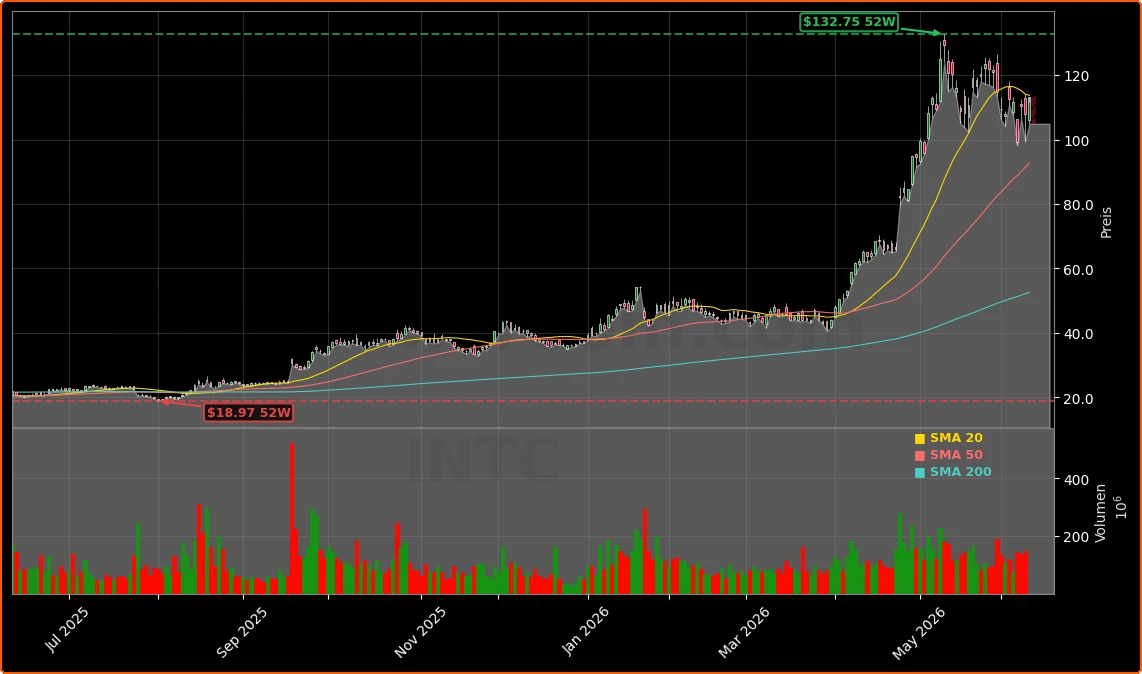
The Intel Upgrade is already reshaping analyst coverage — and not just at Bank of America. Paragon Private Wealth Management LLC added $261,000 in new holdings last quarter, while Zacks Equity Research highlights Intel’s accelerating AI infrastructure partnerships. Yet skepticism remains: one prominent strategist recently labeled Intel a ‘late-cycle KI winner’ and warned that investors ‘must be vertigo-proof’ after its 140% rally over six months. With the stock still trading 18% below its 52-week high, the path to $135 hinges on two near-term catalysts: Q2 2026 earnings clarity on foundry utilization and confirmation of design wins with U.S. cloud providers. Given the current NASDAQ momentum and premarket strength in chip equipment stocks like Lam Research and KLA, Intel’s momentum appears sustainable — for now.