Can Tesla FSD Denmark approval offset fresh valuation pressure as Musk’s empire gets even bigger?

What does Tesla FSD Denmark mean for U.S. investors?
Denmark’s approval of Tesla’s Full Self-Driving (Supervised) system — announced by the Danish Road Traffic Authority on June 9 — validates Tesla’s software-first approach in a key European market. Unlike legacy automakers, Tesla deploys AI-driven driver-assistance features over-the-air, and Denmark’s recognition of the Dutch RDW’s prior approval signals growing regulatory convergence across the EU. For U.S. portfolios, this isn’t just about incremental revenue: it strengthens Tesla’s narrative as a physical AI platform, not just an automaker. That distinction matters as Wall Street re-rates AI infrastructure players — especially with NVIDIA trading at a $5.05 trillion market cap and Apple pushing deeper into on-device AI. Tesla’s FSD data engine — now trained on over 10 billion miles — feeds directly into its Dojo supercomputer and AI5 chip roadmap, both critical to its $3.9 trillion total addressable market estimate from J.P. Morgan analyst Rajat Gupta.
How is SpaceX’s IPO reshaping Tesla’s valuation?
Friday’s SpaceX listing is no ordinary IPO — it’s the largest in history, with 555.6 million Class A shares priced at $135, raising $75 billion. Tesla and SpaceX share not only CEO Elon Musk but also a $2 billion equity investment and the joint Terafab chip foundry initiative in Texas. J.P. Morgan’s recent upgrade — moving Tesla from Underweight to Neutral and lifting its price target from $145 to $475 — coincides precisely with the firm’s lead role in pitching the SpaceX offering. Gupta cited Tesla’s “unique advantages” in vertical hardware-software integration and its leadership in physical AI. Yet BNP Paribas analyst James Piccolo warns that multi-strategy funds with hard “Musk exposure” caps may be forced to rotate out of Tesla to allocate to SpaceX — a dynamic that could pressure TSLA shares despite bullish fundamentals.
Is Tesla still a core MANGOS holding — or just a satellite?
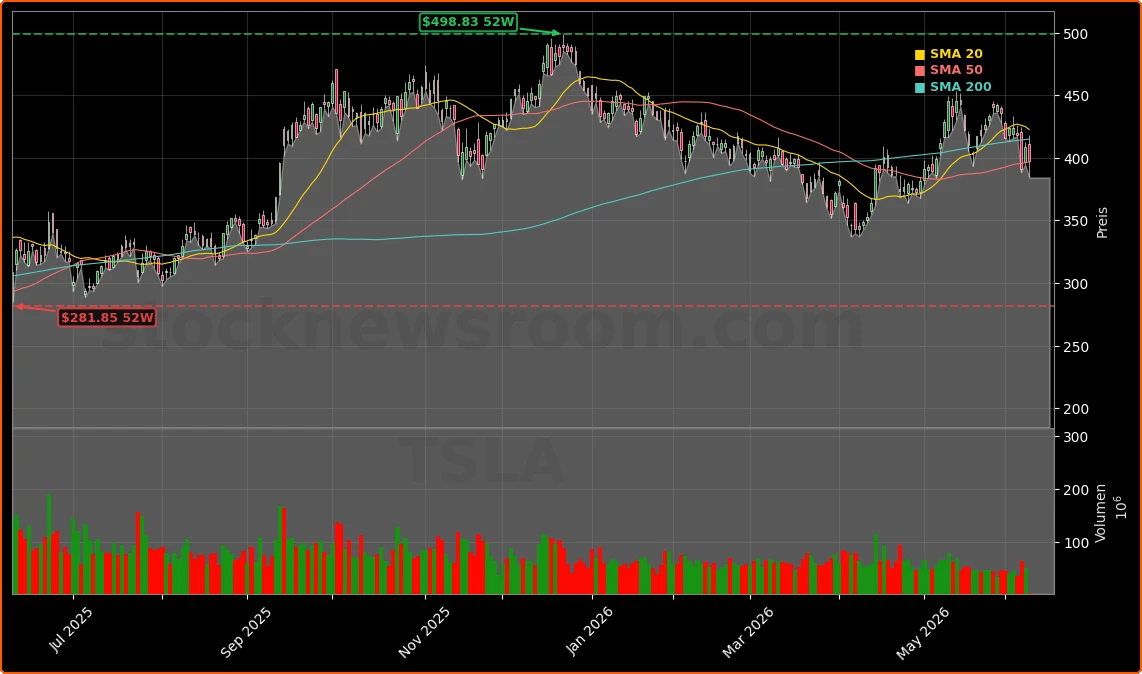
The MANGOS acronym — Meta, Anthropic, NVIDIA, Google (Alphabet), OpenAI, and SpaceX — now dominates Wall Street’s growth narrative. Unlike the Magnificent Seven, MANGOS is built on AI infrastructure and orbital economics, not consumer internet. Tesla’s inclusion hinges on its robotaxi, Optimus, and energy infrastructure ambitions — all underpinned by FSD progress. Yet with OpenAI and Anthropic also nearing public listings, Tesla faces intensifying competition for AI capital. Uber Technologies (UBER), for example, holds a $152 billion market cap and a massive rideshare platform ready to deploy autonomous vehicles — a structural advantage Tesla lacks. Meanwhile, Tesla’s forward P/E remains near 200, a valuation that reflects aspiration more than earnings — a risk magnified as markets brace for hot May CPI data and potential Fed rate cut delays.
What’s next for Tesla’s autonomy timeline?
Tesla has ‘unique advantages’ due to its strong vertical integration between hardware and software — a dynamic still largely misunderstood by the market.— Rajat Gupta, J.P. Morgan
Tesla FSD Denmark arrives amid concrete U.S. progress: Reuters confirmed unsupervised robotaxis are now live across the entire Austin Metro area. That expansion, paired with FSD approvals in four EU nations, suggests accelerating regulatory momentum — but not yet a path to Level 4 autonomy. Competitors like Alphabet’s Waymo operate in over 10 U.S. cities with supervised robo-taxis, and Mercedes-Benz has received U.S. NHTSA approval for Level 3 in Nevada. Tesla’s edge remains its real-time data velocity and Dojo training scale. Still, Dan Ives of Wedbush Securities notes Tesla serves as the “blueprint” for SpaceX’s potential — and the market is now pricing in that interdependence. With SpaceX’s S-1 filing highlighting joint AI and satellite infrastructure development, Tesla FSD Denmark isn’t just a regional win — it’s evidence that Tesla’s software stack is becoming a critical node in Musk’s integrated AI and space ecosystem.