
Can the Intel Hitachi Partnership change Intel’s factory future, or is the market too focused on a brutal semiconductor sell-off?

What Does the Intel Hitachi Partnership Target?
The Intel Hitachi Partnership focuses on five tightly integrated domains: foundry process tools, quantum computing R&D, energy optimization, factory automation, and custom silicon for edge-AI applications. Hitachi will deploy its HMAX Energy platform inside Intel’s U.S. fabrication facilities, while Intel will supply high-voltage silicon chips to upgrade Hitachi’s power systems. Crucially, Hitachi’s metrology and etching systems will feed real-time data into AI models for predictive diagnostics — a direct counter to the rising cost of unplanned downtime in advanced-node fabs. This isn’t theoretical: both companies confirmed joint engineering teams are already embedded at Intel’s Arizona and Ohio sites, with initial pilot deployments slated for Q3 2026.
How Does This Fit Into Intel’s Foundry Ambitions?
Intel’s foundry business — backed by $9 billion in U.S. CHIPS Act funding and a 10% federal equity stake — now has a dedicated AI infrastructure partner. While Taiwan Semiconductor Manufacturing Company remains the industry’s gold standard, TSMC operates near full capacity, creating a window for alternatives. The Intel Hitachi Partnership directly addresses a key bottleneck: tool-level intelligence. Without AI-driven predictive maintenance, even state-of-the-art fabs suffer yield loss and ramp delays. Hitachi’s industrial AI stack, refined over decades in rail and energy systems, brings a unique operational rigor that complements Intel’s silicon and architecture strengths. RBC Capital Markets recently reiterated its ‘Sector Perform’ rating on Intel, citing ‘foundry execution risk’ — but added that ‘this collaboration meaningfully de-risks the tool intelligence layer.’
Why Did the Market Sell Off Despite the News?
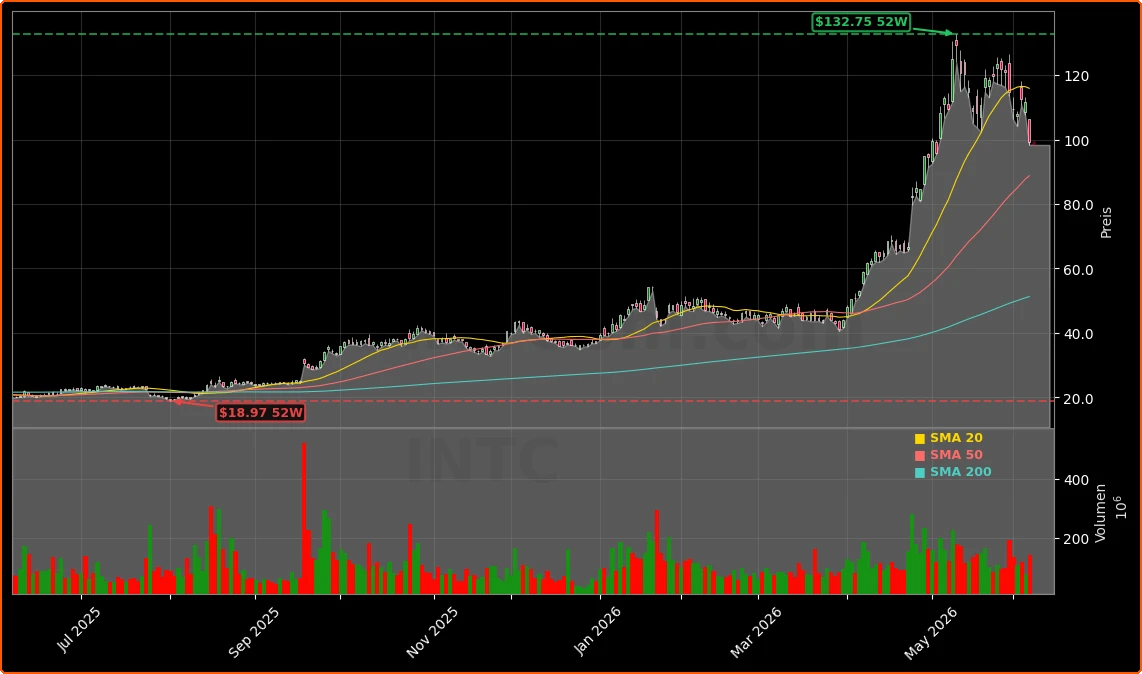
Because the Intel Hitachi Partnership announcement landed amid the worst single-day semiconductor selloff since March 2020. The Philadelphia Semiconductor Index dropped 10.3%, and Intel fell 11.28% — its steepest one-day decline since 2022. The catalyst wasn’t the partnership, but a hotter-than-expected U.S. jobs report: 172,000 new positions and a stable 4.3% unemployment rate crushed hopes for near-term Fed rate cuts. With the 2-year Treasury yield surging to 4.16%, growth-sensitive tech stocks — especially those with rich valuations — were hit hardest. Intel’s 5.88% weighting in the iShares Semiconductor ETF (SOXX) amplified the drag, while Nvidia’s RTX Spark launch added structural anxiety. As Citigroup analysts noted in a Friday note: ‘Investors aren’t pricing AI infrastructure — they’re pricing AI disruption. Intel’s CPU moat is narrowing.’
How Do Competitors Stack Up?
This collaboration brings industrial-scale AI to the heart of semiconductor manufacturing — where uptime, yield, and energy efficiency determine competitive advantage for the next decade.— Toshiaki Tokunaga, CEO of Hitachi
Unlike NVIDIA, which controls the GPU-AI stack and now pushes into CPU-SoC integration, Intel is betting on infrastructure-level AI — a less flashy but potentially more defensible play. Apple’s rumored chip manufacturing deal with Intel adds strategic weight, but AMD and Qualcomm face similar pressure from Nvidia’s ARM-based Grace and RTX Spark chips. Meanwhile, Micron and ASML — both key SOXX holdings — benefit from tighter memory and lithography supply, not AI compute architecture. The Intel Hitachi Partnership doesn’t compete with Tesla’s Dojo or Meta’s custom AI chips; it enables them — by making the factories that build those chips smarter, more efficient, and more resilient. That’s a quieter, capital-intensive, and longer-term value proposition — one that Wall Street is currently discounting in favor of near-term AI revenue visibility.