
Is Intel Foundry’s AI-fueled rally the start of a durable turnaround or just another hype-driven spike in chip stocks?

Is Intel now an AI market leader again?
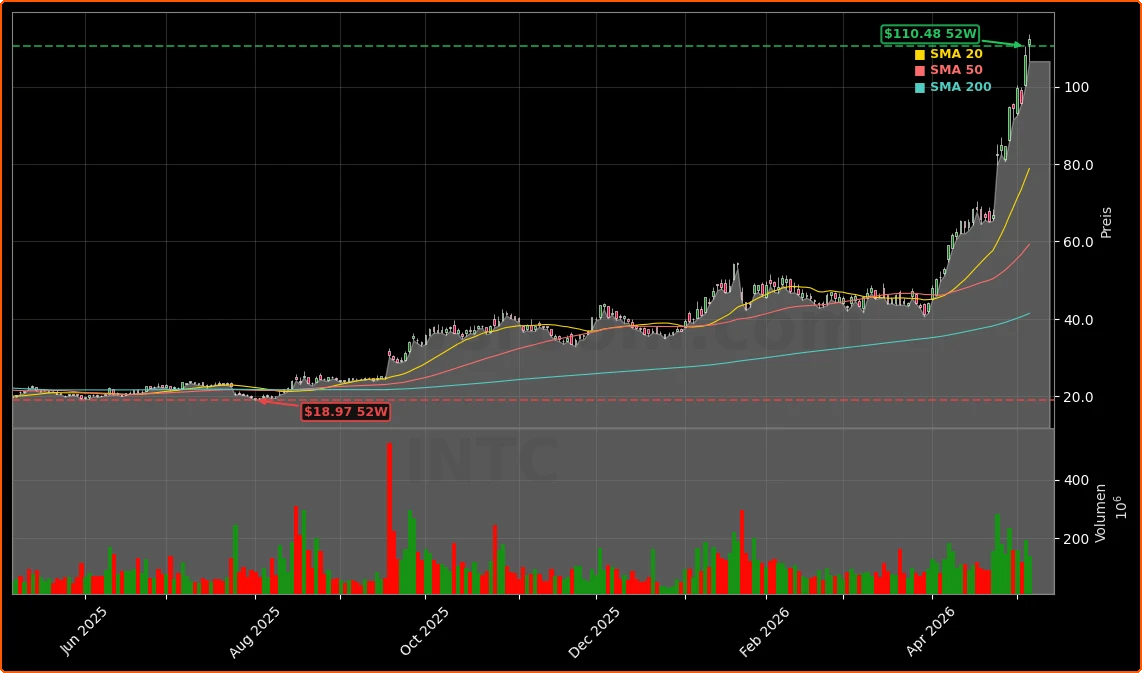
Intel Corporation has transformed from a long-running laggard into one of 2026’s biggest large-cap winners on the NASDAQ. At $112.39 after Wednesday’s U.S. session, the stock is up nearly 4% on the day and more than 190% in 2026, massively outperforming both the S&P 500 and the broader semiconductor group. The latest leg higher came as traders reacted to strong CPU commentary from AMD and renewed enthusiasm for AI infrastructure plays, where Intel is the host CPU in NVIDIA’s DGX Rubin systems used in cutting-edge data centers.
In its most recent quarter, Intel reported Q1 revenue of $13.58 billion, with the Data Center and AI segment contributing $5.05 billion. While that still leaves Intel behind NVIDIA and AMD in high-end accelerators, investors are increasingly pricing in the idea that a much larger CPU market for inference and agentic AI could support several winners. Wall Street desks highlight that tight supply for GPUs and Intel CPUs, combined with rising memory costs, is driving a broader capacity squeeze that benefits any company able to add new manufacturing.
What is changing inside Intel’s AI strategy?
Beyond the macro AI tailwind, Intel is reshaping its leadership to better align around PCs and “physical AI” devices. The company has hired former Qualcomm executive Alex Katouzian to lead its PC and AI client businesses, a move aimed at capturing demand for on-device AI processing in laptops and edge hardware. For U.S. retail traders following the AI hardware theme, this adds a new narrative layer to a stock that was previously seen mainly as a data center and legacy PC CPU provider.
Investors are also watching how Intel balances its traditional product roadmap with its manufacturing ambitions. CEO Lip Bu Tan has focused on upgrading technical execution and culture, with the goal of restoring the company’s historical lead in process technology. The CPU roadmap, including the upcoming 14A node, is now directly tied to external manufacturing deals, blurring the line between product and foundry businesses. If Intel can ship competitive AI-centric CPUs while also selling manufacturing capacity to third parties, the earnings profile could look very different in the next upcycle.
How big is the Intel Foundry opportunity?
The emerging Intel Foundry narrative is anchored in two high-profile opportunities: prospective chipmaking for Apple and participation in SpaceX’s “Terafab” plant in Texas. Market chatter around exploratory talks with Apple to produce some future chips in the U.S. has been a core driver of Intel’s more than 400% share price gain over the past twelve months. Any concrete Apple volume would be a major validation of Intel Foundry’s credibility and a strategic hedge for Apple against Taiwan supply risk.
At the same time, SpaceX has laid out an eye-watering plan to invest at least $55 billion in an initial phase of the Terafab chip facility in Texas, with total spending potentially rising as high as $119 billion over time. The plant, built in collaboration with Intel, is envisioned as a high-volume site to produce chips for SpaceX, Tesla and potentially other customers, targeting output equivalent to chips drawing one terawatt of power annually. Even if this ultimate capacity proves aspirational, Terafab positions Intel Foundry as a key partner in one of the most ambitious U.S. semiconductor build-outs ever attempted.
On a recent Tesla earnings call, Elon Musk said the automaker plans to use Intel’s upcoming 14A process for chips at the facility, implying future foundry revenue tied directly to automotive and autonomous-driving workloads. For long-term investors, that suggests Intel Foundry could extend well beyond classic PC and server markets into transportation and space infrastructure.
Can Intel challenge TSMC and its rivals?
For now, Taiwan Semiconductor still dominates advanced-node manufacturing for giants like Apple and NVIDIA, but capacity at leading-edge nodes is tight and largely pre-booked years ahead. That bottleneck is creating room for alternative suppliers. Intel Foundry is positioning itself as the Western manufacturing complement, offering U.S.-based fabs and a roadmap that could absorb incremental demand from customers seeking geographic diversification and security of supply.
Compared with AMD and Arm in CPUs, and NVIDIA in GPUs, Intel remains a relative underdog at the performance high end. UBS recently projected that the server CPU market could reach around $170 billion by 2030, arguing that Arm-based platforms are currently best positioned, followed by AMD and then Intel. Still, Wall Street’s view is that all three should benefit from the secular AI compute surge. For American portfolio managers, Intel’s appeal lies in its leverage to both the product side and the manufacturing side of that growth curve.
Analyst sentiment has been steadily improving. Large banks such as Goldman Sachs and Morgan Stanley have highlighted Intel’s foundry strategy and AI design wins as key upside drivers, while others remain cautious on execution risk and capital intensity. With U.S. government incentives backing domestic fabs, any incremental foundry contract – especially with a marquee customer like Apple or a large-scale program like Terafab – could trigger further earnings estimate revisions.
Related coverage: Where does Intel Foundry go from here?
For a deeper dive into how potential Apple volumes could reshape the economics of Intel’s manufacturing arm, readers can explore Intel Apple Foundry +9.8% Surge on US Chip Shift, which analyzes whether Intel’s U.S. fab buildout is finally emerging as a real threat to TSMC’s dominance. That piece looks more closely at capacity plans, Apple’s strategic options outside Asia, and what a sustained Intel Foundry ramp could mean for long-term margins and capital returns.
In summary, the Intel Foundry story is rapidly becoming the central pillar of the Intel investment case, tying together AI demand, U.S. industrial policy and marquee customers from Apple to Tesla and SpaceX. For investors on Wall Street, the stock now offers a leveraged play on both AI compute and the onshoring of leading-edge semiconductor capacity. The next test will be whether Intel Foundry can convert today’s high expectations into binding contracts and scalable production, but for now, the momentum clearly remains on Intel’s side.