Is the Intel Management Shift toward quantum bets powering a durable AI rally or setting up investors for a sharp reversal?

How does Intel Management Shift collide with quantum?
The centerpiece of the current Intel Management Shift is Tan’s decision to join the board of PsiQuantum, a privately held quantum computing company valued at roughly $7 billion and backed by industry heavyweights including Microsoft and NVIDIA. PsiQuantum is pursuing fault-tolerant quantum machines using photonic qubits and aims to manufacture at scale using semiconductor-style processes, with major facilities under construction in Brisbane and Chicago.
Tan has been financially involved with PsiQuantum for years through A&E Investments, his venture capital firm that participated in the company’s 2019 Series C round and also funded quantum rival IonQ. His new board role deepens this long-standing relationship just as Intel is trying to cement its position as a foundational layer of global AI infrastructure. The move is being read on Wall Street as both a strategic bridge into quantum hardware and a fresh reminder of earlier conflict-of-interest debates around Tan’s personal investments.
Those concerns flared in 2025 when Intel’s board rejected his push to acquire AI chip start-up Rivos, in which he held a stake, and cooled on a potential SambaNova deal. Governance experts at the time highlighted the risk of overlapping roles across Intel, A&E Investments and portfolio companies, even as they acknowledged that Tan’s access to bleeding-edge start-ups could ultimately benefit Intel’s technology roadmap.
Is Intel’s AI rally outrunning fundamentals?
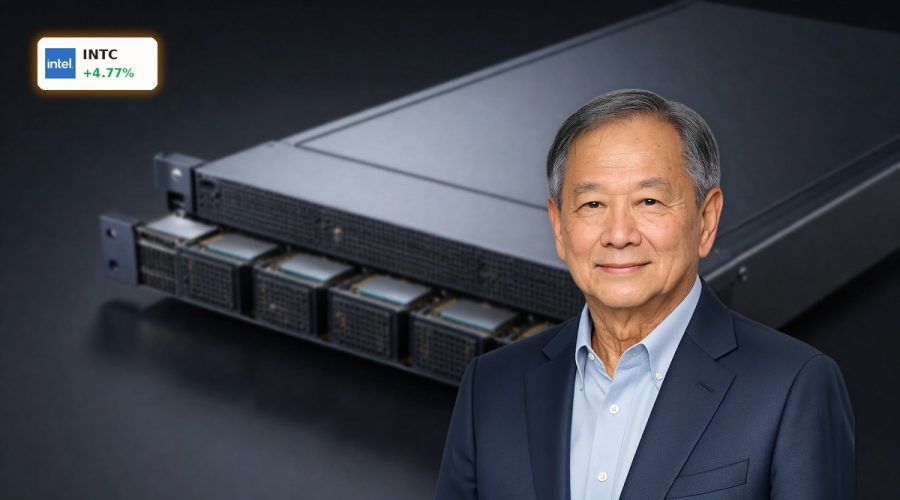
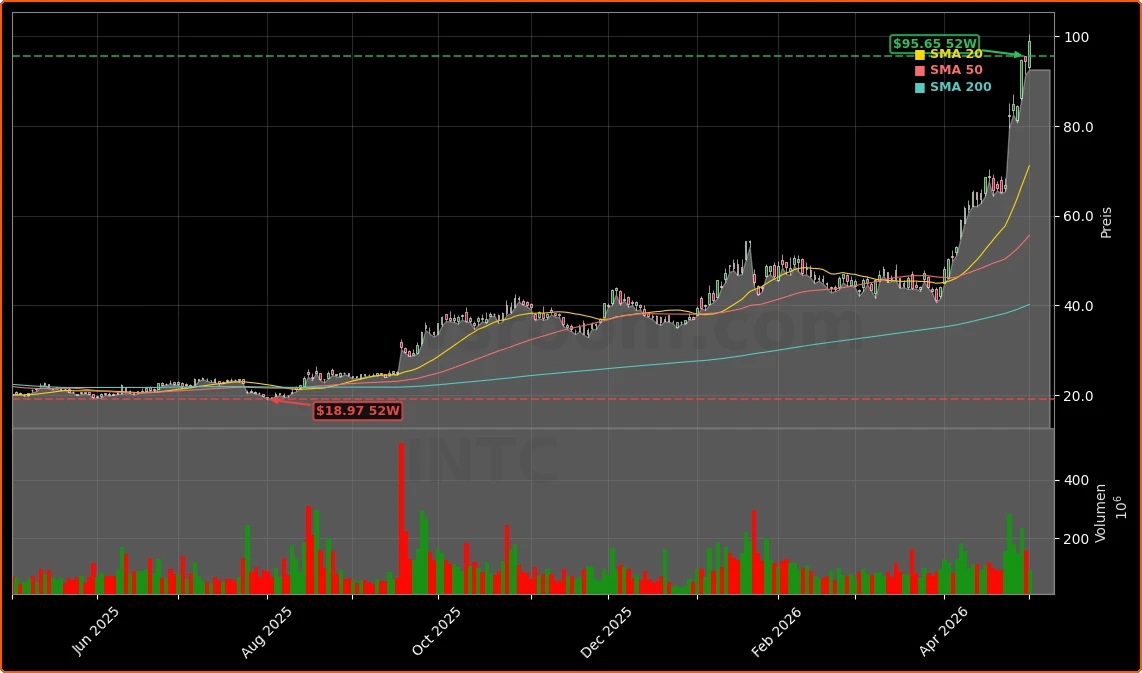
While the Intel Management Shift toward deeper quantum ties unfolds, the stock price is telling a different story: euphoria. Shares have rocketed to about $98.98, up 4.77% on Friday and roughly 122% year to date, after what was effectively the best month in company history. April alone saw gains of over 110%, propelling Intel past its dot-com-era peaks and putting it among the top performers in the S&P 500 and NASDAQ for 2026.
The fundamental backdrop behind this surge has been improving. For Q1 2026, Intel Corporation delivered strong upside, with revenue growth driven by its Data Center and AI (DCAI) group and an aggressive ramp of Xeon 6 processors and Gaudi 3 accelerators into hyperscale environments. Management is guiding to continued double-digit server CPU growth through 2027, as the industry moves from AI model training to around-the-clock inference—where Intel’s CPUs and custom silicon can be paired with GPUs from NVIDIA and AMD in heterogeneous architectures.
Foundry revenue is also moving in the right direction, rising double digits year over year, helped by demand for advanced packaging and the transition of Intel’s 18A process node into high-volume production. This plays into the broader reshoring narrative, with Intel positioned as a national asset for sovereign AI infrastructure and a key beneficiary of CHIPS Act incentives and a large U.S. government equity stake.
Yet valuation worries are mounting. The stock trades far above consensus price targets. MarketBeat data shows an average target around $70.61 and a Hold rating, even after recent bullish moves such as Tigress Financial lifting its target to $118 and Freedom Broker upgrading to Buy with a $100 goal. Morgan Stanley’s Joseph Moore recently reiterated an Equal-weight stance on Intel while favoring Micron as the “superior AI chip stock,” citing memory’s leverage to AI demand and lingering share-loss concerns around Intel’s core businesses.
What does market technicals say about Intel now?
From a technical perspective, Intel’s chart underscores how stretched the move has become. Earlier this week the stock was trading more than 35% above its 20-day simple moving average and nearly 90% above its 100-day SMA. The relative strength index (RSI) hovered in the mid-80s—deep in overbought territory that typically precedes choppy, headline-sensitive trading. These conditions leave the stock vulnerable to profit-taking around any hint of disappointment, whether from macro AI news or further Intel Management Shift headlines around Tan’s outside roles.
Key levels to watch include resistance around $95–$100, where recent intraday spikes have stalled, and support in the high-$60s to low-$70s, an area that roughly aligns with the rising 20-day moving average and prior consolidation. With Intel heavily weighted in AI-focused and value-oriented ETFs, flows into products like the First Trust Nasdaq Semiconductor ETF and Pacer Data and Digital Revolution ETF can amplify swings in both directions.
Despite the rich valuation, the bond market is signaling confidence in Intel’s long-term strategy. The company recently raised $6.5 billion via multi-tranche senior notes due between 2031 and 2066, with coupons ranging from 4.65% to 6.2%. The proceeds give Intel additional flexibility to fund foundry build-outs, buy back stakes in joint-venture fabs, and navigate restructuring moves such as the $4 billion Mobileye-related impairment that underscored the pressure on standalone autonomous-vehicle plays, even as AI infrastructure booms.
How should investors read the Intel Management Shift?
For investors, the Intel Management Shift around Tan’s PsiQuantum role poses a nuanced question: does it enhance Intel’s strategic optionality or re-open a governance overhang just as AI momentum peaks? On the positive side, Tan’s seat at PsiQuantum strengthens Intel’s visibility into next-generation compute architectures that could eventually complement or disrupt classical AI accelerators from NVIDIA and others. It also extends Intel’s footprint in an ecosystem where quantum, classical CPUs, and accelerators may ultimately coexist in hybrid systems.
On the risk side, the overlap between Intel’s CEO, his venture capital firm, and portfolio companies could complicate capital allocation decisions, potential M&A, and partnership priorities. Institutional investors—who collectively hold more than 60% of the float—are already recalibrating exposure, with some like US Bancorp DE trimming positions while others add. For U.S. portfolios heavily weighted to megacap tech and AI, the question is whether Intel can continue to execute on its AI and foundry roadmap fast enough to justify the premium now attached to the stock.
Related Coverage: For a deeper dive into how Intel’s earnings tie into the AI CPU upcycle, readers can explore Intel Earnings +10.2% Surge as AI CPU Boom Accelerates, which examines whether the recent stock spike reflects a durable transformation or a rally ahead of fundamentals.
In the end, the Intel Management Shift represented by Tan’s growing outside influence, coupled with a nearly $100 share price, underscores how central Intel has become to the AI infrastructure story. The company now sits at the crossroads of sovereign semiconductor policy, hyperscale data center capex, and emerging quantum platforms, and the next few quarters will show whether this new leadership configuration can convert market optimism into sustained earnings power for long-term investors.