Are Intel Earnings signaling a lasting AI-driven turnaround, or is the latest double-digit stock surge running ahead of fundamentals?

How are Intel Earnings moving the stock?
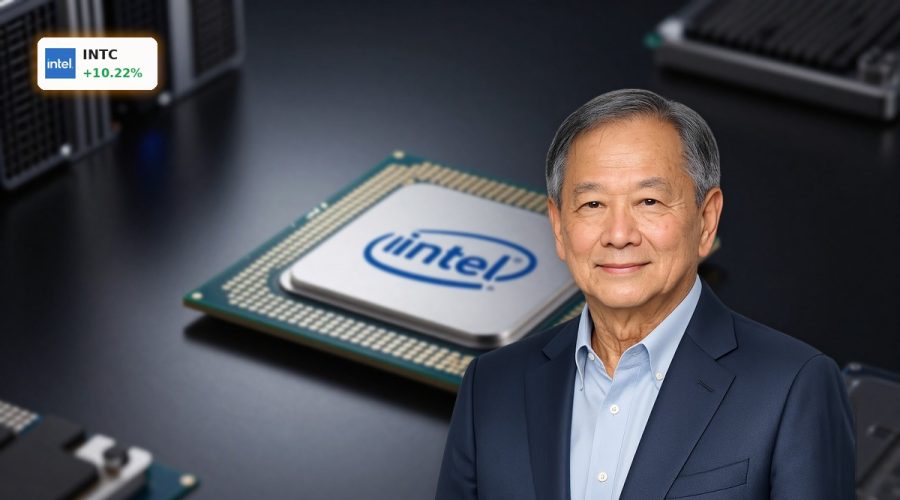
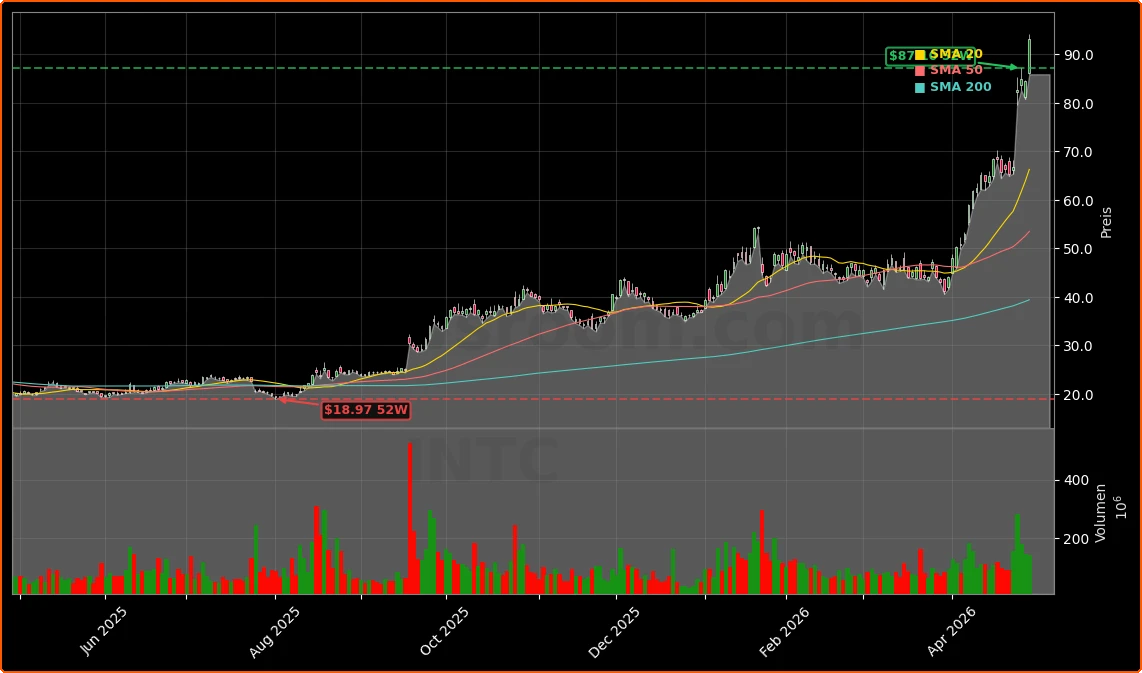
On Wall Street, the reaction to the new Intel Earnings has been immediate. The stock recently traded near $93.20, up roughly 10% on the day and more than 120% year to date, putting Intel among the standout gainers on the NASDAQ and within the semiconductor cohort of the S&P 500. The rally extends a powerful move that accelerated after Intel issued what many investors saw as “blockbuster” revenue forecasts tied to AI infrastructure and new marquee customers such as Tesla, which is leaning on Intel’s server chips to manage agentic AI models in its autonomous driving and robotics ambitions.
The Q1 2026 Intel Earnings report showed revenue and profit comfortably ahead of consensus, with management also lifting its outlook for Q2. Data center revenue — historically a swing factor for Intel — jumped about 22% to more than $5 billion, driven by AI‑focused CPU demand from hyperscalers, cloud providers, and large enterprise customers refreshing aging server fleets. That acceleration, together with higher factory utilization, is helping to stabilize margins even as Intel ramps spending on leading‑edge process technology and advanced packaging.
Why are CPUs suddenly the AI stars?
For much of the last AI cycle, investors have focused on GPUs from NVIDIA and Advanced Micro Devices as the primary winners. Intel’s latest quarter suggests the narrative is broadening. CEO Lip‑Bu Tan emphasized on the earnings call that CPUs are reasserting themselves as the “indispensable foundation of the AI era,” acting as the orchestration layer and control plane for sprawling AI stacks. As enterprises deploy more agentic AI systems that pull data from multiple sources, run tools, and coordinate autonomous agents, the need for flexible, general‑purpose compute has surged.
Tan noted that where data centers previously deployed ratios of roughly eight GPUs to one CPU for certain AI workloads, that mix has already shifted closer to four‑to‑one and could move toward parity over time. Inference tasks increasingly rely on CPUs to handle routing, memory management, context assembly, and safety checks while GPUs crunch matrix math. This structural shift plays straight into Intel’s long‑standing strength in high‑volume CPU design and manufacturing and gives investors a differentiated way to gain AI exposure beyond the pure‑GPU trade in names like NVIDIA.
What’s behind the margin improvement at Intel?
Beyond topline growth, the latest Intel Earnings also highlight a more subtle but important story: yield and inventory optimization. With AI‑driven demand creating what some in the industry dub “CPU‑maggedon,” Intel is finding buyers even for chips that previously would have been written off as scrap. Lower‑performance CPUs that missed premium specifications are now being sold into markets willing to trade peak performance for availability and price stability.
That shift converts what used to be a cost burden into a revenue stream. Every wafer now has a higher effective sell‑through rate, fixed manufacturing costs are spread over more saleable units, and inventory write‑downs are reduced. For a capital‑intensive manufacturer like Intel, especially as it scales its foundry ambitions and invests in capacity from the U.S. to Ireland, this kind of yield flexibility can meaningfully dampen gross margin volatility during periods of extreme demand. It is not a permanent advantage — once supply and demand normalize, customers will again be pickier — but for now it acts as a strong cyclical tailwind.
How are analysts on Wall Street reacting?
Sell‑side sentiment is becoming more polarized as the stock climbs. Bernstein analyst Stacy Rasgon recently argued that while AI is lifting the entire chip space, Intel and Qualcomm are “living in a bad neighborhood,” cautioning that Intel’s valuation is getting harder to justify at these levels despite improving fundamentals. His stance contrasts with more constructive views from firms like Zacks Investment Research, which has highlighted Intel’s AI progress, data center momentum, and role in EV and autonomous driving ecosystems as reasons U.S. portfolios may want exposure.
Other commentators point to industry tailwinds outside pure data center AI. The Global X Autonomous & Electric Vehicles ETF has outperformed peers by emphasizing semiconductor and infrastructure names such as Intel instead of only chasing headline EV makers. That approach underscores how Intel’s chips are increasingly embedded across AI‑enabled manufacturing, vehicles, and industrial applications. At the same time, Intel is investing in next‑generation technologies like glass substrates — backed by packaging partner Amkor — which are expected to reach commercialization within three years and could enhance thermal performance for advanced AI chips.
How is Intel positioned against big tech rivals?
Despite the strong Intel Earnings, competition remains intense. Apple continues to expand its in‑house silicon across Macs and mobile devices, reducing incremental CPU demand from Intel in consumer PCs, while cloud giants like Amazon Web Services explore custom chips for selective workloads. In GPUs, Intel still trails both NVIDIA and AMD in high‑end performance, though new leadership hires and a focus on data center‑class accelerators aim to narrow that gap over the next product cycle.
Intel is countering by doubling down on partnerships and system‑level solutions. A new collaboration with FPT targets AI‑driven autonomous factories, combining Intel’s simulation and optimization tools with FPT’s digital manufacturing platforms to help global manufacturers cut bottlenecks and improve uptime. For U.S. and international investors, these moves suggest Intel is positioning itself less as a commodity chip supplier and more as a strategic AI infrastructure partner across cloud, edge, and industrial markets.
Related Coverage
Investors who want a deeper dive into how the latest Intel Earnings have reshaped sentiment can review our earlier analysis in “Intel Earnings +23.6% Shock as AI Boom Lifts the Stock to Records”. That piece examines whether the post‑earnings spike represents the start of a durable re‑rating or simply a one‑day AI mania, and places Intel’s surge in the broader context of NASDAQ tech leadership and AI infrastructure spending.
In recent months, we have seen clear signs that the CPU is reinserting itself as the indispensable foundation of the AI era.— Lip-Bu Tan, Intel CEO
In summary, the newest Intel Earnings confirm that the company has become a central beneficiary of the AI CPU boom, translating strong data center demand and better factory economics into a powerful share‑price recovery. For investors, Intel now offers a diversified AI play spanning cloud, EVs, and smart manufacturing, albeit with a valuation that some analysts view skeptically. The next few quarters will show whether Intel can sustain its execution, close competitive gaps in GPUs and foundry, and turn today’s AI momentum into a long‑term leadership position.