
Can the latest Tesla Robotaxi rollout promise really justify the stock’s rich valuation as competition and legal risks intensify?

How big is the new Tesla Robotaxi promise?
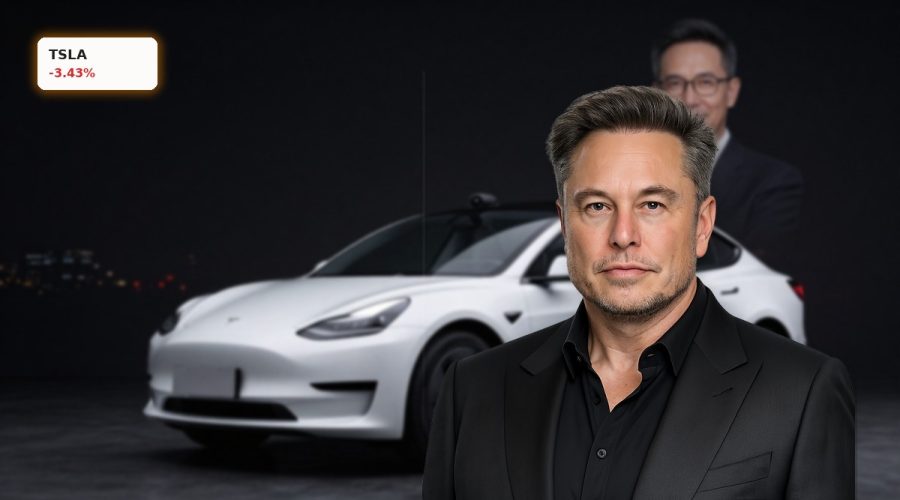
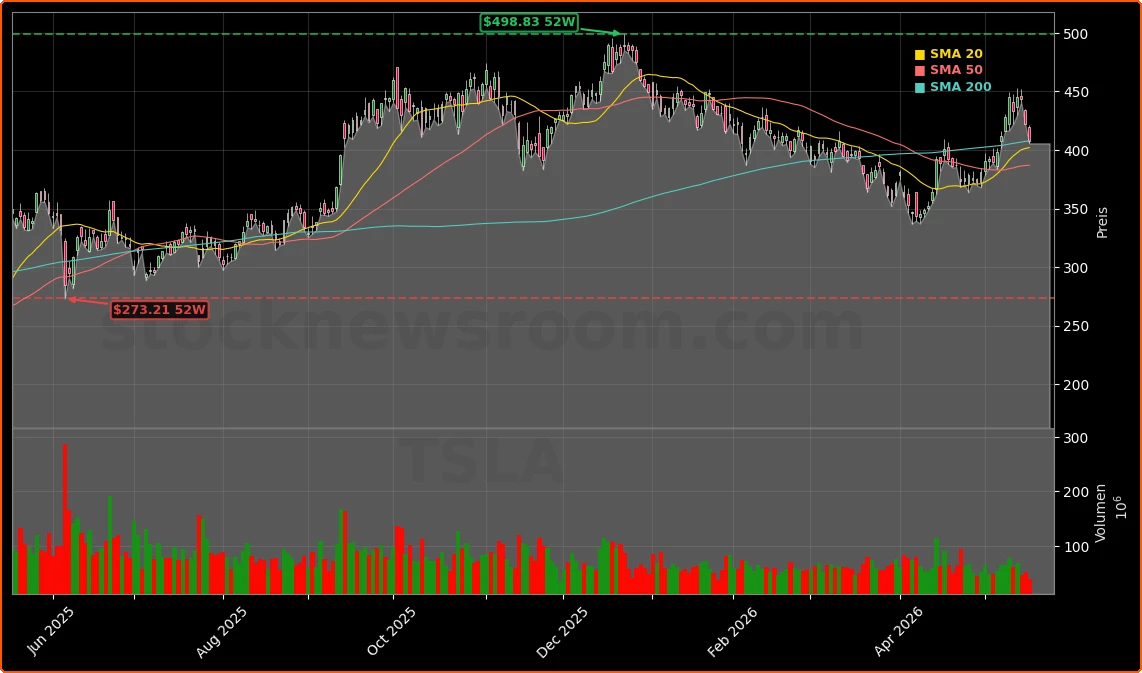
Tesla, Inc. shares traded around $407.76 on Monday, down about 3.4% from the prior close, as investors digested Musk’s latest pledge on autonomy. The CEO said Tesla already has vehicles operating with no driver and no safety monitor in three Texas cities — Dallas, Houston and Austin — and argued that the service could be scaled nationwide within months. That marks a shift from his April guidance, when he suggested robotaxis would probably reach “a dozen states or more” later this year. For US investors, the updated timeline raises the stakes: the Tesla Robotaxi business is one of the key justifications for the company’s premium valuation relative to traditional automakers.
Musk framed self-driving as close to inevitable, predicting that within 10 years, roughly 90% of miles driven could be handled by AI. He reiterated that Tesla’s Full Self-Driving (FSD) software is on a clear path to being an order of magnitude safer than human drivers. The company currently charges American drivers $99 per month for FSD and has amassed about 1.3 million subscribers, turning the software into a recurring-revenue pillar that could feed directly into any large-scale robotaxi network.
What does this mean for Tesla and competitors?
Musk has worked hard to reposition Tesla as an artificial-intelligence and robotics company rather than a pure EV maker, an approach some analysts say justifies stretching traditional valuation metrics to include “optionality” from future products. The Tesla Robotaxi initiative sits alongside projects like the Optimus humanoid robot and the Terafab AI training infrastructure, forming a narrative that the company is building a broad robotics ecosystem, not just selling cars. That narrative helps explain why many institutional investors still treat Tesla as a core growth holding in the technology-heavy S&P 500 and NASDAQ indices.
Still, competition is intensifying. Chinese EV maker XPeng has begun mass-producing a dedicated robotaxi model, while U.S. players such as Alphabet’s Waymo and GM’s Cruise have their own autonomous fleets at various stages of deployment and regulatory scrutiny. XPeng’s approach is notably similar to the Tesla Robotaxi strategy, relying on advanced driver-assistance hardware and software built into consumer-style vehicles rather than heavily customized pods. For now, Tesla’s edge lies in its installed base, data collection and integrated software, but rivals are closing the gap, particularly in China, where President Xi Jinping recently told U.S. executives from Apple, NVIDIA and Tesla that the country will “open wider” to their businesses.
How are analysts and hedge funds reacting?
On Wall Street, opinions on Tesla, Inc. remain polarized. Roth Capital recently reiterated a Buy rating and a $505 price target, citing growth optionality in FSD subscriptions and robotics as key upside drivers. RBC Capital trimmed its target slightly, to $475 from $480, while keeping an Outperform rating and highlighting healthier-than-feared automotive gross margins. Both firms effectively assume that autonomy and software will become a much larger share of Tesla’s earnings mix over time.
Not all institutional investors are leaning in. Hedge fund Coatue Management disclosed that it cut its Tesla position by roughly 96% in the latest quarter, rotating capital into other mobility and tech names. Meanwhile, broader S&P 500 momentum in 2026 has been dominated by tech, media and telecom, with Tesla grouped alongside mega-cap growth names that have driven most of the index’s gains and volatility. Some portfolio managers now argue that robotaxis, Optimus and other AI ventures are necessary to sustain Tesla’s current multiple, even as the core EV business faces price competition and cyclical headwinds.
Are lawsuits and delays a risk to the robotaxis plan?
Execution risk around the Tesla Robotaxi roadmap is not just technical; it is also legal and regulatory. Tesla has faced multiple lawsuits from owners who paid thousands of dollars for FSD years ago and say the company failed to deliver unsupervised autonomy as marketed. In one recent case, an Oracle executive in Texas won a default judgment of more than $10,000 after arguing that his Model 3 could not support unsupervised FSD without a major hardware upgrade. Musk has acknowledged that pre-2023 vehicles will require new AI computers and cameras to reach full autonomy, and the company is exploring so-called micro-factories near major cities to perform those retrofits.
At the same time, Tesla has finally begun series production of the long-delayed Tesla Semi truck and continues to tweak pricing on vehicles like the Model Y, which just saw its first U.S. price increase in roughly two years. These moves highlight a balancing act: funding aggressive, capital-intensive bets like the Tesla Robotaxi fleet and humanoid robots, while keeping the core EV and energy-storage operations competitive and profitable.
Related Coverage
Investors looking for a deeper dive into Tesla’s geopolitical and China-specific AI ambitions can read “Tesla China Talks Boom: Can Musk’s Beijing Push Pay Off?”. That analysis explores how Musk’s high-level meetings in Beijing could shape regulatory approvals for FSD and robotaxis in the world’s largest EV market and what that might mean for the company’s next leg of growth.
We already have some vehicles operating with no people inside and no safety monitors in three cities in Texas and we probably will be widespread in the U.S. by the end of this year.— Elon Musk, CEO of Tesla, Inc.
In sum, the latest Musk comments raise the bar on expectations for the Tesla Robotaxi business, reinforcing the view that autonomy and AI are central to Tesla’s long-term story. For U.S. investors, the key question is whether the company can turn today’s limited Texas pilot into a scaled national network without stumbling on regulation, safety, or hardware constraints. If Tesla can execute on even part of its robotaxis vision while expanding in China and other markets, the stock’s premium valuation could remain intact and the next phase of growth may well be driven more by code and chips than by sheet metal.