Can the Amazon AI Partnership with OpenAI turn AWS into the must-have infrastructure play for the next phase of the AI boom?

How does the Amazon AI Partnership reshape the AI race?
OpenAI’s new revenue chief has flagged the company’s alliance with Amazon Web Services as a key pillar for enterprise growth, underscoring how the evolving Amazon AI Partnership is loosening OpenAI’s historic reliance on Microsoft. AWS is making OpenAI models accessible via its Bedrock platform, where corporate clients can already tap a range of leading large-language models alongside Amazon’s own foundation models. For Amazon, this deepens its role as neutral infrastructure in the AI arms race, even as Microsoft remains a core strategic partner for OpenAI.
Amazon has signaled plans to invest up to $50 billion in OpenAI over time as part of this Amazon AI Partnership, countering Microsoft’s more than $13 billion commitment since 2019. For S&P 500 and NASDAQ investors, this positions Amazon as one of the few hyperscale cloud platforms directly intertwined with the leading frontier-model player. It also bolsters the strategic case for Amazon Web Services as a separate value driver, especially as some research houses argue that hidden assets like AWS and the in-house Trainium AI chips are not fully reflected in today’s valuation.
That valuation point is critical: comparative work versus Walmart suggests Amazon still trades at a lower earnings multiple despite stronger exposure to cloud, AI and custom silicon. If the Amazon AI Partnership with OpenAI delivers sustained enterprise demand on Bedrock, it could justify a premium multiple relative to more traditional retail peers and even cement Amazon’s status alongside NVIDIA as essential infrastructure for the generative AI boom.
Is Amazon building the next big autos marketplace?
Beyond AI, Amazon is pushing deeper into high-ticket e-commerce with an expanded online car-buying program. After launching with Hyundai, Amazon is now adding major brands including Jeep and Chevrolet, with reports also highlighting names like Kia, Mazda and Subaru on the roadmap. Shoppers can handle model selection, configuration and financing end-to-end on Amazon, before picking up the vehicle at a participating local dealer, which still controls final pricing and delivery.
This hybrid approach mirrors the online-first model pioneered by Tesla and newer EV makers, but leverages Amazon’s massive traffic and user trust. Strategically, it aligns with management’s effort to move beyond low-margin retail into categories where the transaction size is large and the digital experience is still fragmented. For US investors, the autos initiative adds yet another optionality layer on top of the core North American e-commerce segment, at a time when Wall Street is highly focused on recurring, fee-like platform revenues.
The autos expansion also strengthens Amazon’s relationships with legacy OEMs such as General Motors, which has been in focus after RBC Capital trimmed its price target to $96 from $107 while maintaining an Outperform rating. As more manufacturers plug into Amazon’s marketplace, the company could secure additional advertising, data and cloud workloads, reinforcing the broader ecosystem.
What does the AMZW ETF mean for Amazon investors?
In parallel with the Amazon AI Partnership narrative, a new ETF is putting Amazon at the center of an income-focused trading product. The Roundhill AMZN WeeklyPay ETF (AMZW) is designed to deliver 1.2x Amazon’s weekly total return, using a total-return swap structure combined with a partial direct holding of Amazon shares and a government money-market position. In theory, if Amazon gains 5% in a week, AMZW aims for around 6%; if Amazon drops 5%, the ETF targets roughly a 6% decline.
Crucially, the weekly distributions that make AMZW attractive to income-seeking traders are currently estimated to be almost entirely return of capital. That means the payouts are largely funded from investors’ own principal, lowering cost basis rather than reflecting earned income or option premiums. Since its launch, AMZW has gained about 10%, far below Amazon’s roughly 32% one-year move, illustrating how fees, leverage drag and distributions can erode long-term performance versus simply owning the stock.
For retail investors, the key takeaway is that AMZW may suit short-term traders who want amplified exposure and regular cash flows, but it is not a free yield play on the Amazon AI Partnership or on Amazon’s broader fundamentals. Losses are magnified symmetrically in down weeks, without the protection of option collars or downside hedges.
How strong is Amazon’s technical and sector setup?
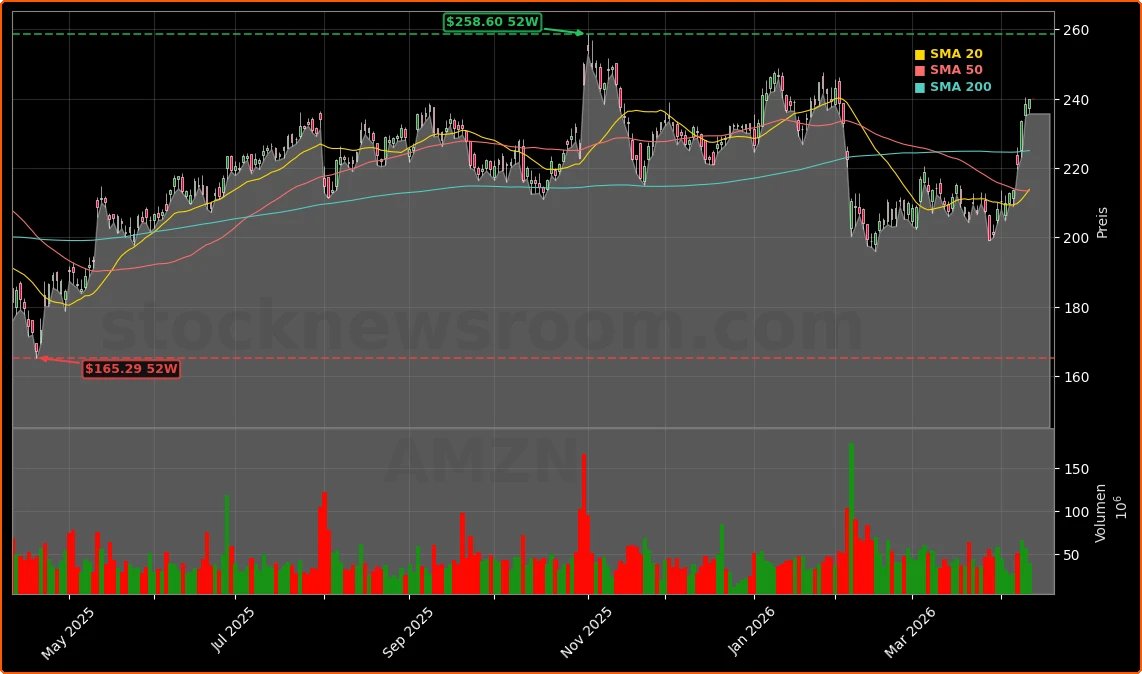
Technically, Amazon has staged a clear rebound from its March 30 lows and now sits just shy of a $240 resistance area and a longer-term negative trendline. A convincing breakout could open the door to a retest of prior record levels in the $255–$260 zone, but the sharp run-up has left the stock somewhat extended. Many traders are looking for either a consolidation phase or a fresh catalyst, such as another major Amazon AI Partnership announcement or strong Q1 2026 earnings, to power the next leg higher.
Macro-wise, Amazon remains a central component of the S&P 500 and NASDAQ 100, and upcoming Big Tech earnings — including Apple, Google and Amazon itself — are likely to influence index direction. Fund manager Dan Niles has publicly suggested that Amazon is positioned to deliver solid numbers, arguing that AI leaders still need to post very strong results to justify elevated expectations across the sector. Meanwhile, Amazon’s Project Kuiper (Amazon Leo) has just unveiled gigabit-speed antennas for commercial aviation, extending Amazon’s infrastructure footprint into space-based and aerospace connectivity, and helping chip partners like Marvell reach record highs on growing optical and networking demand.
Related Coverage: Investors who want a deeper dive into capex and AI infrastructure can read how Amazon’s $200 billion build-out is reshaping expectations in this detailed look at Amazon’s AI strategy and capex boom. For a broader sector view on how alliances can reprice legacy chip names, the analysis of Intel’s AI partnerships and the resulting surge in its share price offers a useful comparison to the Amazon AI Partnership story.
Fazit folgt.