
Are Chevron Earnings strong enough beneath the headline slowdown to keep the oil major’s long-term bull case firmly intact?

Do Chevron Earnings change the bull case?
Chevron Corporation posted first-quarter 2026 earnings of $2.2 billion, or $1.11 per diluted share, down from $3.5 billion and $2.00 per share a year earlier. On an adjusted basis, stripping out a $360 million legal reserve and other special items, profit came in at $2.8 billion, or $1.41 per share. That comfortably beat Wall Street estimates of roughly $0.95 to $0.97 per share, even though it marked a year-over-year decline from adjusted EPS of $2.18 in Q1 2025.
Revenue told a different story. Chevron generated about $48.6 billion in quarterly sales, only slightly above the $47.6 billion it booked a year ago and below analyst expectations of around $52.1 to $52.7 billion. The gap points to a quarter where higher production and stronger refining margins were offset by timing effects in derivatives and inventory accounting that depressed reported profit and cash flow. For S&P 500 investors, the latest Chevron Earnings underscored how accounting impacts and working capital swings can mask the underlying strength of the business in a period of sharp commodity price moves.
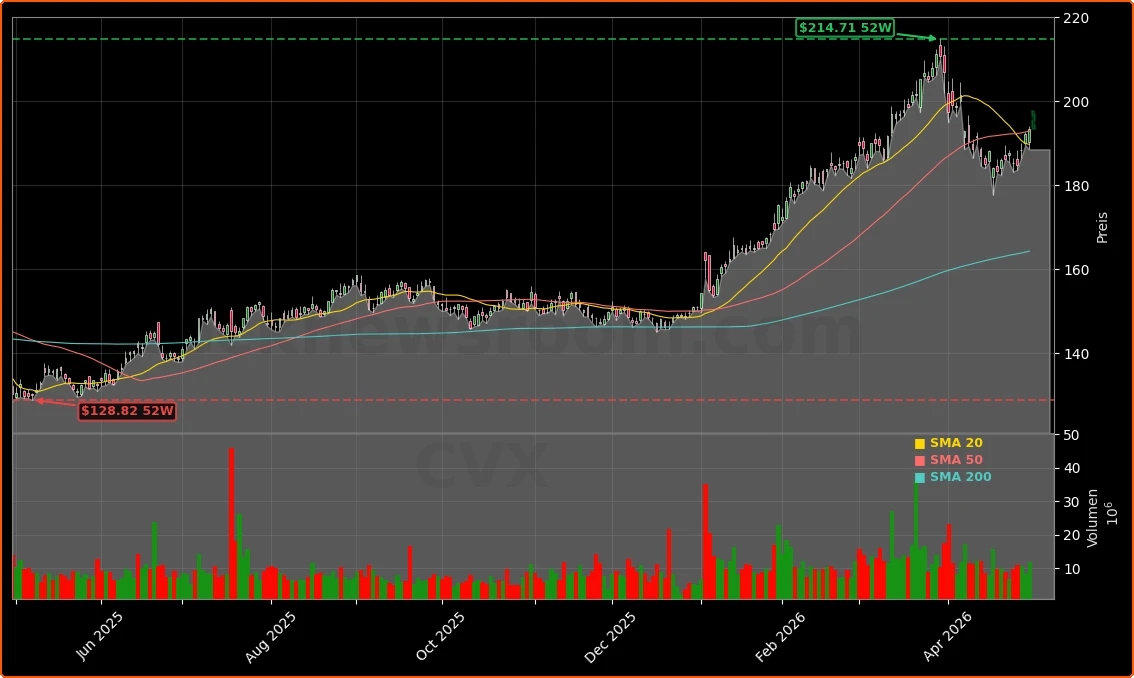
At Thursday’s close, Chevron shares finished at $193.31 on the NYSE, with pre-market indications on Friday suggesting a move toward $197.59, up a bit more than 2%. That leaves the stock below its 52-week high of $214.71 but well above the 52-week low of $133.77, keeping CVX firmly in the top tier of large-cap energy plays alongside names like Exxon Mobil and Apple-heavy index funds that dominate many US portfolios.
How strong is Chevron’s operating performance?
Operationally, the quarter was robust. Worldwide net oil-equivalent production reached 3.86 million barrels per day (MBOED), up about 15% from 3.35 million in the prior-year period. U.S. production climbed 24% to just over 2 million barrels per day for the third straight quarter, fueled by the Hess acquisition, project ramp-ups in the Gulf of America, and continued growth in the Permian Basin. International volumes also grew despite outages in the Middle East and downtime at the Tengizchevroil affiliate in Kazakhstan.
Upstream earnings totaled $3.9 billion, significantly outpacing the consolidated bottom line due to losses in downstream and “All Other.” U.S. upstream profit rose to about $2.1 billion, benefiting from higher sales volumes, even as depreciation and operating costs increased. International upstream earnings were roughly $1.8 billion, with higher liquids realizations and increased production partly offset by foreign currency headwinds of more than $200 million.
Downstream was the drag. The segment swung to a loss of $817 million from a $325 million profit a year earlier, driven in part by the U.S. legal reserve. Yet operationally, Chevron’s U.S. refining system remained strong: crude throughput exceeded 1 million barrels per day for the fifth consecutive quarter and hit a record in March 2026. That operational resilience supports the longer-term cash-generation story behind the current Chevron Earnings trajectory.
What do Chevron Earnings say about cash flow and balance sheet?
Cash flow from operations dropped to $2.5 billion in the quarter, down from $5.2 billion a year ago. The main culprit was working capital: a sharp rise in commodity prices in March 2026 drove higher inventory and receivables, resulting in operating working capital outflows of about $4.6 billion. Excluding working capital swings, cash flow from operations was a healthier $7.1 billion, roughly in line with last year’s $7.6 billion.
Free cash flow was negative $1.5 billion after $4.1 billion of capital expenditures, which were up modestly year over year, primarily due to spending on legacy Hess assets. Adjusted free cash flow, which adds back working capital effects and incorporates affiliate loan repayments and asset sale proceeds, reached about $4.1 billion, virtually flat versus the prior year. Net debt stood around $40.1 billion, with a net debt ratio near 17.9% of total capital, leaving Chevron with ample financial flexibility relative to many peers in the global energy space, including diversified majors followed closely by NVIDIA– and tech-heavy ETF investors seeking sector balance.
Despite the noisy cash flow picture, Chevron returned $6.0 billion to shareholders in the quarter, including $3.5 billion in dividends and $2.5 billion in share repurchases. The board declared a quarterly dividend of $1.78 per share, payable June 10, 2026, to shareholders of record on May 19, underscoring management’s confidence in the sustainability of payouts through the cycle.
How is Wall Street reacting to Chevron Earnings?
Analysts had turned more constructive on CVX heading into the report, and the Chevron Earnings beat on adjusted profit largely validates that stance. Citigroup’s Alastair Syme maintains a Buy rating and recently raised his price target from $210 to $235. Wells Fargo’s Sam Margolin remains Overweight with a target lifted from $204 to $222, while Morgan Stanley’s Devin McDermott keeps an Overweight rating and boosted his target from $174 to $212.
RBC Capital’s Biraj Borkhataria continues to rate the stock Outperform with a $220 target, and Scotiabank’s Paul Cheng sits at Sector Perform with a $187 target. TD Cowen, for its part, rates Chevron at Hold with a $204 price objective, noting that the company has less direct exposure to the Middle East than some peers and could benefit disproportionately from elevated oil prices and disciplined capital returns.
As energy remains a volatile but critical slice of the S&P 500, many US investors are reevaluating allocations to Chevron alongside other large-cap names such as Tesla. For value-focused strategies, including certain ETFs highlighted by GuruFocus, Chevron’s combination of a robust dividend, ongoing buybacks, and a fortress balance sheet continues to appeal despite the near-term earnings and cash flow noise.
Related Coverage: What about Chevron’s recent oil price shock?
Investors trying to put the new Chevron Earnings in context may want to revisit how the stock reacted to headline-driven oil price swings earlier this year. In early April, the company’s share price was hit by a sharp move in crude after cease-fire headlines, a dynamic explored in detail in “Chevron Oil Price Plunge -5.5% After Cease-Fire Shock”. That piece analyzes whether the drop was a knee-jerk reaction or a warning sign for energy bulls and helps frame how geopolitical news can temporarily overshadow fundamentals. Comparing that episode with today’s fundamentally driven response to Chevron’s Q1 numbers can give long-term investors a better sense of when to lean into volatility and when to step aside.
Overall, the latest Chevron Earnings show a company that is growing production, maintaining hefty shareholder returns, and navigating a turbulent macro backdrop with a solid balance sheet. For US investors, the key takeaway is that operational momentum remains intact even as headline earnings and free cash flow fluctuate with working capital and legal items. The next quarters will reveal whether stronger pricing and new projects can push CVX closer to its 52-week highs, but for income-oriented and diversified portfolios, Chevron’s steady dividend and disciplined capital allocation remain a compelling anchor in the energy sector.