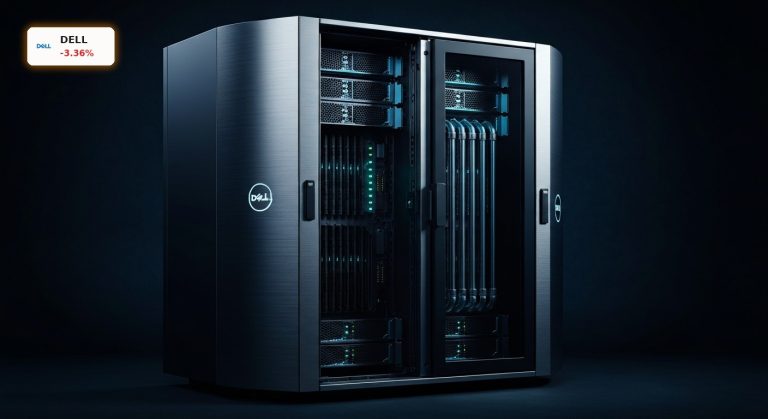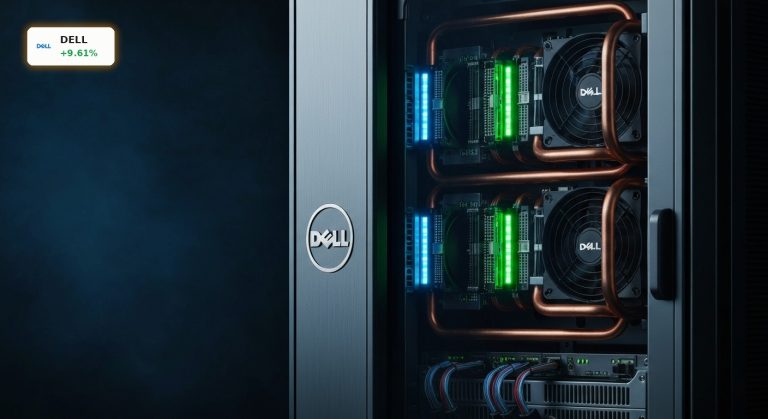

Can the massive boom in Dell Technologies AI servers overcome growing supply chain risks and save the stock from its latest plunge?

How Is Dell Technologies AI Driving Server Sales?
The fundamental story surrounding Dell Technologies Inc. has shifted entirely from consumer laptops to high-performance enterprise hardware. In fiscal year 2026, the company’s revenue reached approximately $113.5 billion, representing a robust 19% growth compared to the previous year, while net income surged to over $5.9 billion. This impressive performance reflects a steady upward trajectory from fiscal year 2024, when revenue stood at $88.4 billion.
The primary catalyst for this expansion is the unprecedented enterprise demand for high-performance computing. For the current fiscal year 2027, management expects **Dell Technologies AI** server sales to exceed $60 billion, almost tripling the prior year’s figures. Total sales for fiscal year 2027 are projected to rise by 50% to approximately $171 billion, with net income and free cash flow both estimated to surpass $11 billion. While rising memory prices continue to pressure the traditional PC and laptop segments, the massive volume of AI-optimized server sales is more than compensating for these headwinds, positioning the firm at the center of the global data center expansion.
Is Dell a Better Bet Than Snowflake?
When evaluating how to allocate capital within the tech sector, investors often weigh the established value of hardware giants against disruptive cloud players like Snowflake (SNOW). While Snowflake offers a platform-agnostic cloud database that benefits from partnerships with major AI developers like OpenAI, it trades at a premium. Snowflake is expected to grow its fiscal year 2027 sales by 30% to $6.1 billion, though it will likely post a narrower net loss of $990 million.
In contrast, the financial metrics favor Dell as a highly conservative value play. Dell trades at a highly attractive Forward P/E ratio of 23.8x, compared to Snowflake’s astronomical 135.1x. Furthermore, Dell’s massive cash generation—highlighted by $8.6 billion in free cash flow in fiscal year 2026—allows it to reinvest heavily in its product pipeline. For value-conscious investors, the tangible hardware sales generated by **Dell Technologies AI** solutions present a more reliable risk-to-reward profile than speculative high-multiple software stocks, even as Snowflake secures major infrastructure deals with cloud giants like Amazon AWS.
What Risks Face Dell Technologies?
Despite its strong market positioning, the company faces notable operational headwinds. Dell relies heavily on single-source suppliers and outsourced manufacturing in Asia, leaving its supply chain highly vulnerable to geopolitical conflicts and disruptions. Additionally, intense competition from rival manufacturers like Hewlett Packard Enterprise (HPE) threatens to erode net margins in the highly competitive server market.
On the legal front, a $70 million lawsuit from XTX Markets regarding alleged server pricing increases poses a minor financial and reputational risk. Furthermore, rapid shifts in generative AI technology could lead to rapid product obsolescence or inventory write-downs if the company miscalculates market demand. However, Dell’s robust balance sheet, backed by substantial cash reserves that offset its $20 billion in net debt, provides a solid cushion to navigate these challenges while continuing to scale its hardware production.
For investors tracking the broader tech landscape, our Dell Technologies Rally: Stock Jumps 9.6% as AI Server Demand Soars analysis explores how a competitor’s margin surprise could push the stock to new record highs. Additionally, those interested in next-generation computing should read the IonQ Analysis: Stock Soars +9.8% as Benchmark Sets $60 Target to see how quantum computing pioneers are performing.
In conclusion, the massive expansion of **Dell Technologies AI** infrastructure positions the company as an incredibly strong long-term play for tech investors. By combining robust free cash flow with an attractive valuation, the company offers a highly stable alternative to speculative software stocks. As enterprise data centers continue to scale globally, Dell is well-positioned to turn this hardware supercycle into sustained shareholder value.