
Will Super Micro Computer’s massive revenue miss hand the entire AI server market to Dell on a silver platter?

How did Super Micro Computer Earnings miss expectations?
In its preliminary third-quarter fiscal 2026 results, Super Micro Computer reported revenue of $10.24 billion. While this represents an impressive 122.7% increase year-over-year, the figure fell significantly short of Wall Street estimates. Analysts had projected revenue of $12.45 billion, meaning the company missed expectations by roughly 17.75%. This revenue miss during the high-stakes AI buildout has raised concerns among institutional investors who demand flawless execution.
On a positive note, the GAAP gross margin recovered to 9.9% from 6.3% in the prior quarter. However, these figures remain preliminary and unaudited, leaving some market participants cautious. CEO Charles Liang emphasized that the transition of Super Micro Computer into a total data center infrastructure provider is accelerating. Despite this optimistic narrative, the company’s financial health is under scrutiny, highlighted by $6.6 billion in cash used in operations and a heavy debt load of $8.8 billion in debt and convertible notes.
Why is Dell winning the execution battle?
A direct comparison with competitor Dell Technologies illustrates why Wall Street is treating these two AI hardware giants differently. While Supermicro struggled to meet top-line expectations, Dell demonstrated disciplined scale across its business segments. Dell’s AI server revenue surged an astonishing 757% year-over-year to reach $16 billion, proving its ability to capture massive market share without sacrificing operational stability.
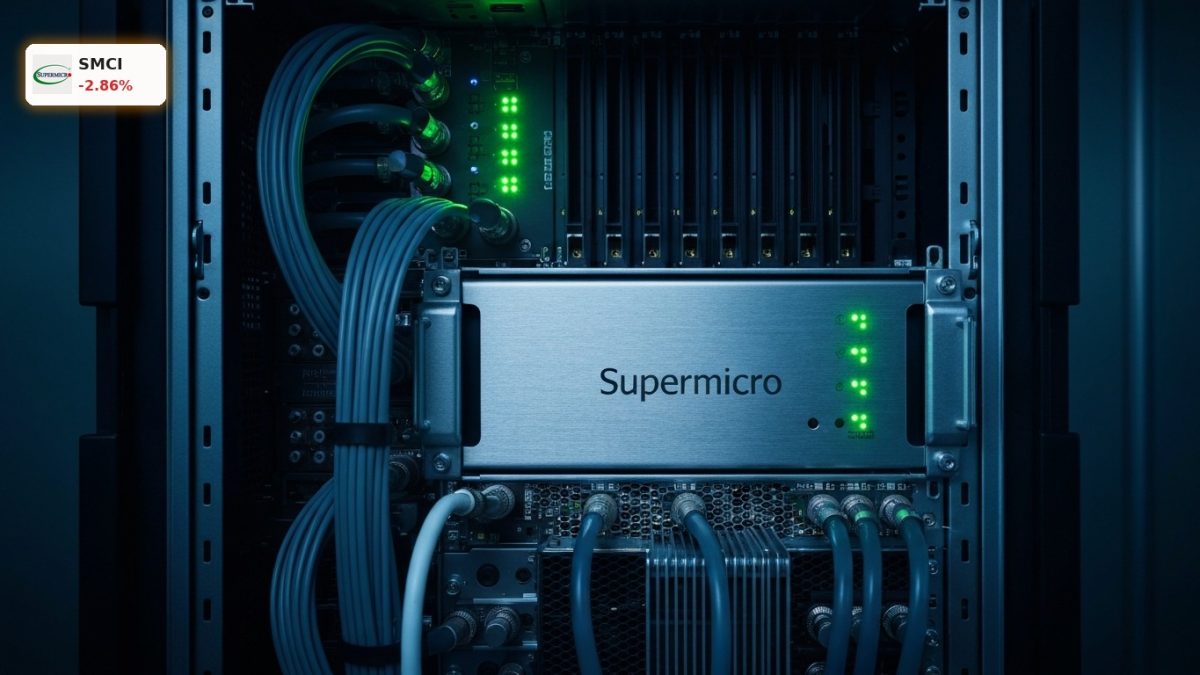
This divergence in execution is clearly reflected in valuation metrics. Dell currently trades at a price-to-earnings (P/E) ratio of 34, whereas Supermicro trades at a much lower P/E of 15. The valuation gap underscores the premium that investors place on governance and reliable execution. While Supermicro boasts more than $13 billion in orders for NVIDIA‘s next-generation Blackwell Ultra platforms, execution bottlenecks and financial overhead continue to weigh on its stock price, which recently fell to $26.86, down 2.86% in recent trading.
What governance risks are impacting Super Micro Computer Earnings?
Beyond the core financial metrics, governance issues are casting a long shadow over the future of Supermicro. Investors are closely monitoring a Taiwan chip smuggling probe, which involved a raid on June 29. The investigation is reportedly tied to the unauthorized diversion of advanced Nvidia AI processors, introducing a severe risk profile to the company’s operational outlook. This regulatory overhang has severely damaged retail and institutional sentiment alike.
Furthermore, the high level of leverage required to sustain Supermicro’s rapid expansion remains a key vulnerability. Managing $8.8 billion in debt and convertibles in a fluctuating interest rate environment limits the company’s financial flexibility. In contrast, Dell’s integrated approach across its Infrastructure Solutions Group (ISG) and Client Solutions Group (CSG) has provided a more stable foundation, even as its own gross margins compressed slightly to 17.8% from 21.1% due to competitive pricing pressures.
Related Coverage
Supermicro’s transformation into a total datacenter infrastructure provider is accelerating.— Charles Liang
For a deeper look into how the company is attempting to pivot its product strategy, read about the Super Micro Edge AI +5.6% Surge After Kubernetes Launch, which examines whether new product rollouts can offset margin pressures. Meanwhile, broader market dynamics are impacting the entire semiconductor landscape; check out the AMD Analysis: Stock Drops -3.5% as Sector Rotation Hits Chipmakers to understand how sector-wide rotations are affecting key hardware suppliers and chip designers.