
Is Ford Energy Storage the catalyst that finally rewires this legacy automaker for the AI power boom—or just another hype cycle?

Why did Ford stock just whipsaw?
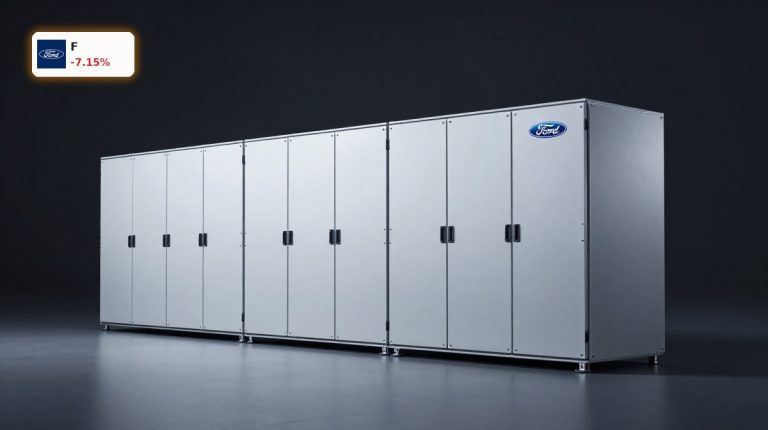
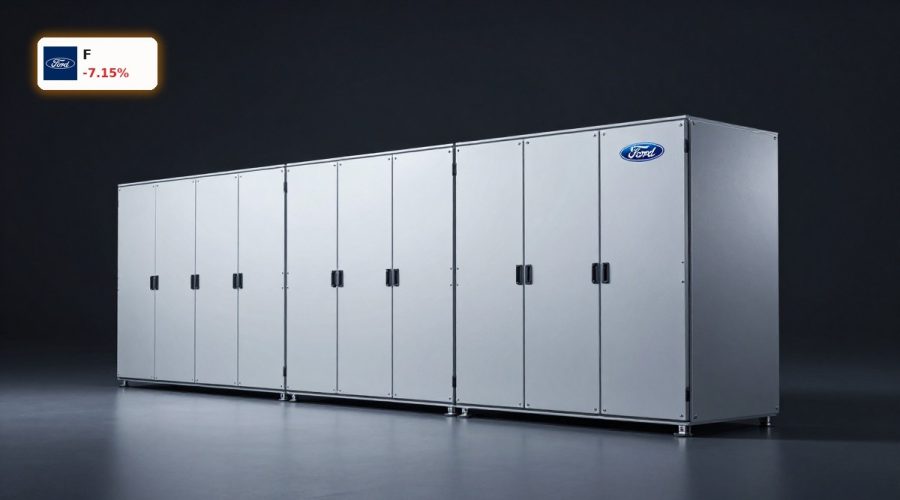
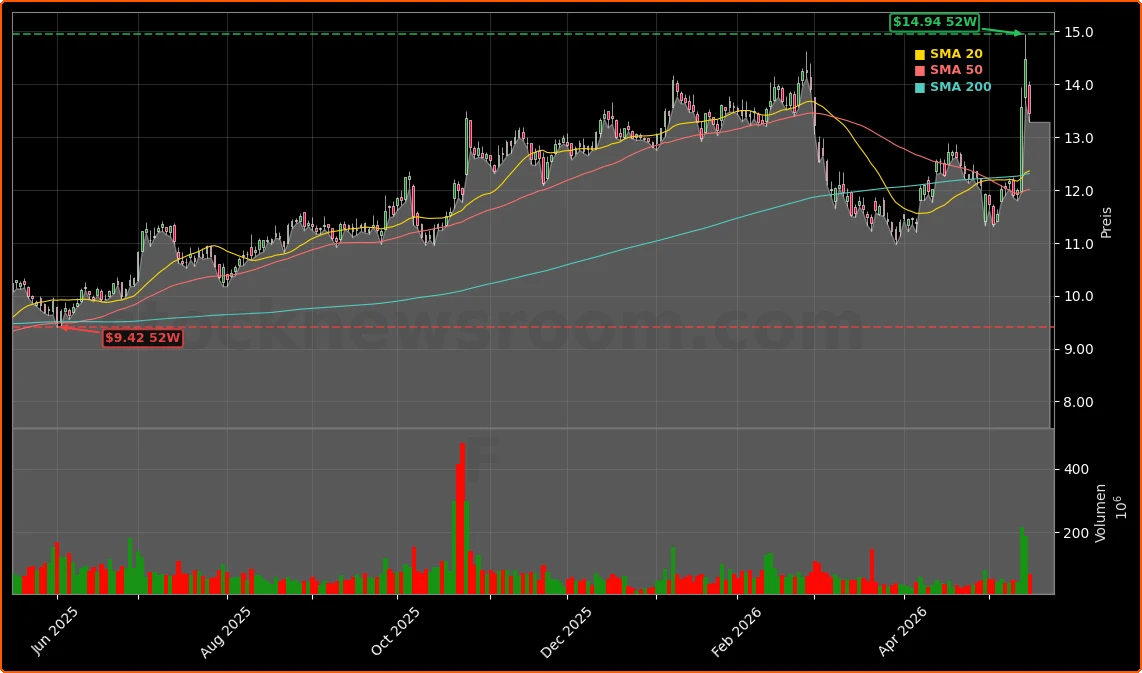
Ford Motor Company (F) is having a volatile week. Shares ripped more than 20% over an explosive two‑day move to a fresh 52‑week high of $14.94, then dropped 7.15% today to $13.45 by late afternoon in New York, erasing much of Thursday’s auto‑sector rally. The pullback reflects profit‑taking more than a sudden shift in fundamentals: Ford recently raised its full‑year 2026 adjusted EBIT outlook to $8.5 billion–$10.5 billion after posting Q1 revenue of $43.25 billion and net income of $2.55 billion.
What changed is the narrative. Instead of being valued just as a cyclical Detroit automaker competing head‑to‑head with General Motors and Tesla, Ford is suddenly being discussed as an AI infrastructure supplier. Traders have started to price in the potential of Ford Energy Storage as a high‑margin, capital‑light growth driver tied to the secular demand for power‑hungry AI data centers.
How big could Ford Energy Storage become?
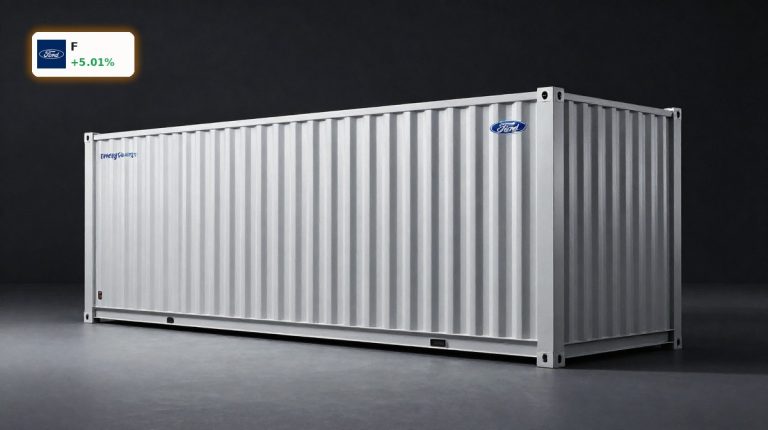
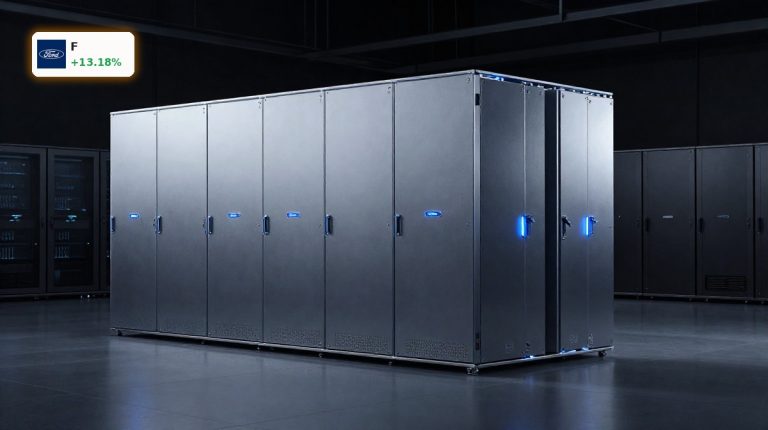
The pivot centers on Ford Energy, a newly highlighted division that will build utility‑scale battery energy storage systems (BESS) for data centers, power grids and industrial customers. Ford plans to spend roughly $2 billion repurposing an underutilized battery plant in Kentucky, targeting at least 20 GWh of annual BESS capacity with first deliveries expected in late 2027. Rather than betting solely on slower‑than‑hoped EV adoption, management is trying to monetize its battery footprint where demand is strongest: AI‑driven electricity loads and grid stabilization.
Morgan Stanley analyst Andrew Percoco has put a spotlight on the opportunity, assigning the Ford Energy business an enterprise value of around $10 billion using an 18x multiple on a potential ~$600 million profit stream once the unit scales. He also argues upside toward $30 billion is possible if Ford wins major contracts with hyperscale cloud operators like NVIDIA’s largest customers and US utilities, especially given Ford’s domestic manufacturing footprint and licensing agreement with Chinese battery giant CATL.
Critically, Ford Energy Storage is modeled with roughly 25% gross margins at maturity, far above traditional auto margins and closer to industrial tech benchmarks. If Ford executes, even a mid‑single‑digit billion revenue run‑rate from this segment could move the needle on consolidated profitability and help offset persistent losses in the Model e EV division, which burned $777 million in Q1.
Can Ford compete with tech and utilities?
The competitive landscape for data center and grid storage is intensifying. Utilities and independent power producers such as Vistra Corp are aggressively rolling out large‑scale battery projects, while industrial players and integrators vie for the same hyperscaler contracts that will underpin AI infrastructure for years. At the same time, cloud and chip leaders like NVIDIA are pushing vertically into energy systems design to guarantee reliable power for their AI clusters.
Ford’s edge is manufacturing scale and an existing battery technology base via CATL licenses. Re‑using a Kentucky factory reduces greenfield risk and could help Ford meet US sourcing and labor rules that favor domestic production over imports. But the company still has to prove it can win complex, long‑cycle BESS contracts against incumbents who have been designing grid‑connected systems for years. Execution risk is substantial: late deliveries or cost overruns would quickly erode the high‑margin story around Ford Energy Storage.
For now, the core auto business remains the profit anchor. Ford’s F‑Series trucks, Bronco, Explorer and Maverick, along with the Ford Pro commercial unit, generated 11.4% margins in Q1 and supported a quarterly dividend of $0.15 per share, a 4.84% yield at current prices. However, recent supply disruptions, including an aluminum plant fire that cut F‑150 inventory by more than 40%, underline how vulnerable the traditional profit engine is to operational hiccups and how valuable a diversified earnings stream from Ford Energy could be over time.
How does Ford stack up against GM and Tesla?
Investors comparing Ford to General Motors and Tesla now have to factor in a new variable: portfolio mix. GM is leaning harder into high‑margin trucks and SUVs, planning to boost production of Silverado and Sierra to capture share while Ford’s F‑150 volumes are constrained. Tesla remains primarily a pure‑play EV and software story, with energy storage still a smaller contributor to overall revenue, albeit growing.
If Ford Energy Storage scales as envisioned, Ford could straddle both worlds: a durable ICE and hybrid truck franchise, plus a data center and grid storage arm that trades more like industrial tech. That hybrid identity might ultimately command a higher multiple than the 8x forward P/E currently implied by the share price and modest average analyst targets around the mid‑teens. But the market will demand concrete order announcements, visibility on 2027–2028 delivery schedules, and proof that BESS projects are generating the targeted 25% gross margins before rerating the stock toward Morgan Stanley’s more optimistic scenario.
Related Coverage
For a deeper dive into how the market initially reacted to Ford’s pivot, including the mechanics of the recent 13.2% surge, readers can review this detailed look at Ford Energy Storage and Detroit’s surprise role in the AI power race. That article breaks down why traders started to value Ford more like an AI infrastructure enabler than a traditional automaker and what early order signals investors should watch.
Our strong first-quarter results and raised full-year guidance reflect the momentum of the Ford+ plan.— Jim Farley, CEO of Ford Motor Company
In summary, Ford Energy Storage has quickly become the centerpiece of a new growth narrative around Ford Motor Company, even as today’s 7% pullback reminds investors how volatile sentiment can be. For US portfolios, the story now hinges on whether Ford can translate a $2 billion Kentucky bet and CATL‑based technology into a multi‑billion‑dollar, high‑margin business serving AI data centers and the grid. The next phase will be all about execution and customer wins; if Ford delivers, this energy storage pivot could materially reshape how Wall Street values the stock over the rest of the decade.