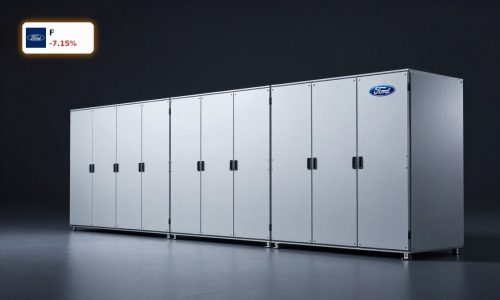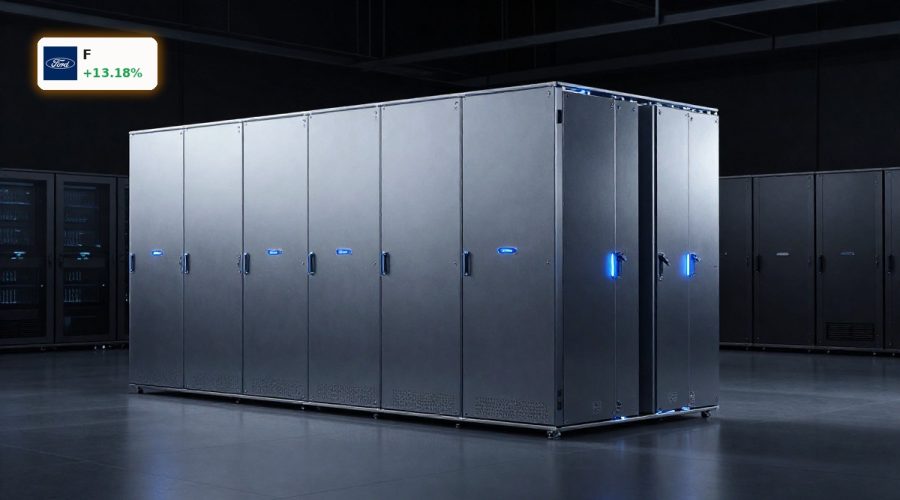

Can Ford Energy Storage turn a legacy automaker into a surprise winner of the AI and data center power race?

Why did Ford Motor Company surge today?
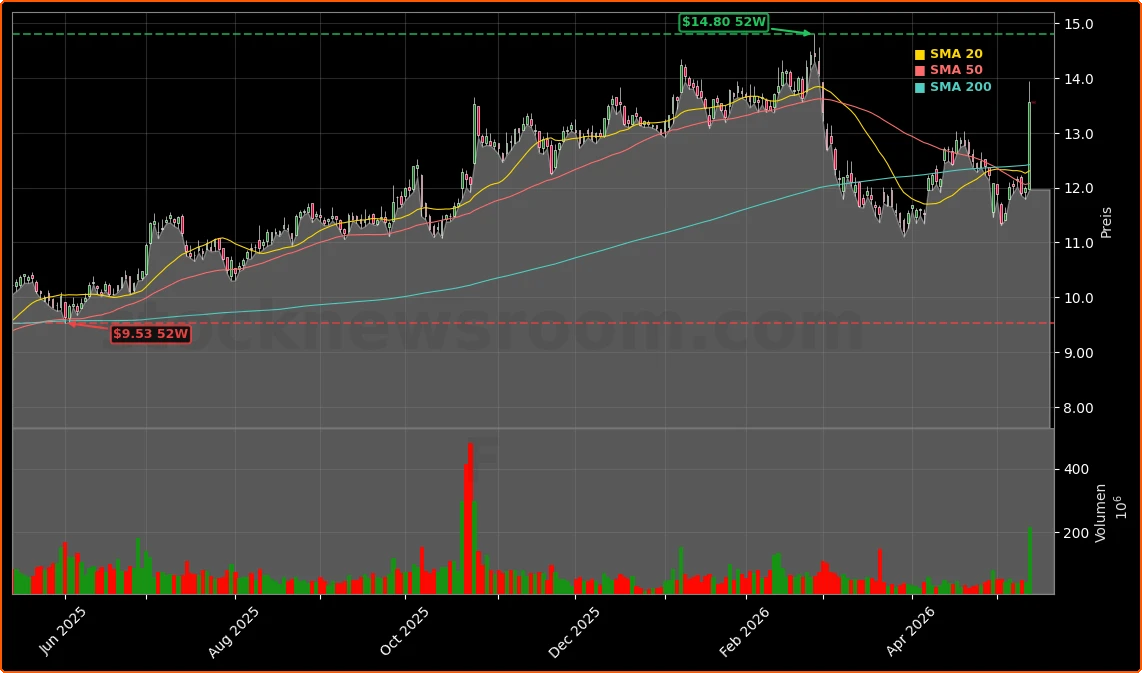
Ford Motor Company was the strongest performer in the S&P 500 on Wednesday, logging its biggest single-day gain since March 2020. The stock leapt from a prior close of $11.99 to $13.57 during the session, before slipping a few cents in late trading. The rally came despite a relatively calm backdrop for legacy auto peers, underscoring how new narratives can move mature industrial names when they intersect with AI and energy themes.
The fresh catalyst builds on Ford’s late-April Q1 2026 earnings, where the company reported EPS of $0.66 on $43.25 billion in revenue, up 6% year over year. Adjusted EBIT reached $3.49 billion, helped by a one-time $1.3 billion International Emergency Economic Powers Act tariff benefit. Management raised full-year adjusted EBIT guidance to a range of $8.5 billion to $10.5 billion, and CEO Jim Farley said the results reflect momentum in the Ford+ transformation plan, driven by cost and quality improvements.
Within that mix, Ford Pro and Ford Blue remain the profit engines. Ford Pro generated $1.69 billion in EBIT with 879,000 paid software subscriptions, while Ford Blue delivered $1.94 billion in EBIT on $23.9 billion of revenue. The EV-focused Model e segment still posted a loss, but it narrowed to $777 million, setting the backdrop for why investors are eager to see a higher-margin battery and energy story emerge alongside the core automotive franchise.
What is the Ford Energy Storage opportunity?
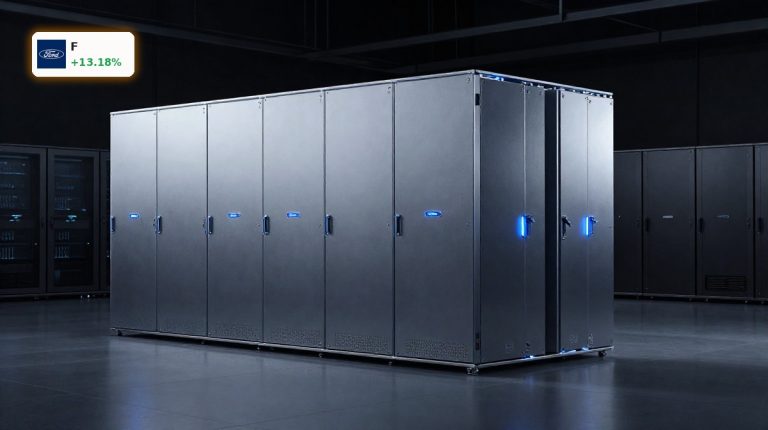
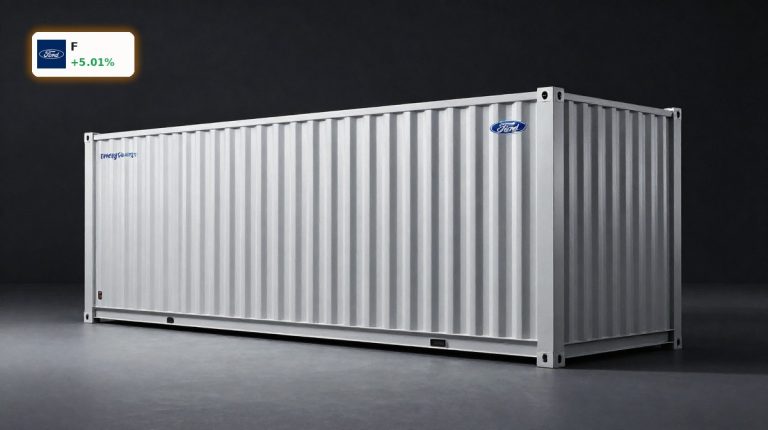
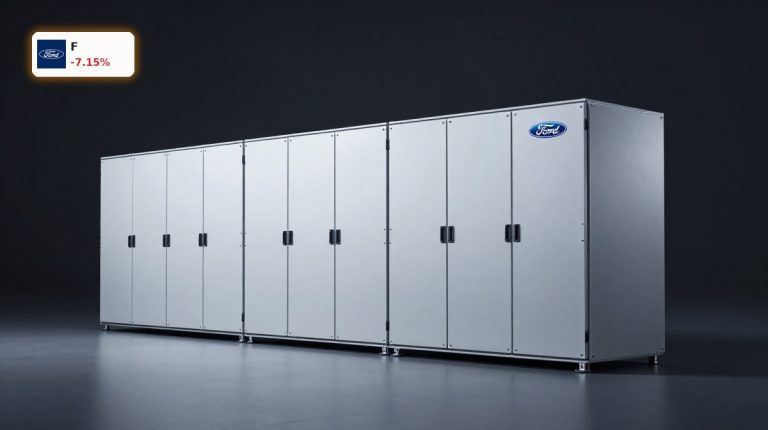
The latest excitement centers on Ford Energy Storage, a division that is only beginning to take shape but now commands serious attention on Wall Street. Morgan Stanley analyst Andrew Percoco reiterated an Equal-weight rating and a $14 price target on Ford, but emphasized that the company’s emerging energy storage ambitions are far more valuable than the market has been pricing in. Percoco suggested the energy business alone could eventually be worth about $10 billion if scaled successfully.
Ford moved into the energy storage arena late last year with a roughly $2 billion investment that arrived alongside a painful, approximately $20 billion write-down in its EV division. Many investors initially focused on the impairment, but Morgan Stanley highlighted that Ford quietly secured a technology licensing deal with Chinese battery giant CATL. The agreement gives Ford rights to produce lithium iron phosphate (LFP) batteries in the United States under a licensing model, rather than relying solely on imports.
Crucially, Morgan Stanley does not expect Ford to deploy this capacity primarily into passenger EVs in direct competition with Tesla. Instead, Percoco argues that Ford Energy Storage will focus on stationary battery systems for utilities, large commercial customers, and hyperscale data center operators. The bank modeled unit economics that include a roughly 25% gross margin at scale, supported in part by a $45 per kilowatt-hour manufacturing tax credit, and estimates that the business could generate $500 million to $600 million in operating profit annually longer term.
How does Ford compare with Tesla and AI plays?
For U.S. investors used to thinking of Tesla as the default EV and energy hybrid, the idea of Ford as an AI infrastructure beneficiary is a notable narrative shift. Morgan Stanley explicitly framed Ford as an AI-adjacent stock, arguing that battery energy storage systems could become a critical bottleneck for power-hungry data centers that support training and inference on GPUs from companies like NVIDIA. In this view, Ford’s CATL-enabled battery capacity could support hyperscalers that are racing to expand AI cloud capacity.
There is a clear precedent: S&P Global Market Intelligence data show that Tesla’s energy unit has achieved profit margins roughly twice as high as its electric vehicle business. If Ford Energy Storage can approach similar economics, it would complement Ford Pro’s commercial software and services, and help offset ongoing losses in Model e. That combination could reshape how Wall Street values Ford, shifting some focus away from cyclical truck demand toward recurring, infrastructure-like revenue streams.
At the same time, Ford is not abandoning its core profit center. Full-size trucks and large SUVs, especially the F-150, continue to generate hefty cash flow, even as inventory remains tighter than usual due to supplier plant fires that disrupted aluminum body supply. To sustain showroom traffic, Ford has rolled out an “American Value for American Values” promotion, extending employee-discount pricing to most customers through the July 4 weekend, while insisting it is maintaining pricing discipline relative to rivals like General Motors and Tesla.
Can Ford fund its pivot with trucks and dividends?
From a portfolio perspective, income-focused investors still see Ford primarily as a cyclical dividend payer. The company declared a $0.15 per-share Q2 2026 dividend payable June 1, while General Motors is paying $0.18 and Tesla continues to reinvest cash into autonomy, energy, and AI compute instead of returning capital. Ford’s ability to keep that dividend intact while investing billions into Ford Energy Storage will be a key metric for conservative shareholders.
Ford’s commercial franchise, especially Ford Pro, is designed to bridge this gap. Higher-margin software, fleet management services, and now potential long-duration battery storage contracts for corporate and cloud customers could smooth earnings volatility over the cycle. Morgan Stanley sees a strong probability that Ford announces one or more sizable energy storage supply agreements with large commercial clients and hyperscalers over the next few months, with an energy-focused facility in Kentucky expected to play a central role in scaling manufacturing.
If that pipeline materializes, the firm believes Ford’s energy business could reach positive EBIT by around 2028, a notable contrast with expectations that the Model e EV unit will still post a $4.25 billion EBIT loss in 2026. In other words, the market may start to value Ford less as a pure-play automaker and more as a diversified industrial and infrastructure platform, with ties to both transportation and digital power demand from AI workloads hosted by giants like Apple and other cloud providers.
Related coverage on Ford’s strategy shift
Investors who want deeper context on how Ford’s truck profits and EV reset are helping finance this energy push should also read this detailed analysis of Ford’s strategy, trucks, EV write-downs, and energy pivot. That piece explains how F-Series cash flow and difficult restructuring decisions in the EV segment created room for management to back a bolder move into energy storage and grid-scale solutions, complementing the emerging Ford Energy Storage story highlighted by Morgan Stanley.
The surge in Ford’s share price shows how quickly sentiment can change when a legacy manufacturer taps into secular themes like AI infrastructure and grid resilience. If management can execute on its CATL-enabled battery plans, secure marquee contracts, and keep its dividend and truck margins intact, Ford Energy Storage could become a meaningful pillar of the investment case. The next few quarters, starting with any announced deals with utilities or hyperscalers, will reveal whether this new narrative has lasting power for U.S. portfolios.