
Can the new Intuitive Surgical AI framework save the stock from its sudden plunge despite stellar quarterly earnings?

How Does the New Intuitive Surgical AI Framework Work?
At the SRS 2026 conference in Hollywood, Florida, the robotic surgery pioneer introduced a five-stage model built on data from over 20 million da Vinci procedures. This proprietary Intuitive Surgical AI structure spans from basic data collection to intraoperative guidance and supervised autonomy. During the event, the company demonstrated a live remote tele-surgery connection between Sunnyvale, California, and Atlanta, Georgia.
CEO Dave Rosa highlighted that AI integration is designed to improve clinical outcomes, lower healthcare costs, and democratize access to high-quality surgical care. Senior Vice President Iman Jeddi emphasized that supervised autonomy is meant to enhance the surgeon’s natural capabilities rather than replace human expertise, proving that specialized medical models can outperform general-purpose artificial intelligence in clinical context understanding.
Can Johnson & Johnson Disrupt the Da Vinci Monopoly?
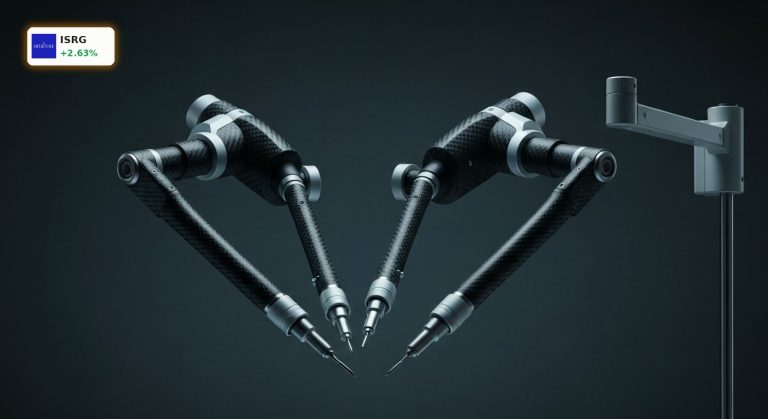
The technological showcase coincided with a major regulatory shift. The FDA recently approved the Ottava Robotic Surgical System developed by healthcare giant Johnson & Johnson. Featuring four arms integrated directly into the operating table, Ottava is cleared for various soft-tissue procedures, including gastric bypasses and cholecystectomies. Despite this new threat, J.P. Morgan analyst Robbie Marcus noted that the da Vinci platform is likely to remain the preferred choice for hospitals due to deeply entrenched relationships between Intuitive Surgical and practicing physicians.
Why Did Strong Earnings Lead to a Stock Drop?
For the second quarter of 2026, Intuitive Surgical reported impressive financial results. Earnings per share reached $2.80, easily beating the consensus estimate of $2.48. Revenue climbed 18.4% year-over-year to $2.89 billion, surpassing the $2.83 billion expected by analysts. However, the market reacted with caution, pushing the stock close to its 52-week low of $328.57. With a 14-day Relative Strength Index (RSI) of 28.9, the stock has entered oversold territory. Institutional activity remains mixed; while Dimensional Fund Advisors and NewEdge Wealth expanded their positions, Sei Investments reduced its holdings. Meanwhile, several company insiders executed minor share sales.
Wall Street analysts maintain a highly constructive outlook. Goldman Sachs maintains a price target of $558, Citigroup rates the stock a buy with a $500 target, and TD Cowen targets $520. Bernstein is the most bullish, issuing an “Outperform” rating with a $685 target, citing strong procedure growth, recurring revenue streams, and the rollout of the da Vinci 5 platform.
Related Coverage
For deeper insights into the company’s financial performance, read about how the Intuitive Surgical Earnings Rise 19% But Spark Shock Sell-Off, analyzing the immediate market reaction and subsequent analyst target adjustments. To understand broader trends in the healthcare and biotech sectors, check out how the Hims & Hers FDA Surge: $2.2B Peptide Market Opens for Telehealth is reshaping digital health portfolios.
Supervised autonomy expands the surgeon’s capabilities, but it does not replace them.— Iman Jeddi
Despite short-term pressure from regulatory approvals of rival systems, the long-term potential of the Intuitive Surgical AI ecosystem provides a solid foundation for future growth. For forward-looking investors, the current market correction may represent an attractive entry point into a dominant medical technology leader. As digital intelligence becomes central to operating rooms worldwide, the company is well-positioned to maintain its market leadership.