
Can Plug Power’s bold hydrogen build-out ever translate into real profitability before investor patience and capital run out?

Is Wall Street losing patience with Plug Power?
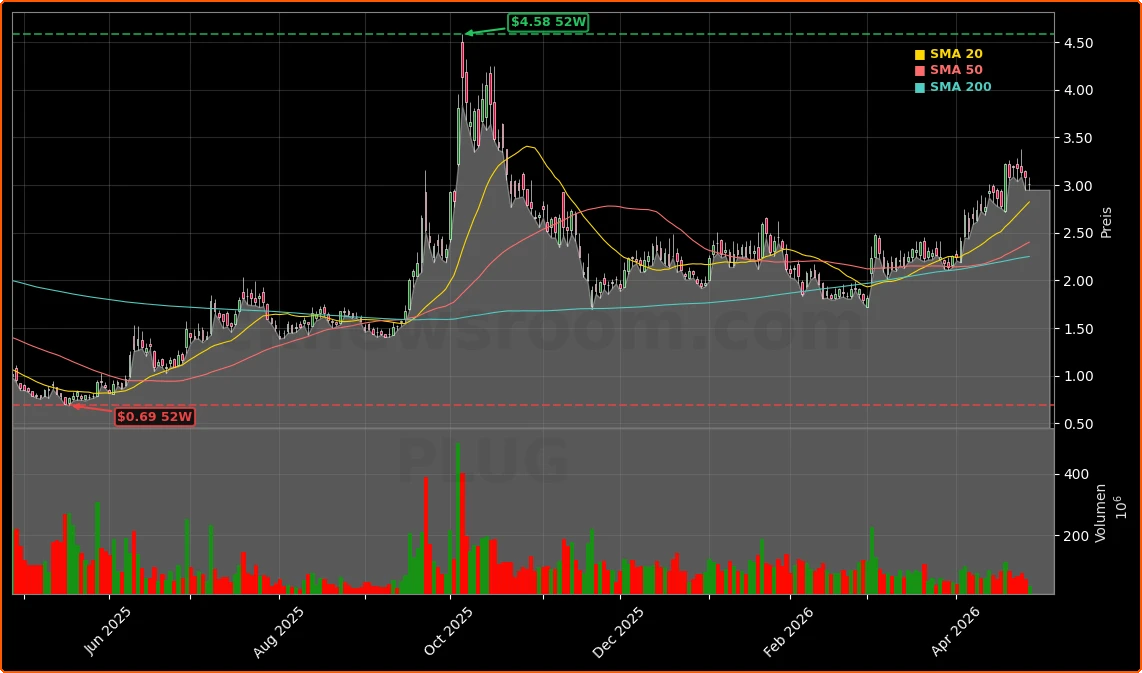
Plug Power Inc. (PLUG) ended today’s session at roughly $3.02, down about 2.11% from the previous close of $3.06, underscoring persistent pressure on one of NASDAQ’s most volatile clean-energy names. The move comes as investors weigh the company’s mounting losses against its promise in hydrogen fuel cells, a sector that has struggled to keep up with the broader S&P 500 and mega-cap winners like NVIDIA and Tesla.
While the stock is a fraction of prior highs, the core debate is no longer about top-line potential. Instead, the focus has shifted decisively to the path to Plug Power Profitability and whether management can finance its build-out without excessive dilution or balance-sheet stress. For U.S. retail and institutional investors, PLUG is increasingly a high-risk, high-uncertainty turnaround rather than a pure growth story.
How bad are Plug Power’s losses?
The financial picture remains challenging. Plug Power generated a little over $700 million in revenue last year, up from $628 million in 2024 but notably below the roughly $891 million figure it posted in 2023. That revenue volatility is problematic for a company that is still scaling its hydrogen production, electrolyzer, and fuel cell businesses and needs operating leverage to kick in.
On the bottom line, the company recorded a net loss of more than $1.6 billion last year, widening from nearly $1.4 billion in 2023. Operating cash flow was deeply negative as well, with about $536 million used in cash from operations. To bridge this gap, Plug Power issued new shares, diluting existing holders and putting pressure on the share price.
This dynamic is at the heart of the Plug Power Profitability problem: the firm must keep investing heavily to stay competitive in hydrogen, but those investments are still far from producing sustainable earnings or positive cash flow. In contrast, fuel-cell peer Bloom Energy has begun to show improving earnings trends, highlighting that profitability in the space is possible but far from guaranteed for every player.
What is the roadmap to Plug Power Profitability?
Management has laid out a multi-stage timeline to improve margins and reach break-even. The company targets positive EBITDA by the fourth quarter of this year, followed by positive operating income by the end of 2027, and full net Plug Power Profitability by 2028. Hitting these milestones would require more consistent revenue growth, higher utilization of hydrogen plants, and tighter cost control across its integrated value chain.
One reason profits remain elusive is the firm’s ambition to build an end-to-end green hydrogen ecosystem across the U.S. and Europe. Plug Power is investing in hydrogen production plants, electrolyzers for on-site hydrogen generation, and fuel cell systems for logistics, mobility, and backup power applications. The strategy gives the company multiple ways to capture value as the hydrogen economy scales, but it is also capital-intensive and execution-heavy.
To shore up its finances, Plug Power has started to streamline its approach. It monetized certain electricity rights in New York and another location — agreements initially secured to support green hydrogen production — to improve its balance sheet and liquidity. The company also entered a partnership with a data center developer to explore using its fuel cells for auxiliary and backup power, aiming to tap a fast-growing market that has already benefited players like NVIDIA on the AI-chip side and power-hungry cloud operators such as Apple.
How do analysts and competitors shape the risk profile?
On Wall Street, opinions remain divided. Some growth-oriented analysts still highlight long-term hydrogen demand, while others emphasize balance-sheet risk and execution challenges. Houses such as Citigroup, Goldman Sachs, and Morgan Stanley have in recent years adjusted ratings and price targets across the clean-energy space as higher interest rates and funding concerns pressured unprofitable names, and Plug Power is squarely in that camp. For many institutions, PLUG now screens more as a speculative small-cap energy technology bet than a core holding.
Competition adds another layer of complexity. Bloom Energy has moved closer to consistent profitability, setting a benchmark that underscores investor expectations for operating discipline. At the same time, hydrogen is competing with alternatives such as advanced batteries, expanded grid capacity, and even nuclear options in some markets. For now, the market appears more comfortable rewarding profitable or near-profitable innovators rather than backing open-ended cash-burn stories, which keeps Plug Power Profitability under intense scrutiny.
Related Coverage
Investors looking for a deeper dive into the recent trading dynamics around PLUG can read “Plug Power Turnaround -9.1%: Rally Setup or Crash Warning for PLUG?”, which examines whether the latest swings signal a sustainable recovery or just another head fake in this volatile hydrogen stock. That analysis complements the current focus on Plug Power Profitability by zooming in on technical signals, sentiment shifts, and risk-reward considerations for short- and medium-term traders.
Ultimately, Plug Power Profitability is still a target rather than a reality, with large losses and substantial cash burn defining today’s fundamentals. For U.S. investors, the stock may only fit in high-risk slices of a diversified portfolio until the company proves it can execute on its 2027–2028 profit roadmap. The next few years of project ramp-ups, cost controls, and capital-raising decisions will determine whether Plug Power can evolve from a speculative hydrogen story into a durable clean-energy business.