
Can PVH Earnings stabilize investor confidence after a brutal outlook cut, or is the EMEA slowdown only getting worse?

What Did PVH Earnings Reveal?
PVH Corp reported Q1 2026 revenue of $2.0 billion — up 2% reported, but down 2% in constant currency — aligning with internal expectations. Non-GAAP EPS exceeded guidance, and operating margin hit 6.5%, the top end of the company’s forecast range. Direct-to-consumer (DTC) revenue rose 3% in constant currency, powered by 11% reported e-commerce growth and strong performance from the Jungkook x Calvin Klein capsule, which achieved 99% sell-through on Tmall and sold out at a Los Angeles pop-up. Yet the gains were overshadowed by wholesale weakness: flat reported, down 6% in constant currency across all regions. Interim CFO Melissa Stone attributed the wholesale drag to cautious partner positioning and timing effects — a red flag for near-term inventory health.
Why Did PVH Corp Cut Its Outlook?
The full-year revenue revision stems almost entirely from EMEA — where PVH Earnings exposed deepening strain. Revenue in the region rose 2% reported but fell 5% in constant currency, with both DTC and wholesale down mid-single digits. CEO Stefan Larsson cited three converging pressures: reduced wholesale demand in the direct Middle East business, weaker tourism-driven demand in Turkey, and broader EMEA consumer softness — including higher fuel costs, lower foot traffic, and inflationary fatigue. Notably, Larsson stated roughly half the outlook reduction ties directly to Middle East conflict spillover, while the other half reflects broad-based European consumer caution. Though May DTC trends improved from April — aided by calendar timing — the damage to wholesale momentum remains structural.
How Does PVH Compare to Apparel Peers?
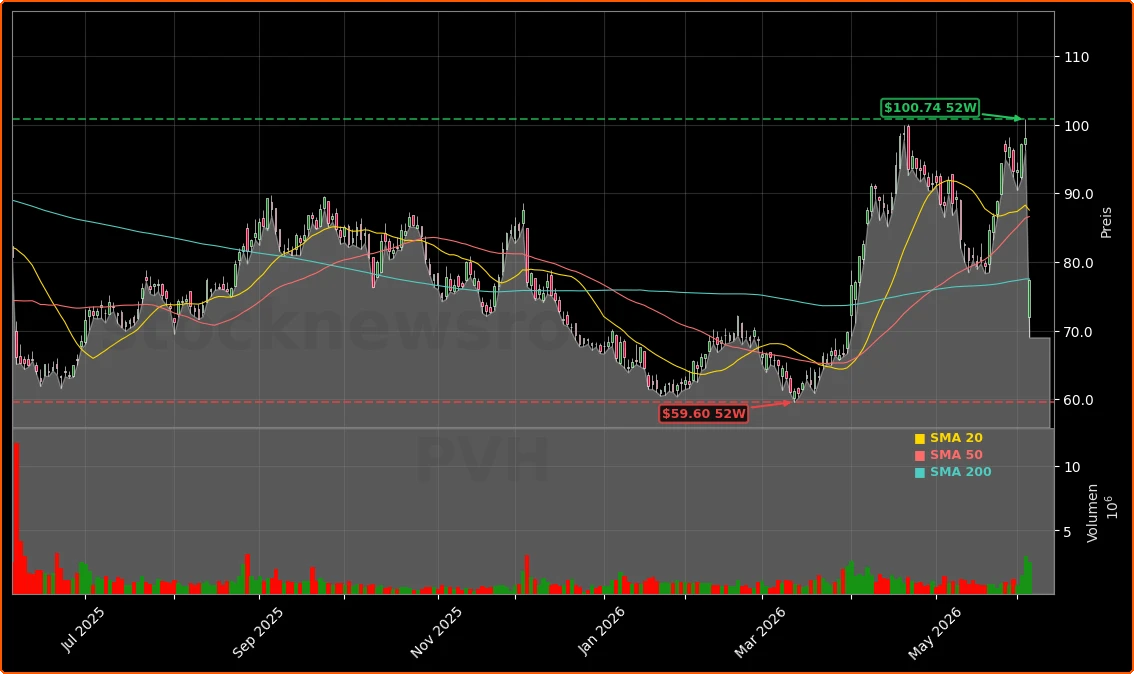
Unlike Nike, which posted modest EMEA growth in its latest quarter, or LVMH, whose luxury segment showed pricing power resilience, PVH Corp’s exposure to mid-tier premium apparel leaves it more vulnerable to discretionary pullback. That contrast is reflected in Wall Street sentiment: Citigroup downgraded PVH Corp to ‘Neutral’ with a $68 price target, citing “unresolved EMEA margin pressure and wholesale dependency.” RBC Capital Markets maintained its ‘Underperform’ rating, warning that “EMEA headwinds could persist into Q3 and pressure full-year EPS by up to $0.25.” Meanwhile, Morgan Stanley highlighted PVH’s strong digital execution — particularly Calvin Klein’s 6% DTC denim growth — but cautioned that “brand momentum alone can’t offset macro-driven wholesale erosion in Europe.”
What’s Next for PVH Earnings and Strategy?
For the first quarter, we achieved our guidance across all key metrics and delivered EPS above our guidance.— Stefan Larsson, CEO of PVH Corp
Despite the cut, PVH Corp reaffirmed its PVH+ Plan priorities: growing Calvin Klein’s status shopper and Tommy Hilfiger’s style enthusiast segments, expanding e-commerce globally, and leveraging high-impact partnerships. The upcoming Travis Kelce fall 2026 campaign — announced with over 300 million social impressions — signals continued investment in cultural relevance. The company expects full-year EMEA e-commerce growth, even as store traffic remains depressed. With $100 million in tariff-free funds secured this year, PVH Corp is prioritizing inventory discipline and regional agility over aggressive expansion. Still, analysts warn that sustained EMEA weakness could trigger further guidance revisions — especially if Middle East tensions escalate or European recession risks intensify. For investors, the near-term focus remains on Q2 wholesale order books and whether May’s DTC rebound proves durable.