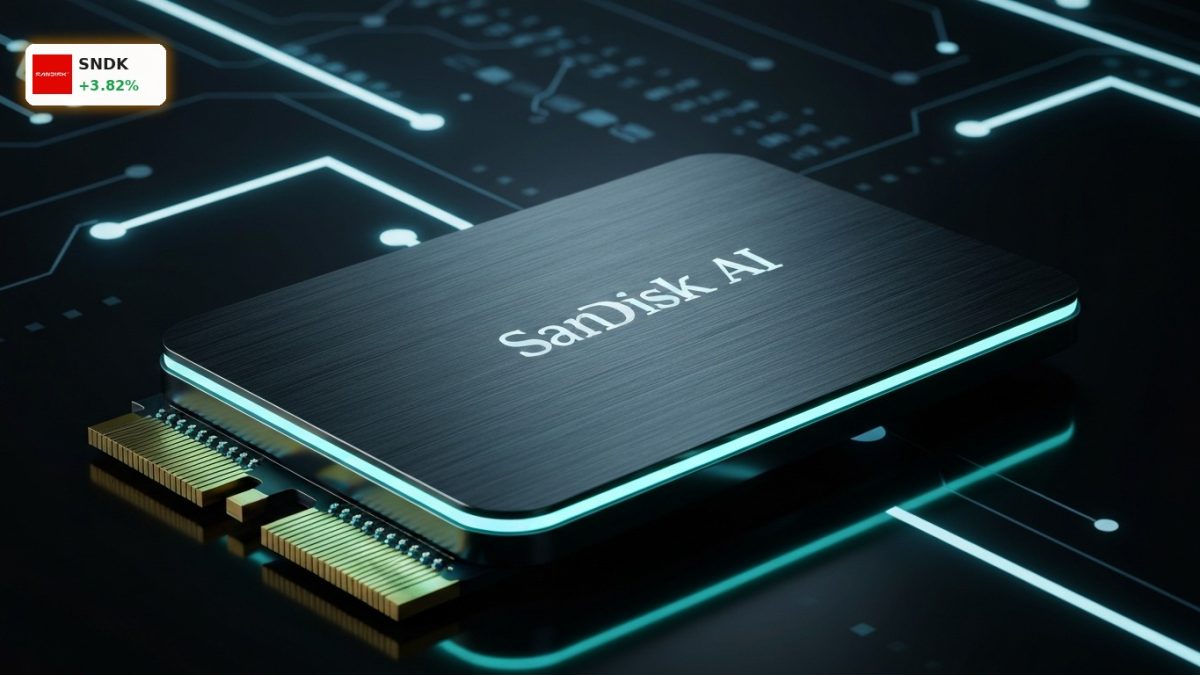

Will SanDisk AI hardware solutions enable the chipmaker to defy the massive semiconductor sell-off and reach new record highs?

Why is SanDisk Corporation facing short-term pressure?
In Friday’s trading session, shares of SanDisk Corporation (SNDK) rose by 3.82% to close at $1,464.99, recovering some ground after a sharp double-digit decline on Thursday. The broader semiconductor sector has shed roughly $1.5 trillion in market value since late June, driven by a toxic cocktail of profit-taking and geopolitical concerns. This sector-wide correction was further intensified by Taiwan Semiconductor Manufacturing Co.’s recent earnings report, which, despite solid numbers, sparked capital expenditure concerns across the industry.
Additionally, investors are closely monitoring rising competition after China’s ChangXin Memory Technologies filed for a massive $10 billion initial public offering in Shanghai. This has led to institutional profit-taking, causing short-term momentum indicators like the MACD to weaken. Currently, the stock trades about 25.8% below its 20-day simple moving average, though it remains in a healthy long-term uptrend, trading well above its 200-day simple moving average.
How does the SanDisk AI partnership with Meta drive growth?
Despite the market noise, the fundamental demand for high-performance memory chips is stronger than ever. A key driver for the company is its integration into the Meta Platforms ecosystem. The social media giant is building an in-house chip to double its compute capacity by next year, requiring massive amounts of flash storage. Meta has reportedly entered into a long-term supply agreement with SanDisk to secure the critical NAND flash memory needed for this multi-gigawatt data center expansion.
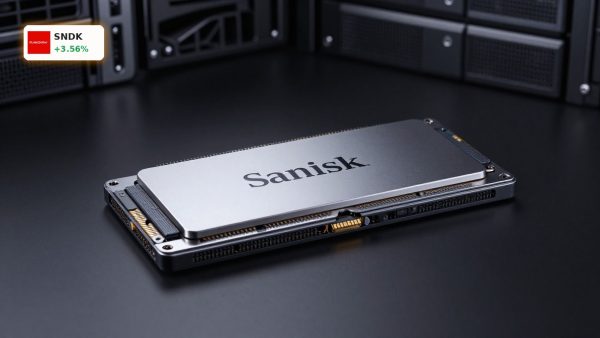
This deal highlights how indispensable the SanDisk AI hardware solutions are for major tech companies. Because high-speed storage is a fundamental pillar of large language model training, demand is shifting from cyclical to highly secular. The company previously disclosed five multi-year supply agreements that are set to generate at least $42 billion in revenue, providing incredible visibility into the company’s financial future through the end of the decade.
What do Wall Street analysts expect from the upcoming earnings?
All eyes are now on the upcoming quarterly earnings report scheduled for August 5, 2026. Wall Street consensus estimates point to quarterly earnings of $33.38 per share on revenue of $8.24 billion, a massive leap from the 29 cents per share and $1.90 billion in revenue reported in the prior-year period. This exponential growth underscores the massive operating leverage inherent in the business as average selling prices and shipment volumes rise in tandem.
Major financial institutions remain overwhelmingly bullish on the stock’s long-term trajectory. Citigroup recently raised its price target to $2,500, while Bernstein increased its target to $3,000. Bank of America also lifted its target to $2,500, citing expectations for tight NAND supply and demand conditions persisting through 2027. Even in a worst-case market crash scenario, a consensus of 20 analysts compiled by StockAnalysis suggests a floor of $1,000, representing a limited downside compared to the massive upside potential.
Related Coverage
Memory supplies are now far short of demand, and prices have soared. The demand has reached unprecedented heights, making SanDisk’s revenues experience a massive surge.— StockAnalysis Research
To better understand the current market dynamics, read about the upcoming SanDisk Earnings: Stock Plunges 13% as Wall Street Eyes $3,000 Target, which analyzes whether the recent double-digit plunge is a warning sign or a buying opportunity. Additionally, explore how competitors are navigating the current tech correction in the article on Micron Customer Agreements: Stock Soars +3.7% Amid New Deals, which details how new supply contracts are shielding semiconductor giants from broader market volatility.