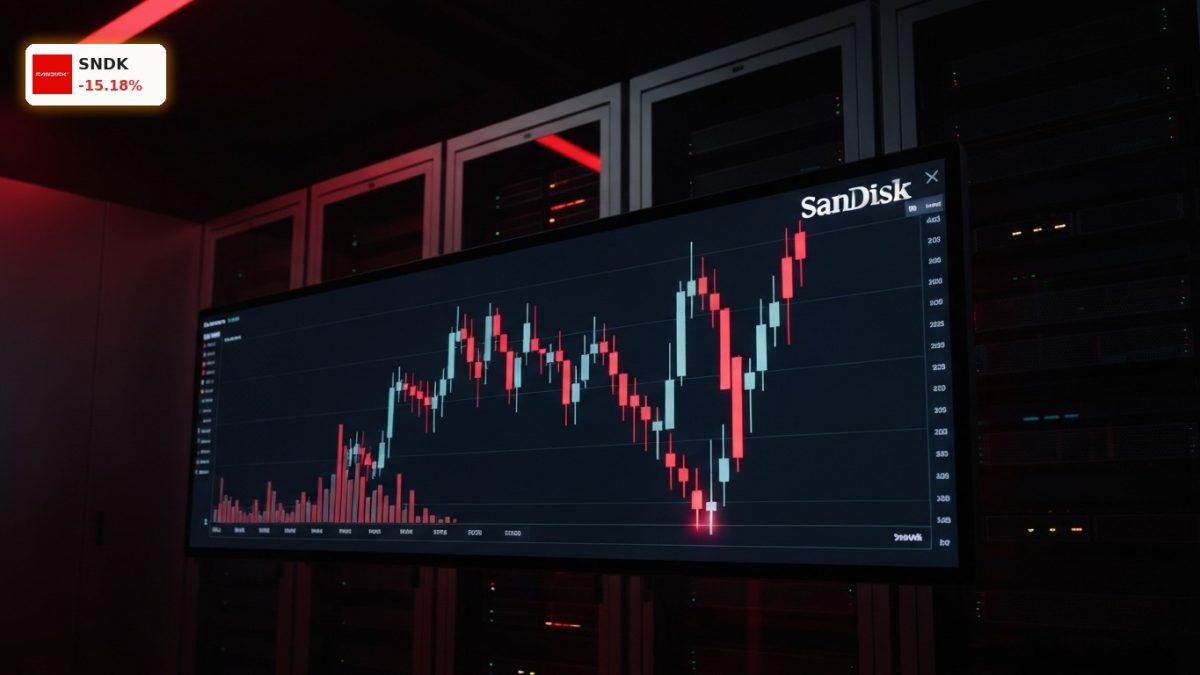

Can SanDisk recover from this brutal sell-off, or will rising Chinese competition permanently crush the memory giant’s margins?

What Triggered the SanDisk Plunge?
The current SanDisk Plunge is part of a broader, violent washout across the global semiconductor industry. Memory and storage names are taking a severe beating, driven by overnight losses in Asia where SK Hynix and Samsung cratered between 13% and 15%. This weakness quickly crossed the Pacific, dragging down US rivals. Micron Technology (MU) and Western Digital also faced heavy selling pressure during the morning hours.
Historically, the memory market has been highly cyclical, defined by extreme boom-and-bust phases. While the artificial intelligence boom recently triggered a massive demand spike for enterprise solid-state drives (SSDs) and high-bandwidth memory, investors are beginning to fear that the peak of this cycle has already passed. This anxiety has prompted a rapid rotation out of highly valued hardware makers.
How Does China Threaten SanDisk?
A major catalyst behind the SanDisk Plunge is the rising threat of Chinese competition in the memory space. Chinese chipmaker CXMT (ChangXin Memory Technologies) recently launched a massive IPO in Shanghai, achieving a staggering $487 billion market capitalization and raising over $8 billion in fresh capital. CXMT plans to aggressively use these funds to build new factories and expand production.
This massive supply injection threatens to end the global memory deficit that has kept profit margins exceptionally high for Western manufacturers. Apple has already expressed interest in sourcing memory chips from CXMT, signaling that global tech giants are open to Chinese alternatives. Although CXMT currently focuses on DRAM, the risk of them expanding into NAND flash memory is a direct threat to the lucrative 78% gross margins that SanDisk enjoyed in the previous quarter.
Will AI Spending Concerns Persist?
Beyond Chinese rivalry, Wall Street is growing increasingly skeptical about the massive capital expenditures poured into artificial intelligence, which has accelerated the SanDisk Plunge as risk-off sentiment takes hold. Wolfe Research recently warned that investors are questioning whether hyperscalers can sustain their current pace of AI infrastructure spending. If tech giants cut back on hardware budgets, memory demand will drop significantly. Furthermore, concerns regarding NVIDIA financing its own ecosystem have added to the market’s nervousness.
Despite the immediate panic, several major investment banks remain optimistic about the long-term prospects. For instance, Susquehanna recently adjusted its price target to $3,050 while maintaining a positive rating. Wells Fargo raised its target to $1,620 with an equal weight rating, and Bank of America reiterated its buy rating with a $2,500 target. Wall Street still expects SanDisk to report quarterly earnings of $33.38 per share on August 5th, representing a massive leap from the $0.29 reported in the prior year period.
Related Coverage
For more insights into how these market dynamics are unfolding, read our analysis on the SanDisk Earnings Under Threat to see how upcoming quarterly results could impact the stock’s recovery. Additionally, you can explore how a recent TSMC Earthquake Triggers -3.9% Plunge has created further volatility across global semiconductor supply chains, impacting major tech players worldwide.
The dramatic SanDisk Plunge highlights the deep cyclicality and geopolitical risks inherent in the semiconductor industry today. While the threat of Chinese competition and AI spending fatigue have shaken investor confidence, the underlying demand for advanced memory storage remains a structural driver for the digital economy. Long-term investors will likely view this sharp correction as a potential buying opportunity once the market stabilizes. The upcoming quarterly earnings release will provide the ultimate test of whether the company’s fundamentals can outshine the current macroeconomic headwinds.