Are ServiceNow Earnings signaling a temporary sentiment reset or the start of a deeper rerating for one of Wall Street’s AI darlings?

How are ServiceNow Earnings reshaping sentiment?
ServiceNow, Inc. (NOW) remains one of the largest cloud software platforms on Wall Street, with a market capitalization still above $90 billion and annual revenue north of $8 billion. The company’s most recent ServiceNow Earnings update for Q1 2026 showed that the underlying business is still growing at a pace that many software peers would envy, even as the share price has been hit by concerns about AI disruption, rising rates, and geopolitical uncertainty.
In that quarter, subscription revenue reached about $3.671 billion, up roughly 22% year over year, while total revenue came in at around $3.770 billion, reflecting similar growth. Non‑GAAP earnings per share landed near $0.97, with management flagging roughly a 75‑basis‑point drag on subscription revenue growth from delayed large deals in the Middle East. Despite those regional delays, demand indicators stayed strong, with current remaining performance obligations (cRPO) rising about 22.5% to $12.64 billion and total RPO climbing 25% to $27.7 billion.
For U.S. investors, those numbers suggest that the ServiceNow Earnings reset is less about a broken business model and more about valuation compression and macro cross‑currents affecting the broader software complex.
What do the new outlook and AI strategy signal?
Crucially for the bull case, management did not respond to volatility with caution; instead, it raised its full‑year outlook. For 2026 as a whole, ServiceNow now expects total revenue between roughly $15.735 billion and $15.775 billion, alongside an operating margin target of about 31.5% and a free cash flow margin near 35%. For Q2 2026, the company guided subscription revenue to a range of $3.815 billion to $3.820 billion and aims to retain about 26.5 cents of operating profit for each dollar of revenue.
This more confident stance is underpinned by ServiceNow’s intensifying focus on AI‑powered workflow automation. The platform already uses natural language processing, machine learning, and virtual agents to handle routine IT and business tasks, freeing human workers for more complex work. Adoption of its AI suite, including Now Assist, has accelerated: customers with annual contract values above $1 million tied to these products grew more than 130% year over year. That AI traction is particularly relevant at a time when investors are scrutinizing whether software vendors can remain relevant in an era dominated by hyperscalers and chip leaders like NVIDIA.
From an S&P 500 and NASDAQ perspective, ServiceNow remains a key way to gain exposure to enterprise automation and AI without owning pure-play chip or consumer internet names.
How are analysts reacting to ServiceNow, Inc.?
On Wall Street, analysts have largely framed the latest ServiceNow Earnings as a confirmation of the company’s strategic positioning rather than a reason to abandon the stock. Barclays analyst Raimo Lenschow recently reinstated coverage of ServiceNow with an “Overweight” rating and a $132 price target. His take on the Q1 2026 print was that while the macro environment clearly weighed on sentiment and delayed some larger deals, the fundamental story of deep integration into customer IT stacks and rising AI adoption remains intact.
Long‑only managers echo that view. Polen Capital’s Focus Growth Strategy, for example, highlighted ServiceNow as one of its highest‑conviction software holdings after a volatile first quarter for U.S. equities. The portfolio commentary emphasized that ServiceNow is tightly woven into customer workflows, processes critical data, and offers proprietary AI tools that clients are likely to use rather than attempting to build or source unproven alternatives. That level of integration gives the company what many institutional investors regard as a durable economic moat.
Internally, confidence seems high as well. Management has argued that CEO Bill McDermott is among the most effective leaders in enterprise software and that the company should emerge as a winner in the AI wave, despite notable short interest that has added pressure to the share price.
How does ServiceNow compare with other AI beneficiaries?
Compared with mega‑cap technology names like Apple or AI‑centric infrastructure providers such as NVIDIA, ServiceNow offers a more targeted play on workflow automation and IT service management rather than hardware or consumer devices. Its customer base spans large enterprises that rely on ServiceNow’s platform for mission‑critical processes, making it difficult and risky to rip and replace. That dynamic is similar to the lock‑in enjoyed by other software‑as‑a‑service leaders and differentiates it from more discretionary tech spending.
Investors also increasingly view ServiceNow alongside high‑growth e‑commerce platform providers and data‑centric companies. Polen Capital, for instance, grouped ServiceNow with Shopify and CoStar Group as businesses where AI disruption fears are likely overdone. All three, in its view, should be among the fastest earnings growers in its portfolio over the next five years, thanks to entrenched customer relationships and proprietary AI offerings. That puts ServiceNow in the conversation with other high‑growth tech names followed closely on Wall Street, such as Tesla, even if the end markets differ.
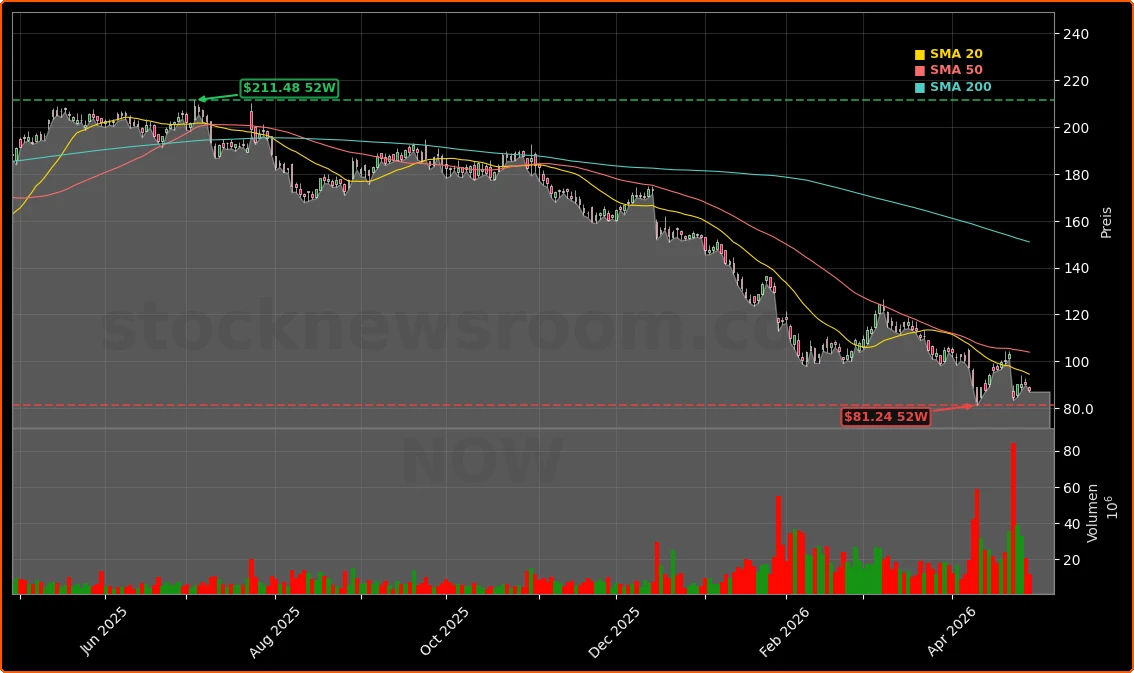
At the same time, recent performance has been challenging. As of late April 2026, ServiceNow shares were down roughly 13% over one month and more than 50% over the past 12 months, a reminder that even high‑quality growth stories can face painful drawdowns when interest rates, geopolitical risk, and AI narratives collide.
Related Coverage
Investors looking to understand the shorter‑term volatility surrounding ServiceNow Earnings can dive deeper into the immediate market reaction in ServiceNow Earnings: -12.7% After-Hours Shock on Margin Cut. That analysis explores whether the recent margin reset marks a structural change in the company’s profitability profile or a temporary reaction to elevated investment and macro uncertainty.
We believe ServiceNow is deeply embedded in customers’ workflows, and generative AI should be a tailwind rather than a threat to its economic moat.— Polen Capital Focus Growth Strategy
Overall, the latest ServiceNow Earnings highlight a company that is still delivering strong double‑digit subscription growth, expanding its AI footprint, and raising guidance even as the share price remains under pressure. For long‑term U.S. investors, the combination of durable RPO growth, improving profitability targets, and strategic AI positioning keeps the stock firmly on the radar. The next quarters will show whether management can turn today’s volatility into an opportunity and convert heightened AI demand into sustained earnings power.