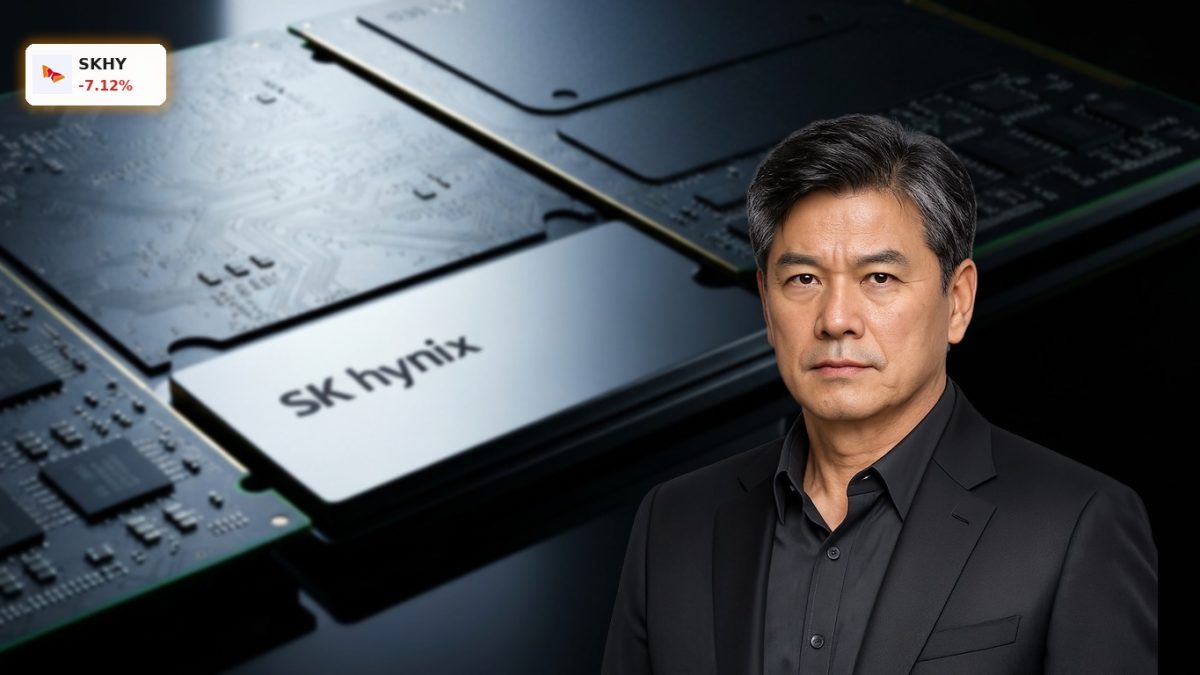
Will the massive $750 billion Nvidia partnership be enough to save SK Hynix from aggressive new Chinese competition?

Why Are SK Hynix Earnings So Crucial Now?
The global tech industry is facing a severe memory shortage that is projected to intensify through 2027. This supply crunch makes the upcoming **SK Hynix Earnings** report highly anticipated, as analysts expect a potential seven-fold increase in quarterly profit. Memory prices for dynamic random-access memory (DRAM) and NAND flash have surged, with average prices climbing 30% compared to last year. SK Hynix currently controls approximately 29% of the global DRAM market and 18% of the NAND flash market, positioning it perfectly to capitalize on these rising prices.
Financially, the company remains highly attractive to value-seeking investors. SK Hynix is currently trading at less than 8 times forward earnings. Consensus estimates suggest that the company’s earnings per share could reach $24.65 in 2026, before climbing another 64% to $40.47 in 2027. If the company maintains its growth trajectory and trades in line with the broader tech sector multiples, some aggressive Wall Street forecasts suggest the stock could eventually target the $1,000 mark over the next 18 months. This makes the forward-looking guidance in the next **SK Hynix Earnings** call essential for validating these long-term projections.
Can SK Hynix Defend Its Market Share?
For years, the high-bandwidth memory market has been dominated by an exclusive “Big Three” club consisting of Micron, SK Hynix, and Samsung Electronics. However, this tight oligopoly is facing a new challenger from China. ChangXin Memory Technologies (CXMT) recently made a spectacular market debut, with its valuation soaring to approximately $487.3 billion.
While CXMT still lags behind the industry leaders technologically, the ongoing global chip shortage could allow the Chinese newcomer to quickly capture market share. If established players like SK Hynix cannot produce enough chips to satisfy demand, hardware developers may have no choice but to turn to alternative suppliers. Nevertheless, closing the technological gap in advanced HBM production will take time, giving the established leaders a temporary shield.
Will Nvidia Partnerships Drive the Stock?
To maintain its dominant position, SK Hynix is securing massive long-term agreements with key players in the AI ecosystem. The company recently secured a series of deals valued at $750 billion, which prominently includes supplying next-generation HBM4 and HBM5 chips to hyperscaler NVIDIA through 2030. These long-term supply agreements provide highly predictable revenue streams and shield the company from short-term market fluctuations.
Furthermore, massive capital expenditure budgets from tech giants like Microsoft, Meta, and Apple ensure that demand for AI infrastructure will remain robust for years to come. While macroeconomic concerns and sector rotations can trigger temporary pullbacks—such as the recent drop below $150—the long-term structural demand for memory hardware remains intact.
Related Coverage
For those tracking the ongoing supply challenges in the semiconductor sector, the SK Hynix Shortage: Stock Surges +1.8% as Memory Crunch Looms article provides a deep dive into how the looming memory crunch could impact global supply chains. Additionally, investors looking at broader AI software trends should read the ServiceNow Earnings Surge +7% as AI Business Model Shifts piece, which highlights how enterprise software companies are successfully monetizing their new AI-driven platforms.