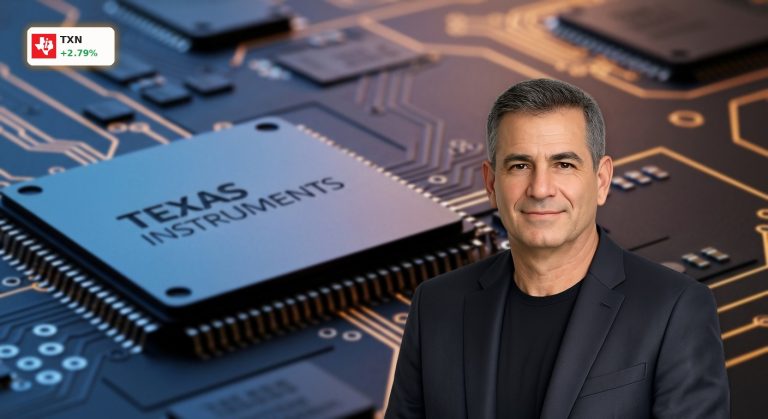

Why did Texas Instruments stock plunge over three percent despite delivering a massive double-beat and raising its forward guidance?

Why Did Texas Instruments Beat Wall Street Expectations?
The Dallas-based semiconductor giant showed robust growth across its core businesses. Texas Instruments reported second-quarter revenue of $5.46 billion, marking a 23% increase year-over-year and comfortably beating the Wall Street consensus estimate of $5.24 billion. Earnings per share (EPS) came in at $2.14, easily surpassing the $1.93 expected by analysts. This impressive performance, highlighted in the latest Texas Instruments Earnings release, was fueled by a broad-based recovery in cyclical markets.
Analog revenue jumped 26% year-over-year, while Embedded Processing grew by 16%. Crucially, the company’s data center segment, which supplies power-management chips for modern server architectures, doubled its revenue compared to the previous year. Free cash flow was another major highlight, coming in at $2.74 billion against the $1.82 billion estimate, supported by capital expenditures of $514 million, which fell 61% year-over-year. Additionally, the company announced a smooth leadership transition, with Julie Knecht set to succeed retiring Chief Financial Officer Rafael Lizardi.
How Do the Texas Instruments Earnings Impact the Broader Chip Sector?
Historically viewed as a bellwether for the global semiconductor market, the latest Texas Instruments Earnings provide vital clues for the entire industry. The results prove that demand for analog and embedded chips is recovering rapidly after bottoming out in late 2024. This cyclical upswing is lifting sectors ranging from automotive to industrial automation, which grew 30% year-over-year for the firm.
However, the negative stock reaction highlights a broader risk for tech investors. Because Texas Instruments had already surged roughly 70% year-to-date prior to the announcement, the market had already priced in a flawless quarter. According to capital market strategist Juergen Molnar of Robomarkets, high expectations often lead to short-term profit-taking even when results are stellar. This cautious sentiment is spreading internationally, weighing on European chipmakers like STMicroelectronics and Infineon, which also saw their shares decline on Thursday morning.
What Is the Outlook for Texas Instruments?
Looking forward, management remains highly optimistic about the structural demand driven by artificial intelligence and industrial modernization. Chief Executive Officer Haviv Ilan emphasized that AI data center demand is expected to remain strong for the foreseeable future, as high-power server architectures require increasingly sophisticated power-management and analog components.
For the third quarter of 2026, the company issued strong guidance. Texas Instruments expects revenue to land between $5.65 billion and $6.15 billion, with the midpoint comfortably exceeding the average analyst estimate of $5.61 billion. Third-quarter EPS is projected to be between $2.23 and $2.57, well ahead of the $2.15 consensus. To support this growth, the company continues to implement strategic price increases while expanding its advanced 300-millimeter manufacturing capacity.
Related Coverage
For more insights into the semiconductor sector, read our preview of the Texas Instruments Earnings: Stock Soars +2.8% on AI Demand to see how the analog giant positioned itself ahead of this release. Additionally, you can explore how other key players are performing in our analysis of Marvell Technology Analysts Bullish as Stock Surges 3.1% on AI Demand to compare market dynamics.
In conclusion, the positive takeaway from the Texas Instruments Earnings is that the fundamental recovery of the semiconductor industry is firmly on track. While short-term traders are locking in profits after a historic 70% rally, long-term investors should focus on the company’s expanding margins, robust cash generation, and critical role in the AI infrastructure boom. The next quarterly reports from peer technology giants will show whether this healthy consolidation phase across Wall Street is temporary or a broader market shift.