Will the next Alphabet earnings prove its massive AI and Gemini spending is visionary growth capital or an overbuild waiting to be punished?

How is Alphabet positioned going into earnings?
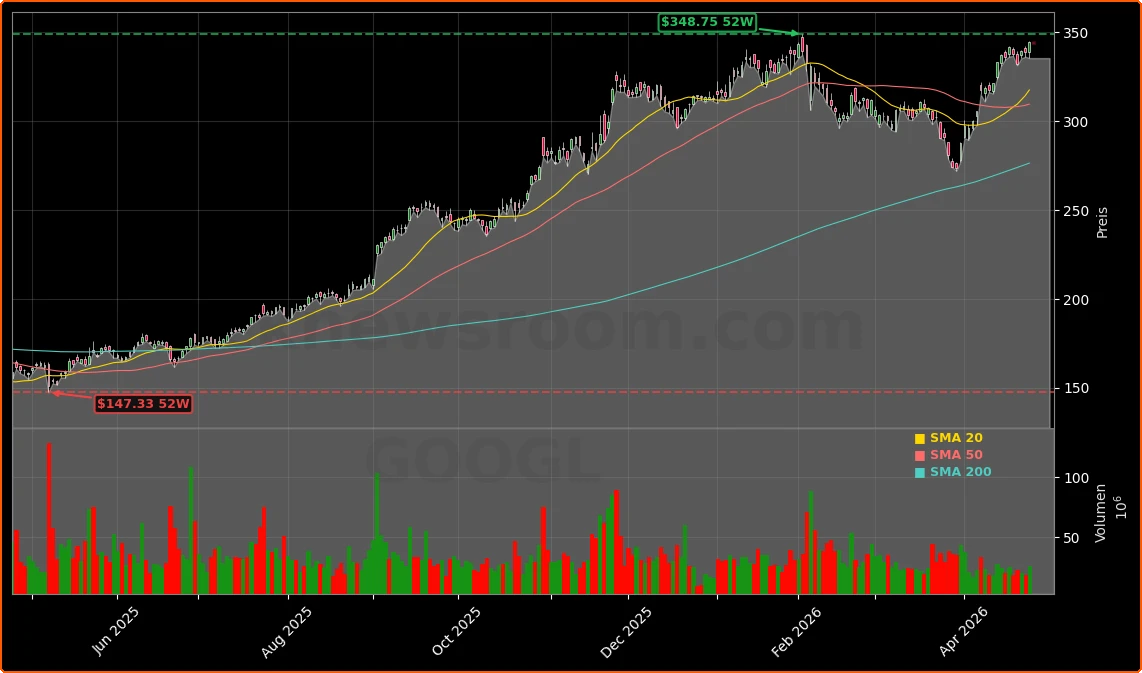
Alphabet Inc. (Google) enters the next Alphabet earnings release as one of the key pillars of the so‑called Magnificent Seven, a group that has powered much of the S&P 500 and NASDAQ rally since late March. The shares trade around $344, leaving the company roughly 10%–30% below recent peaks, a range where large-cap tech has often attracted both dip buyers and profit-takers. For U.S. investors, the setup is binary: either the company proves that its AI spending is driving real revenue and margin leverage, or concerns about overbuild and regulation resurface.
Recent quarterly results have shown that Alphabet is no longer just a search and ads story. Google Cloud revenue climbed 48% year over year in the most recent quarter to $17.7 billion, outpacing growth at Amazon Web Services and keeping pace with Microsoft Azure. That strength matters because AI services are largely reported through Google Cloud, making it the clearest window into how the multibillion-dollar Gemini and data-center build-out is monetizing.
Institutional ownership remains strong despite some position trimming. U.S. Capital Wealth Advisors, for example, still holds more than $30 million of Alphabet stock even after a small reduction, and several wealth managers list the company among their top five positions. Analysts tracked by MarketBeat maintain a “Moderate Buy” consensus and a roughly mid‑$300s average price target, suggesting expectations are optimistic but not euphoric.
Will AI and Gemini drive the next leg of growth?
The core debate around the upcoming Alphabet earnings call is whether AI products can become a second major profit engine alongside Search. Gemini, Google’s answer to OpenAI’s ChatGPT and Anthropic’s Claude, has already reported more than 750 million monthly active users across consumer and enterprise channels. That scale is poised to grow meaningfully when Apple rolls out a new Siri later this year that is expected to use Gemini under the hood, a partnership that could bring Alphabet around $1 billion in annual revenue and embed its models in billions of devices worldwide.
Alphabet is simultaneously a competitor and a key backer in the broader AI ecosystem. The company recently committed up to $40 billion to Anthropic, with $10 billion funded now and another $30 billion tied to performance milestones, at a $350 billion valuation. The deal includes access to 5 gigawatts of Tensor Processing Unit (TPU) capacity, starting in 2027, in partnership with Broadcom. That infrastructure commitment signals how aggressively Alphabet is moving to secure compute resources that will underpin future Gemini upgrades and enterprise AI services.
At the same time, Alphabet is locking in strategic cloud wins, from PepsiCo using Google Cloud for AI-driven supply chain optimization to Calix shifting its AI-native platform to Google to reduce conflicts with Amazon Web Services. These deals highlight how Alphabet is positioning Google Cloud as a neutral or preferred partner in industries where rivals like Amazon may be seen as both vendor and competitor.
Can Google Cloud sustain its momentum?
Investors will scrutinize Google Cloud metrics when the next Alphabet earnings numbers hit the tape. Street models currently expect Google Cloud revenue growth in the high 40% to around 50% range, faster than Azure’s recent 38% growth and well ahead of the mid‑20s growth expected at Amazon Web Services. Any sign of deceleration could reawaken fears that AI cloud demand is front-loaded rather than durable.
Management has guided for capital expenditures of $175 billion to $185 billion this year, with AI data centers, custom chips and networking consuming the lion’s share. UBS has argued that recent Cloud Next announcements, including new custom silicon and expanded AI tooling, should help ease investor worries about whether that capex will earn acceptable returns. The market reaction to Microsoft’s last results — where robust Azure growth still triggered a 10% share price drop on capex concerns — shows how thin the margin for error is for mega-cap AI spenders like Alphabet, Microsoft and NVIDIA.
Beyond cloud, the Street is looking for continued resilience in Search and an acceleration in YouTube advertising. FactSet consensus has YouTube ad growth reaccelerating toward roughly 12% from the high‑single‑digit pace last quarter, helped by improved brand spending and new AI-driven ad formats. Any commentary on how chatbots and generative search responses are affecting traditional query behavior will be read closely for long-term implications to Alphabet’s core cash cow.
How does Alphabet stack up against rivals?
On valuation, Alphabet trades at a trailing price-to-earnings ratio just above 30, cheaper than many high-growth cloud and AI peers and below where Tesla and some other Magnificent Seven names have recently traded. That relative discount, combined with double-digit top-line growth and strong free cash flow, is why many fund managers still view Alphabet as a core long-term holding despite regulatory and competitive risks.
However, the Magnificent Seven have also become the first stocks sold when volatility spikes. Some strategists recommend rebalancing toward broader indices like the S&P 500 or NASDAQ 100 (QQQ) to reduce concentration risk, especially as combined AI capex at Microsoft, Alphabet, Amazon and Meta is projected to jump from $411 billion in 2025 to roughly $649 billion in 2026. For U.S. investors, the next Alphabet earnings print will be a key data point in deciding whether this spending boom remains a tailwind or turns into an overhang.
Related Coverage: For a deeper dive into the capex story behind the upcoming Alphabet earnings, including detailed scenarios on whether $185 billion in annual AI spending can translate into durable returns, see Alphabet AI Investments Record: Inside the $185B Capex Boom. That analysis explores how Google’s data center expansion, custom chips and cloud partnerships could shape cash flow and competitive positioning into the next decade.
In summary, the next Alphabet earnings report will test whether Google Cloud, Gemini and massive AI infrastructure investments can keep driving faster growth than the broader tech sector. For investors, the combination of strong fundamentals and a still-reasonable multiple makes the stock a pivotal gauge of Wall Street’s confidence in the AI cycle. The coming quarters of Alphabet earnings will show whether this spending spree cements long-term dominance or forces another round of portfolio reshuffling across the NASDAQ’s biggest names.