Can Amazon Quantum Computing turn AWS into the next must-own infrastructure story before practical quantum machines even arrive?

What does Amazon Quantum Computing mean for Wall Street?
Amazon’s quantum roadmap isn’t a standalone project — it’s the next layer in AWS’s $200 billion AI infrastructure push. With AWS revenue up 28% in Q1 2026 and cloud margins expanding, Amazon is doubling down on foundational tech that could lock in enterprise customers for decades. Unlike near-term AI chip plays, Amazon Quantum Computing targets high-value, computationally intractable problems: quantum chemistry simulations, advanced materials discovery, and cryptographic optimization — domains where classical HPC clusters hit hard limits. That makes it especially relevant for pharmaceutical, defense, and financial services clients already deep in AWS’s ecosystem. Citigroup recently reaffirmed its ‘Buy’ rating on Amazon with a $370 price target, citing AWS’s ‘structural moat’ and ‘first-mover advantage in quantum-accessible cloud stacks.’
How does Amazon compare to rivals on quantum?
Amazon sits squarely in the middle of the quantum timing spectrum. Google’s quantum team projected practical applications in five years; Microsoft targets 2029; and Nvidia CEO Jensen Huang previously suggested 15 years — though he later moderated that view. Amazon’s five-to-seven-year window aligns with its proven execution rhythm: it took roughly six years from AWS’s 2017 quantum initiative launch to Ocelot, its error-correcting quantum chip unveiled last year. That disciplined cadence stands in contrast to SpaceX’s $2.65 trillion market cap — a valuation Morningstar analyst Nicolas Owens pegs at $780 billion — and underscores why investors are rotating back toward fundamentals. While SpaceX’s IPO sucked liquidity from AI names, Amazon’s quantum clarity may help stabilize Mag 7 sentiment ahead of Q2 earnings.
Is Amazon’s cash position strong enough to fund quantum?
Yes — but with strategic trade-offs. Amazon generated $139.5 billion in operating cash flow in 2025 but spent $128.3 billion on capex — largely on AI data centers, quantum labs, and satellite infrastructure (Project Kuiper). Free cash flow dipped to $11.2 billion, down from $38.2 billion in 2024, reflecting a deliberate pivot toward long-duration infrastructure. The company now holds $86.8 billion in cash and equivalents, and long-term debt stands at $119.1 billion — a figure Morgan Stanley notes is being increasingly managed via off-balance-sheet SPVs to preserve investment-grade credit metrics. That financial architecture enables Amazon Quantum Computing investment without jeopardizing AWS’s profitability or retail reinvestment.
Why does quantum matter for Amazon’s stock right now?
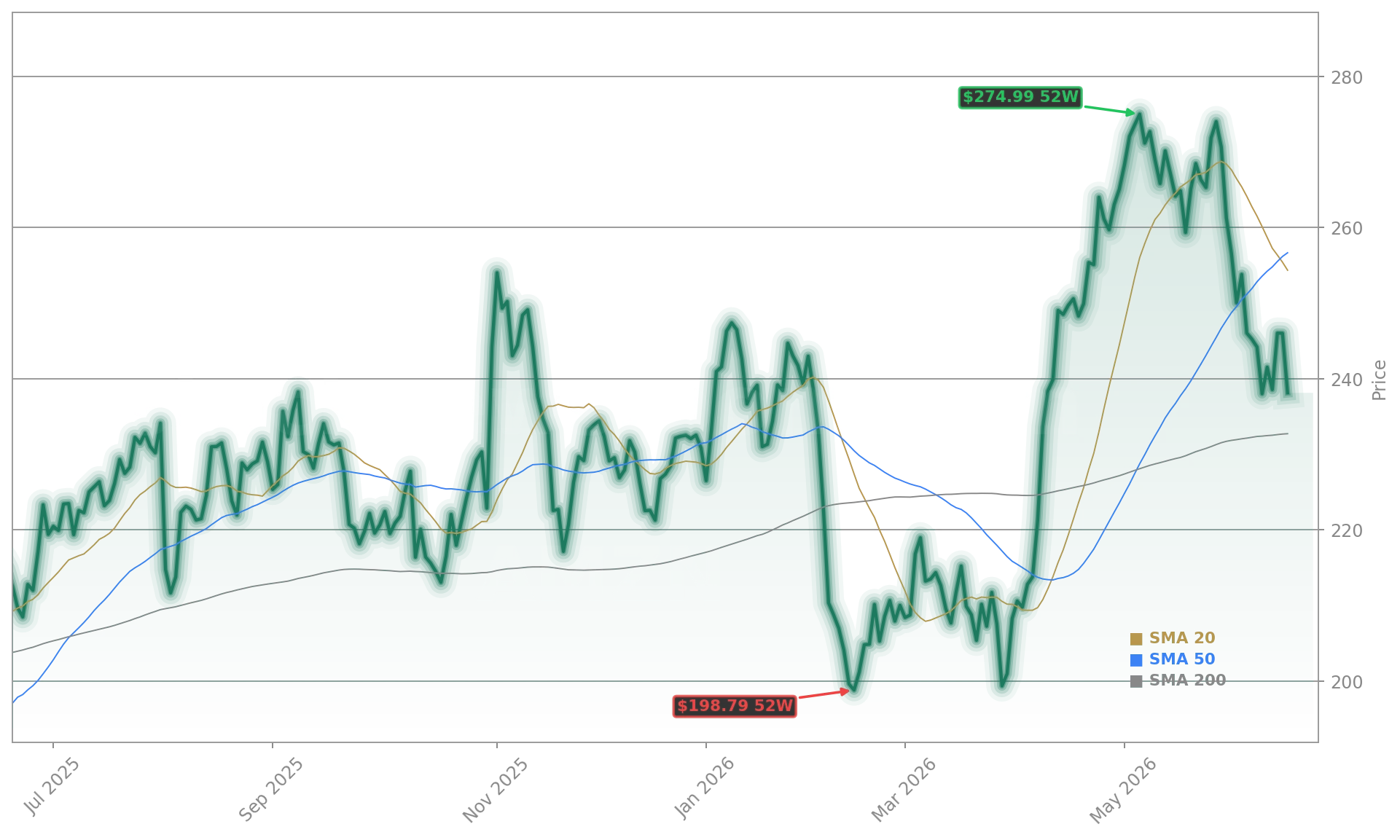
Because it reframes Amazon’s narrative beyond retail and cloud — into sovereign-grade infrastructure. While Meta and Alphabet chase AI agents and Apple re-enters the AI fray, Amazon is betting its most defensible advantage lies in full-stack control: from silicon (Trainium, Inferentia, Ocelot) to quantum error correction to hybrid quantum-classical cloud orchestration. That’s why the stock dipped only 3.5% on the Fed’s hawkish pivot — less than Meta’s 5.5% drop — and why it’s holding above its 200-day moving average ($232.67) despite trading at $239.15. RBC Capital Markets maintains its ‘Outperform’ rating, highlighting Amazon’s ‘unique ability to monetize foundational compute layers before competitors scale.’
What’s next for Amazon Quantum Computing?
I actually do believe, over the next five-to-seven years, we’re going to start to see the first commercially useful small-scale quantum computers.— Peter DeSantis, Amazon AI and Quantum Lead
The next milestone arrives this fall: Amazon plans to open its first quantum computing sandbox to select enterprise customers via AWS Braket, integrating Ocelot-based simulators with real hardware from Rigetti and IonQ. DeSantis confirmed that early use cases will focus on battery chemistry modeling and drug-binding simulations — high-margin, low-volume applications that validate quantum advantage before scaling. Meanwhile, the broader Mag 7 is under pressure: Morgan Stanley expects hyperscaler capex to top $1 trillion in 2027, with Amazon, Meta, Alphabet, and Oracle collectively committing nearly $1 trillion in off-balance-sheet obligations. In that context, Amazon Quantum Computing isn’t a moonshot — it’s the next logical step in a $200 billion infrastructure cycle already underway.