
Is Amazon’s massive AI build-out a smart long-term bet or the moment its cloud dominance finally gets stress-tested?

Is Amazon lagging despite the AI rally?
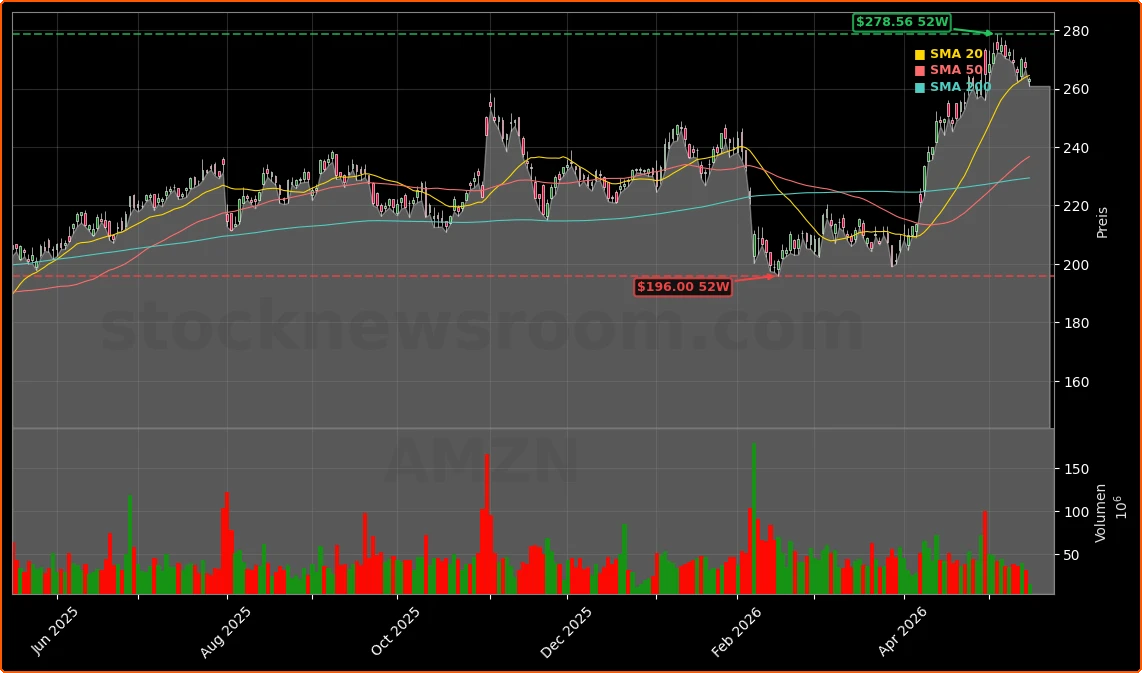
Amazon.com, Inc. shares are modestly lower today, even as the Nasdaq 100 and broader AI basket trade firmer, highlighting some fatigue after a powerful run that has lifted the stock roughly 30% since March. At about $263 per share, Amazon is off recent highs and below many Wall Street price targets, but still up strongly year to date. The pullback comes as some hedge funds, including Renaissance Technologies, have exited positions, rotating capital toward other AI winners like NVIDIA and Apple. Yet large long‑only and activist investors such as Bill Ackman’s Pershing Square have treated volatility as a buying opportunity, building Amazon into a core holding on the thesis that the Amazon AI Strategy will underpin earnings growth for years.
Today’s weakness also reflects position‑trimming in mega‑cap tech and profit‑taking after a robust Q1 earnings reaction. But with 95% of covering analysts reportedly rating the stock a buy, sentiment on Wall Street remains firmly skewed to the upside. Goldman Sachs, for example, maintains a $325 price target, while TD Cowen sees the shares at $350, citing AWS acceleration and new initiatives in ultra‑fast grocery delivery as key AI‑enabled growth drivers.
How central is AWS to the Amazon AI Strategy?
The Amazon AI Strategy is anchored in Amazon Web Services, now a roughly $150 billion annualized revenue business growing 28% year over year, its fastest pace in 15 quarters. AWS remains the profit engine of the group, generating operating margins near 38% and funding heavy investments across retail, advertising and logistics. Management has been explicit that AI is no side project: CEO Andy Jassy recently disclosed that the AI revenue run‑rate at AWS already exceeds $15 billion, roughly 260 times the size of AWS’s first three years.
AWS is doubling down on vertical integration. Its custom silicon portfolio – Graviton for general compute, Trainium for model training and Nitro for virtualization – is on a roughly $20 billion revenue run rate growing triple digits. Amazon has secured over $225 billion in revenue commitments tied to Trainium, including more than $100 billion from Anthropic alone, and sits on a $364 billion AWS backlog even before the latest Anthropic deal. For investors, that backlog provides unusual visibility into multi‑year AI infrastructure demand, supporting the view that Amazon’s cloud arm will remain a dominant cash generator even as retail margins stay thin.
Why are capex and bonds exploding higher?
To execute on the Amazon AI Strategy, management has opened the spending spigot. Recent quarters saw around $44.2 billion of capital expenditures, and internal plans point to roughly $200 billion of capex in 2026, largely directed toward data centers, power, networking and custom chips. That level of investment places Amazon alongside Alphabet and Microsoft in a hyperscaler race that could top $500–$700 billion in annual AI‑related capex across the sector.
Financing this build has required fresh debt. In Europe, Amazon recently placed bonds worth about CHF 2.9 billion, adding to a long‑term debt load now north of $100 billion. The company’s free cash flow has been temporarily pressured – trailing‑twelve‑month free cash flow reportedly fell about 95% to near $1.2 billion as capex ballooned – but management argues that much of the capacity is already effectively pre‑sold via cloud commitments. For equity holders, the key question is whether those fixed investments will earn returns above the cost of capital if AI demand slows or competitive dynamics shift.
How do partnerships and competition shape Amazon’s AI edge?
Partnerships sit at the heart of the Amazon AI Strategy. Anthropic, one of the leading frontier AI labs, is training its Claude models on more than 500,000 Trainium2 chips hosted in AWS under “Project Rainier,” and spreads workloads across NVIDIA GPUs and Google TPUs to avoid vendor lock‑in. That multi‑vendor approach underscores AWS’s role as both supplier and strategic shareholder, positioning Amazon to capture value even if model providers change over time.
Beyond cloud, Amazon is extending AI into consumer and enterprise touchpoints. In retail, the company is fusing Alexa with its new shopping chatbot Rufus to turn conversational queries into purchases, an attempt to counter rising pressure from low‑cost rivals like Shein and Temu and to lift stagnant app downloads. In connectivity, Delta Air Lines chose Amazon’s Leo low‑Earth‑orbit satellite service over SpaceX’s Starlink for its future high‑speed in‑flight Wi‑Fi, a win that validates Amazon’s broader technology stack versus high‑profile competitors associated with Tesla.
At the same time, Amazon is tightening its belt in legacy operations. Over 57,000 corporate roles have been eliminated since 2022, including fresh cuts in Selling Partner Services and robotics this year. Management links these reductions directly to AI automation in logistics, customer service and marketplace support, signaling that headcount will increasingly be replaced by machine intelligence as the infrastructure matures.
What are analysts watching next?
Wall Street is now focused on three metrics to judge the Amazon AI Strategy: AWS growth and margins, capex intensity versus free cash flow, and evidence that AI is lifting monetization in retail and advertising. Goldman Sachs emphasizes the rebound in unit growth – Q1 online units rose about 15%, with online store revenue up 12% to more than $64 billion – while TD Cowen points to ultra‑fast 30‑minute grocery delivery as a way to leverage Amazon’s fulfillment network and AI‑driven routing. If those initiatives translate into higher basket sizes and ad yield, consensus earnings estimates may still prove conservative.
On valuation, the stock trades around a mid‑30s P/E based on forward estimates, a premium to the S&P 500 but in line with other AI‑levered megacaps. Bulls argue that Amazon’s unique combination of physical “dirt” – warehouses, trucks, planes and robotics – and high‑margin compute creates a defensible moat that pure software platforms cannot easily replicate. Bears counter that rising debt and massive fixed costs could become a drag if AI spending normalizes or if hyperscaler competition compresses cloud pricing.
Related Coverage
For a deeper dive into how AI is reshaping Amazon’s consumer front end, including the integration of Alexa and shopping chatbot Rufus, readers can explore this analysis of Amazon’s AI shopping push and Alexa’s role in rewriting e‑commerce. That piece examines whether conversational checkout can translate AI enthusiasm into sustained revenue growth and support the current valuation premium.
We have high confidence this will be monetized well, as we already have customer commitments for a substantial portion of it.— Andy Jassy, CEO of Amazon.com, Inc.
In sum, the Amazon AI Strategy is transforming the company into an even more capital‑intensive but potentially higher‑margin AI infrastructure and logistics powerhouse. For investors building US and global equity portfolios, the stock offers a levered play on cloud, custom silicon and AI‑driven retail productivity with meaningful execution and balance‑sheet risk. The next few quarters of AWS bookings, capex guidance and AI‑linked retail metrics will determine whether today’s pullbacks are long‑term buying opportunities or early warnings in an overheated AI build‑out.