Are Amazon Earnings strong enough to justify a $200 billion AI and data center spending spree that is crushing free cash flow?

How did Amazon Earnings move the stock?
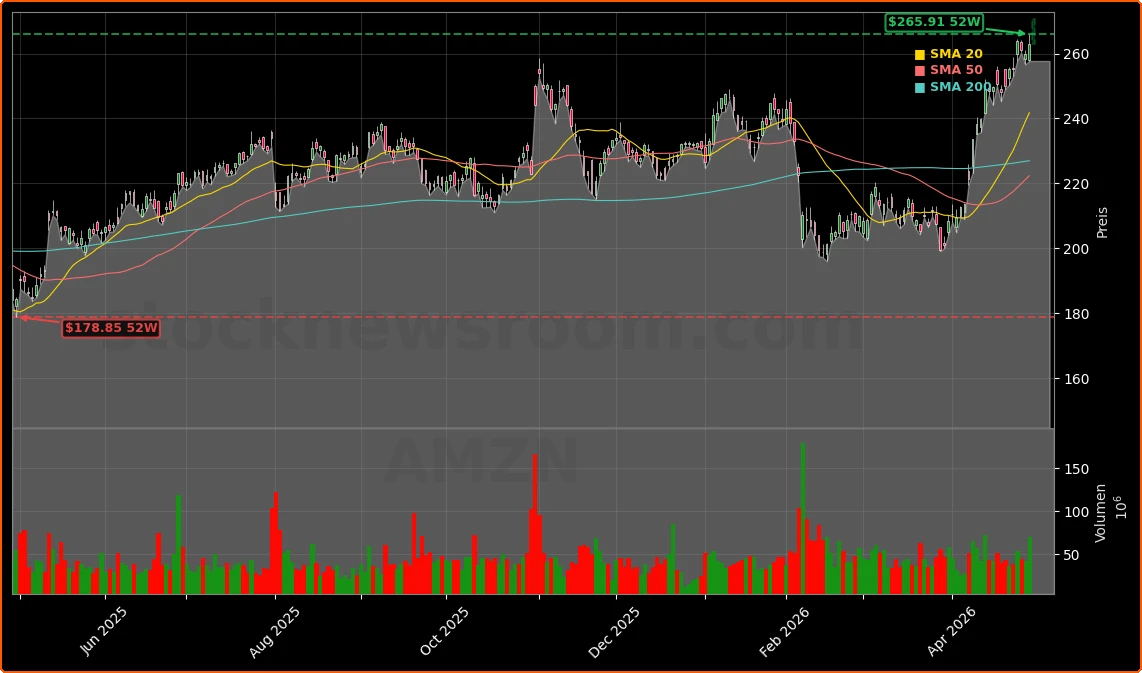
Amazon.com, Inc. (AMZN) beat on both the top and bottom line for Q1 2026, yet the immediate share reaction was volatile. After swinging between modest losses and gains on Wednesday evening ET, the stock is now up about 2.9% in pre-market trading near $270.60, versus Wednesday’s close at $263.04. That leaves Amazon up more than 30% since late March, making it one of the strongest mega-cap performers on Wall Street over the past month.
For U.S. investors, the message from the latest Amazon Earnings is twofold: the business is growing faster than most S&P 500 peers, but the cash flow drag from AI infrastructure remains pronounced. Trailing 12‑month free cash flow collapsed to just $1.2 billion from $25.9 billion a year earlier as capital expenditures surged to roughly $43–44 billion in Q1 alone, largely for AWS data centers and generative AI capacity.
Despite those cash flow concerns, the market appears willing to look through near-term pressure as long as AWS and AI revenues keep inflecting higher, especially given Amazon’s outsized weight in the major U.S. equity indices.
What stands out inside the Amazon Earnings report?
The core of the bullish reaction is AWS. Cloud revenue climbed 28% year over year to about $37.6 billion, the fastest pace in roughly 15 quarters and comfortably ahead of Wall Street’s estimates around $36.9 billion. AWS now runs at roughly a $150 billion annualized revenue rate, with management indicating that AI-related services alone are on track to generate around $15 billion this year if the current run rate holds.
Beyond AWS, Amazon delivered broad-based strength. Online stores revenue grew 12% to $64.3 billion as the company continues to compress delivery times and expand into new categories, from luxury goods to autos. Advertising revenue rose 24% to $17.2 billion, providing a high-margin tailwind that helps offset lower-margin first‑party retail sales. Overall operating income reached about $23.9 billion, up nearly 30% year over year, with AWS contributing more than half of that figure.
Net income jumped 77% to roughly $30.3 billion, helped by pretax gains tied to Amazon’s investment in AI startup Anthropic. That one‑time boost flatters headline profitability in this quarter, a nuance U.S. portfolio managers will factor in when they assess the sustainability of current Amazon Earnings power.
How aggressive is Amazon on AI and data centers?
The investment story is dominated by AI infrastructure. Management reaffirmed plans to spend about $200 billion on capital expenditures in 2026, roughly 60% more than in 2025, with the bulk flowing into AWS data centers, custom silicon, robotics and the new Leo satellite internet network. Q1 capex of around $43–44 billion already ran ahead of many Wall Street models.
CEO Andy Jassy has argued that this is not speculative spending. Amazon reports an AWS backlog of roughly $364 billion, up over 90% year on year, and more than $225 billion in revenue commitments specifically tied to its Trainium AI accelerator chips. Anthropic has agreed to purchase up to $100 billion in AWS services, while Meta is set to deploy millions of Amazon’s Graviton CPU cores to power next-generation agentic AI workloads.
These commitments suggest the capex cycle is underpinned by contracted demand rather than hope, but the timing mismatch is real: AWS must pay for land, power and chips many quarters before it invoices customers. That lag explains why free cash flow looks weak today even as operating income surges.
How do analysts view the latest Amazon Earnings?
Sell-side sentiment remains broadly constructive. Citi Research reiterated a Buy rating and lifted its price target to $285, highlighting upside surprises in Q1 revenue and operating income along with stronger‑than‑expected guidance for Q2 sales between $194 billion and $199 billion. Oppenheimer also maintains an Outperform rating and recently raised its target to $275, calling AWS the key growth engine and pointing to improving e‑commerce margins even amid higher fuel costs.
Not every perspective is unreservedly bullish. Some Wall Street desks emphasize that while AWS’s 28% growth rate is strong, it fell short of whisper expectations that had crept higher after rival cloud results. Others flag the midpoint of Amazon’s Q2 operating income outlook at $22 billion, which is slightly below consensus around $22.7 billion, as a sign that the company is choosing growth and capex over maximized near‑term profitability.
Still, compared with peers like Alphabet, Microsoft and Meta, Amazon is seen as one of the clearest winners from the AI capex super‑cycle. Its custom chips and deep integration across cloud, retail and ads offer a diversified earnings base that many U.S. growth funds prize.
How does Amazon stack up against Big Tech rivals?
Within the mega‑cap tech cohort, Amazon now sits alongside Alphabet and Microsoft as one of the three critical hyperscalers underwriting the current AI boom. The group’s massive capital spending plans are supportive not only for themselves but also for key suppliers like NVIDIA and, to a lesser extent, other semiconductor names.
Unlike Meta, whose AI investments currently lack a monetizable cloud platform, Amazon can route AI demand directly into AWS and its Trainium and Inferentia chips. That makes its spending look more like a classic build‑out of utility‑style infrastructure with contracted returns rather than an open‑ended R&D bet. For U.S. investors allocating across the NASDAQ 100 and S&P 500, Amazon offers a hybrid profile: a high‑growth cloud and AI play with a still‑dominant e‑commerce and ads franchise, similar in diversification breadth to Apple rather than the narrower focus of some peers like Tesla.
At around 31x earnings and with revenue growth above 13% on a trailing basis, Amazon trades at a premium to the average broadline retail stock but remains reasonably valued versus high‑growth cloud and chip beneficiaries. That combination keeps Amazon front and center in many U.S. growth and tech funds.
Related Coverage
Investors looking for a deeper dive into how AI spending and cloud momentum intersect with valuation can read the earlier analysis “Amazon Earnings +3.5% Surge: AI Capex And AWS Shock“. That piece explores whether the aggressive data-center build-out priced into Amazon shares can be justified by AWS growth and AI chip commitments, offering useful context alongside the latest quarterly numbers.
In summary, the latest Amazon Earnings confirm that AI-driven AWS growth and a booming ads business are more than offsetting heavy capex and near-term free cash flow pressure. For U.S. investors, Amazon remains a core vehicle for expressing conviction in the long-term AI infrastructure theme while still owning a leader in global e‑commerce. The next few quarters will show whether rising AWS margins and chip demand can fully translate this investment wave into sustained earnings and cash flow acceleration.