
Will the latest Amazon Earnings justify a massive AI spending spree or expose how fragile the Big Tech rally really is?

How crucial are Amazon Earnings for this Big Tech week?
The mid‑week cluster of results from Amazon.com, Inc., Alphabet, Microsoft and Meta will effectively decide whether the market’s AI trade stays in overdrive. Together with Apple, these names command an outsized weight in the S&P 500 and Nasdaq, and their commentary on AI infrastructure and cloud demand will set the tone for risk assets into May.
Amazon reports on Wednesday after the bell (ET), with consensus looking for revenue to rise from $155.67 billion to about $177.18 billion, roughly 13.8% year over year. Adjusted EPS are forecast around $1.65 versus $1.59 a year earlier, implying earnings growth that lags sales as the company leans into heavy AI and data center investment. Options markets are pricing an implied post‑report move of about 7.3%, signaling investors are braced for volatility around these Amazon Earnings.
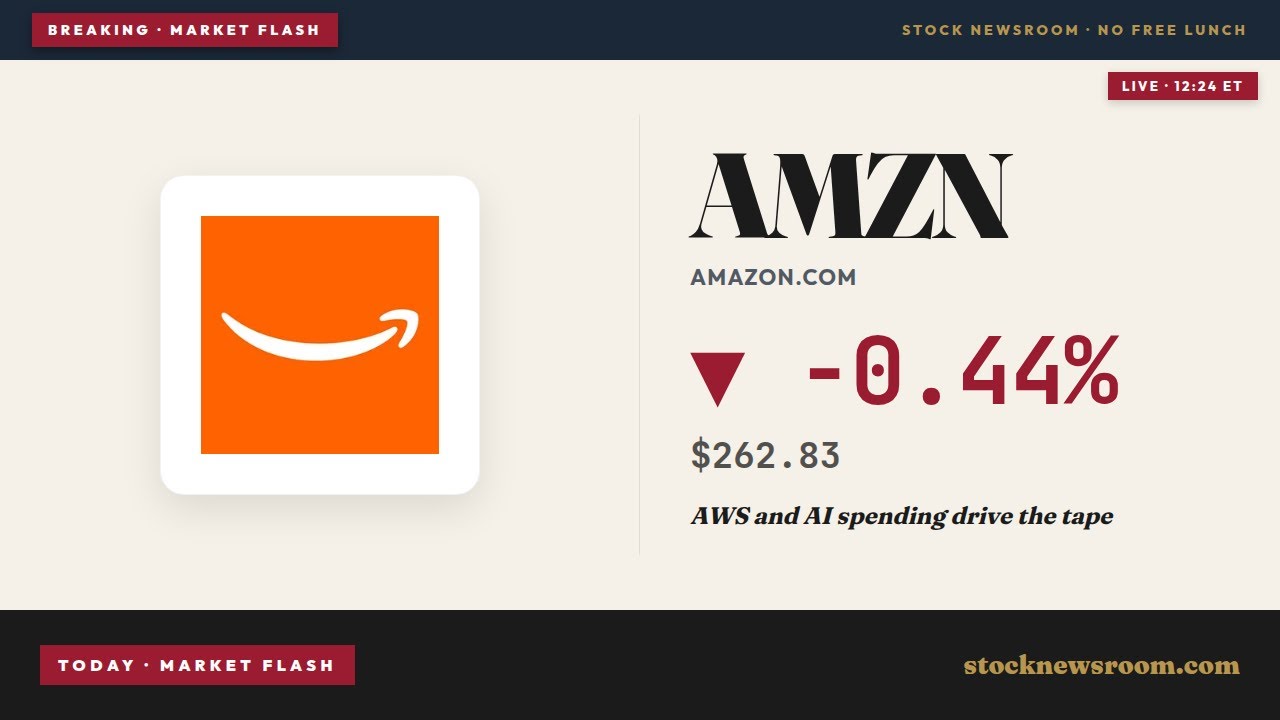
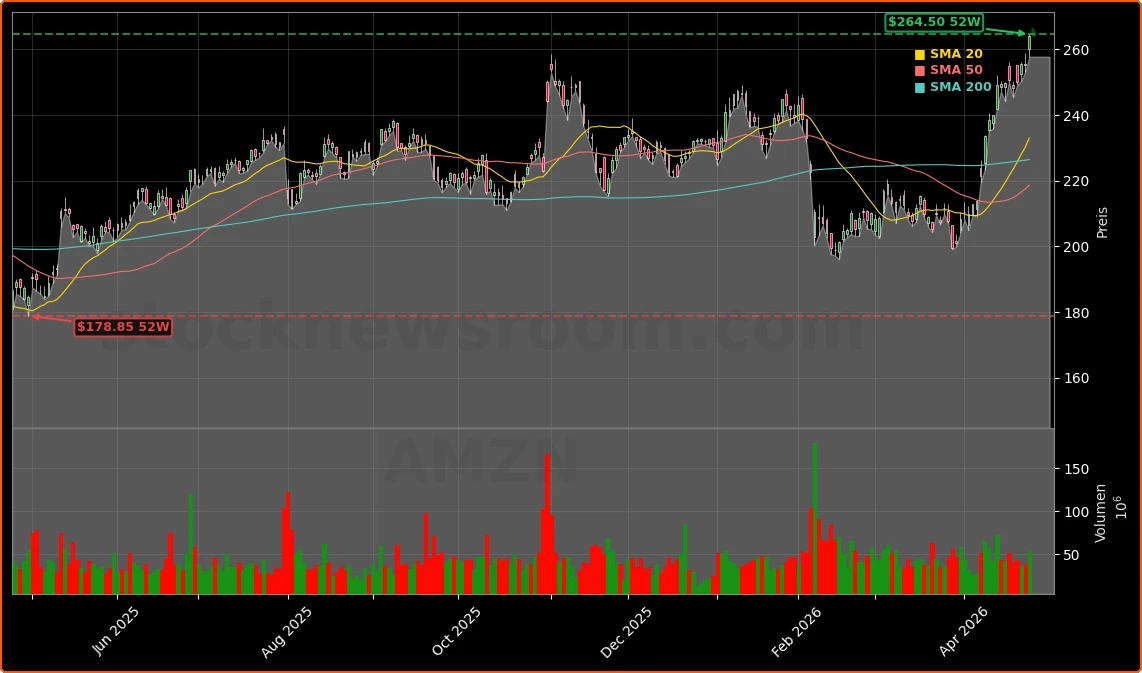
At the equity level, Amazon gained 3.49% on Friday to $263.99 and is indicated at $266.11 pre‑market, extending a powerful run that has taken the shares into all‑time‑high territory after breaking resistance in the $242 area. With the Magnificent Seven again leading the Nasdaq to record levels, any disappointment on growth, margins or capex discipline could quickly be punished.
What will investors watch inside Amazon Web Services?
The spotlight within the Amazon Earnings release will fall squarely on Amazon Web Services (AWS), the company’s profit engine and its primary lever in the AI race against Microsoft Azure and Google Cloud. AWS already generates the bulk of operating income, contrasting with the structurally thinner margins of the global e‑commerce operation.
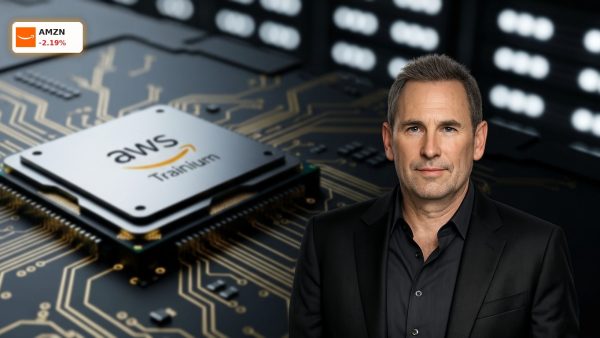
Amazon has moved aggressively to reduce its dependence on external chip vendors such as NVIDIA by designing its own Graviton and Trainium processors. Those in‑house accelerators are being positioned as cost‑efficient options for training and running advanced AI models on AWS, particularly for customers scaling generative AI workloads. One marquee win is Anthropic, which has adopted Trainium and deepened its partnership with Amazon across both equity and infrastructure.
The market will look for AWS growth acceleration tied to AI workloads and for management to outline how quickly AI‑related revenue can offset a capex plan that some estimates place in the high tens of billions annually. Analysts also want clarity on free cash flow, which has slipped back toward 2022 levels as Amazon builds out new data centers and network capacity to meet what it describes as concrete customer demand rather than speculative future use.
How heavy is the AI investment burden for Amazon?
Management has signaled that AI capex this year alone will land in a three‑digit billion‑dollar range across cloud, chips, logistics automation and internal productivity tools. Unlike cash‑rich peers, Amazon enters this spending cycle with roughly $55.5 billion in net debt, giving it less balance‑sheet flexibility than Alphabet or Microsoft and increasing pressure to show a clear path to return on investment.
That tension is central to the Amazon Earnings debate: can AI‑driven upside in AWS, advertising and retail productivity offset higher depreciation, energy costs and the impact of geopolitical shocks on logistics? The ongoing conflict in the Middle East keeps oil prices elevated, threatening to squeeze delivery margins just as Amazon pushes for faster shipping and continues to expand same‑day coverage.
On the equity‑derivatives side, positioning is cautiously optimistic. Around 59.1% of outstanding short‑dated options are calls versus 40.9% puts, reflecting bullish bias but far from euphoria. For active traders, the combination of elevated expectations, tight positioning and a 7% implied move makes these Amazon Earnings a pivotal catalyst.
What role do sustainability deals like Veolia play?
Beyond the income statement, Amazon is trying to convince investors that its AI and cloud expansion can scale sustainably. A new agreement with French environmental services group Veolia aims to cut water usage at data centers in Mississippi by using reclaimed wastewater for cooling. The first facility, targeted to be operational in 2027, is expected to reuse more than 83 million gallons of potable water annually, roughly equivalent to the yearly consumption of 760 US homes.
Veolia will deploy modular, containerized treatment systems that can be replicated at additional Amazon sites worldwide, aligning with Amazon’s goal of becoming water positive across direct data center operations by 2030. At the same time, AWS will provide Veolia with AI‑powered tools for real‑time optimization, predictive maintenance and resource efficiency across its global water treatment network. For ESG‑focused investors, these initiatives could soften concerns that AI data centers are unmanageable consumers of energy and water.
Amazon is also investing in alternative power solutions for data centers. It is a key customer of Bloom Energy’s solid‑oxide fuel cells, which can be deployed quickly to deliver on‑site, lower‑carbon electricity for energy‑hungry AI clusters. Such partnerships complement long‑term power agreements with utilities like NiSource, which is expanding generation to serve large Amazon data center loads in Indiana.
How do analysts view the stock going into Amazon Earnings?
The analyst community remains broadly constructive. Across Wall Street, Amazon is rated a strong buy, with one recent note from Wells Fargo reiterating an Overweight rating and a $307 price target, implying further upside from current levels. Other brokers have highlighted Amazon as one of the core beneficiaries of the AI build‑out, alongside Tesla on the EV/robotics side and cloud‑infrastructure names tied into the AWS ecosystem.
At the same time, valuation is no longer cheap. With a P/E around 37 and rich price‑to‑sales and price‑to‑book ratios versus other broadline retailers, investors are clearly paying a premium for sustained double‑digit revenue growth and improving margins. The Amazon Earnings print on Wednesday will need to validate that premium through solid AWS trends, firm ad growth and evidence that AI capex is translating into durable, high‑margin demand.
Related Coverage
For a deeper dive into how Amazon’s AI partnerships are reshaping the competitive landscape, including its collaboration with Meta, readers can explore “Amazon Meta AI Deal +3.1%: Record AI Surge for AMZN”, which examines whether in‑house chips and cloud scale can turn AWS into the central engine of Big Tech’s AI race.
In summary, the upcoming Amazon Earnings report will test whether the company can balance aggressive AI and cloud investments with disciplined profitability and free cash flow. For US investors positioned in the Nasdaq and S&P 500, Amazon’s guidance on AWS growth, capex and sustainability could shape tech sentiment for the rest of Q2. If management can pair strong numbers with a convincing roadmap on AI returns, Amazon should remain a core holding for long‑term portfolios.