Can Amazon’s new Alexa for Shopping turn AI chat into real checkout dollars and justify Wall Street’s growing AI optimism?

How big is this Amazon AI Shopping pivot?
Amazon is officially retiring Rufus, the generative AI assistant it rolled out just over two years ago, and replacing it with a new bot called Alexa for Shopping. Rather than living as a separate beta chatbot, the new tool will sit directly inside Amazon’s search experience, turning the familiar search bar into a conversational Q&A engine. Users will summon it via a cursive A icon in the app or website, or through Echo Show devices.
The new Amazon AI Shopping strategy merges technologies from Rufus and Alexa+, and taps into data from Amazon’s massive product catalog, customer reviews, and individual shopping histories. The company describes Alexa for Shopping as aiming to be “the world’s best, most personalized AI assistant for shopping,” able to answer detailed product questions, compare items side by side, and schedule purchases once prices hit user-defined thresholds. Notably, shoppers will not need a Prime membership to use the tool, lowering friction for adoption across the broader customer base.
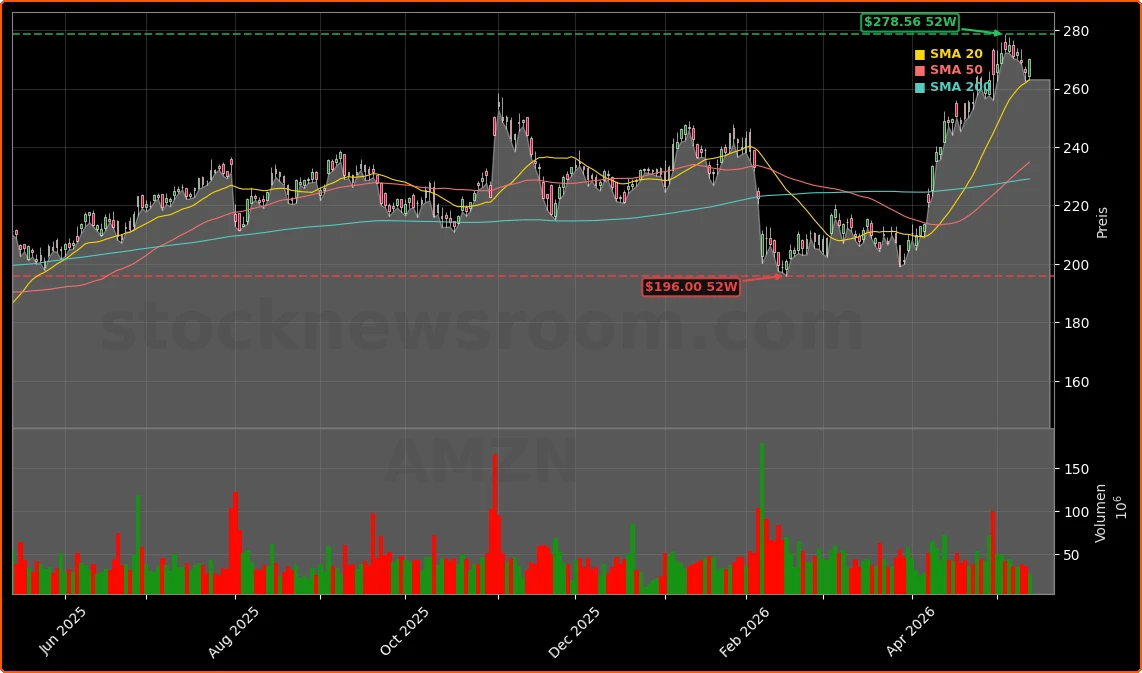
Shares of Amazon.com, Inc. have climbed roughly 18% year to date, and at $270.27 remain below the recent 52-week high of $278.56, leaving the stock off peak levels even as AI headlines intensify.
What makes Amazon AI Shopping different from rivals?
Daniel Rausch, Amazon’s top Alexa executive, argues that Amazon AI Shopping has structural advantages over tools from OpenAI, Google and Perplexity, which have experimented with shopping bots and research agents. While those competitors often rely on scraped web data, Alexa for Shopping can directly access real-time inventory, pricing, estimated delivery times, and the full depth of Amazon’s internal data. That allows the assistant to confirm whether an item is in stock, surface verified reviews, and personalize recommendations based on past purchases in a way standalone models struggle to match.
Amazon’s stance contrasts with OpenAI’s recent decision to wind down its Instant Checkout feature, which had allowed users to complete purchases directly from ChatGPT. OpenAI is now steering merchants toward building dedicated shopping apps inside ChatGPT instead. Rausch said he was unsurprised that others “have basically had to undo a bunch of features” that were incomplete, emphasizing that shopping is not something customers want to treat as a side quest.
Importantly for Wall Street, Amazon remains cautious about letting external AI agents crawl its storefront, even as CEO Andy Jassy has signaled the company is “having conversations with” potential third-party partners. For now, Amazon continues to block many bots from its site while building its own tools, including the separate “Buy for Me” feature that can complete purchases across other retailers’ websites.
What does this mean for Amazon, AWS and ad dollars?
The Amazon AI Shopping rollout comes amid a strong fundamental backdrop. In Q1 2026, Amazon reported revenue of $181.52 billion, up 16.6% year over year, while Amazon Web Services (AWS) revenue jumped 28% to $37.59 billion, its fastest growth in 15 quarters. AWS operating margins are in the high-30% range, and the company’s custom silicon business around Trainium, Graviton and Nitro chips has reached a $20 billion annual revenue run rate, growing triple digits.
On the retail side, Amazon’s advertising segment has crossed $70 billion in trailing-12-month revenue at 24% growth, and Rufus had been contributing roughly $12 billion in incremental annualized sales before this rebrand. Alexa for Shopping will retain advertising, including sponsored product listings, but Amazon stresses that ads will appear only when they “enhance” the customer experience. For millions of third-party sellers who bid aggressively for search placement, the key question is whether conversational AI broadens exposure to products or concentrates traffic into a narrower recommendation set.
Capital intensity remains the main risk in the Amazon AI Shopping and AWS story. Management plans around $200 billion in 2026 capex, much of it tied to AI data centers, power contracts, and chips. Trailing 12‑month free cash flow has compressed to about $1.2 billion from $25.9 billion a year earlier, and long-term debt stands near $119.1 billion. Bulls argue this is deliberate investment in an AI infrastructure moat; bears worry it may outpace demand if macro conditions or AI adoption slow.
How is Wall Street valuing Amazon’s AI push?
Analysts remain broadly constructive on both AWS and Amazon AI Shopping. 24/7 Wall St. recently set a 12‑month price target of $333.60, implying roughly 25.5% upside from around $265 at the time of publication, and characterizing the stock as a high‑confidence buy. Its bull case stretches to $384.78, while even the bear case lands at $286.44, modestly above current levels. Separately, TD Cowen’s managing director John Blackledge reiterated a strong buy rating on Amazon this week and lifted his target to $350, implying roughly 30% upside from current prices.
More broadly, Amazon trades near 32 times earnings, a premium to the S&P 500 but consistent with other mega-cap AI leaders like NVIDIA and Apple. For investors, the debate is whether accelerating AWS growth, a $225+ billion AI chip backlog, and new consumer tools like Amazon AI Shopping justify that multiple in the face of squeezed free cash flow.
In the Magnificent Seven cohort, Amazon has lagged some peers at points in this bull cycle, but its recent breakout helped diversify leadership away from names like Tesla and NVIDIA. Hyperscaler capex from Amazon, Alphabet, Meta and Microsoft is expected to approach $700–725 billion in 2026, underscoring the scale of the AI infrastructure race.
Related Coverage
Readers who want a deeper dive into the infrastructure side of Amazon’s strategy can review how cloud reliability interacts with massive AI spending in this analysis of an Amazon AWS outage and the company’s $200 billion AI bet. That piece examines how a single service disruption can expose new operational and financial risks even as AWS and Amazon AI Shopping power the next leg of growth.
We’re in the middle of some of the biggest inflections of our lifetime, and we’re well positioned to lead.— Andy Jassy, CEO of Amazon.com, Inc.
In sum, Amazon AI Shopping via Alexa for Shopping marks a major step in fusing generative AI with the core e‑commerce experience, while AWS continues to reaccelerate on the back of custom chips and massive capex. For U.S. investors, the stock offers a leveraged play on both AI infrastructure and AI-driven retail monetization, albeit with higher balance-sheet and execution risk. The next few quarters will show whether Amazon can convert its AI investments into durable earnings growth and justify the bullish price targets on Wall Street.