Is surging AMD AI Demand signaling just another semiconductor swing trade, or the start of a multi-year data center upgrade boom?

Why is Advanced Micro Devices jumping today?
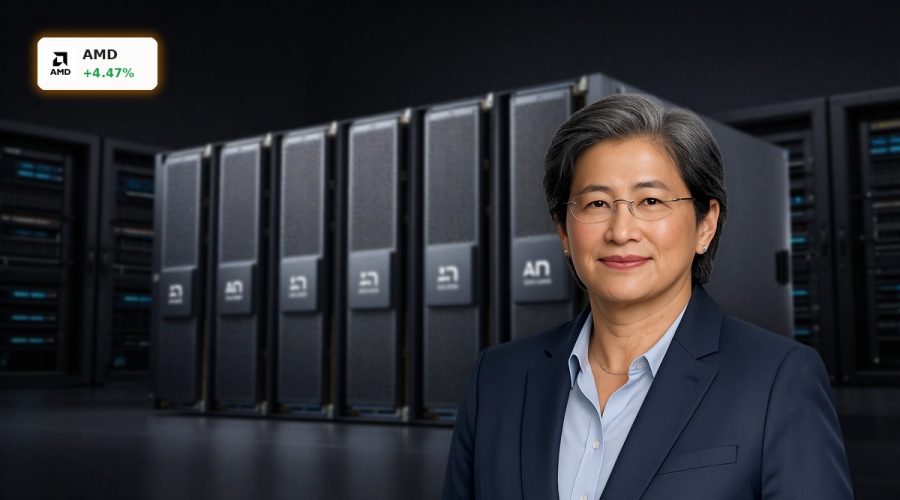
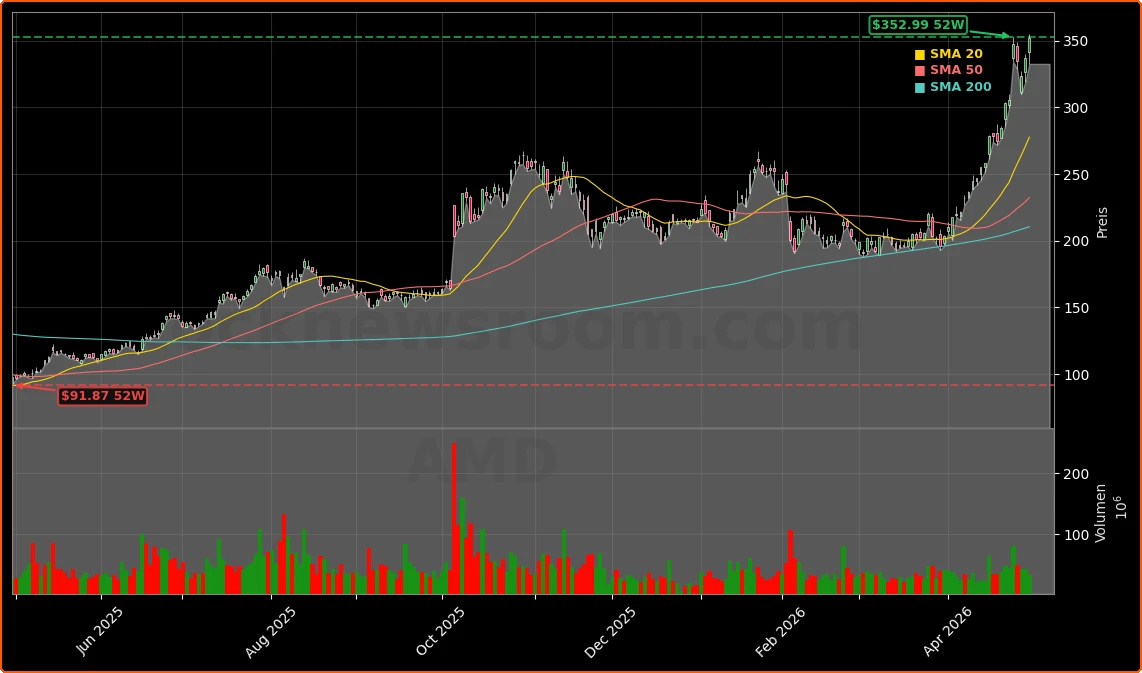
Shares of Advanced Micro Devices, Inc. (AMD) climbed 4.47% today to $352.18, extending a powerful April run fueled by enthusiasm around data center and AI workloads. The move comes alongside a strong rebound in the iShares Semiconductor ETF (SOXX), which has delivered an eye‑catching one-year return of nearly 150% as investors crowd into chip designers seen as direct beneficiaries of AI infrastructure spending.
Within that ETF, AMD now represents roughly 7.9% of holdings, putting it among the top positions alongside Broadcom and Micron Technology. This concentrated exposure has amplified every swing in AMD’s share price: when AI optimism builds, flows into sector ETFs often translate into incremental buying of AMD. Today’s advance also follows a strong month for the stock, with gains north of 70% over the past weeks as traders reposition away from mega-cap AI winners and toward perceived “catch-up” plays.
The current price is well below theoretical bubble territory but far above levels from early March, when some analysts highlighted underperformance versus NVIDIA as a potential opportunity. Since then, AMD has significantly narrowed that gap, supported by a narrative that AMD AI Demand in server and custom silicon deployments is just beginning a multi‑year ramp.
Is AMD AI Demand driving a new server cycle?
Much of the renewed bullishness rests on expectations for a structural shift in the server and AI markets. AMD’s data center CPUs and accelerators are increasingly seen as credible alternatives to entrenched incumbents, and capacity plans by hyperscalers suggest that AI training and inference workloads will require far more compute over the coming years. RBC Capital Markets recently emphasized that strong capital expenditure trends at cloud and enterprise customers should “bode well” for sector‑perform‑rated names including AMD, Broadcom, SanDisk and Intel, noting that AI demand is driving double‑digit growth in wafer fabrication.
On the memory and interconnect side, partners such as Rambus are preparing for a next‑generation rollout of DDR5 and MRDIMM solutions later this decade, timing that aligns with future platform releases from Intel and AMD. That roadmap reinforces the view that AMD AI Demand is not a one‑quarter story but part of a broader hardware refresh cycle as data centers optimize for higher bandwidth and lower latency.
At the same time, Wall Street is starting to frame AMD and Intel as key CPU suppliers for “agentic AI” workloads—more autonomous, continuously running AI agents that require both high-performance accelerators and powerful general-purpose CPUs. In that context, AMD is no longer seen only as a GPU and gaming chip designer but as a full-stack compute provider that can capture a larger share of total AI silicon budgets.
How does AMD stack up against competitors?
Today’s move in AMD comes in tandem with a broader rally in peers. Qualcomm surged 9% earlier today, while Intel jumped roughly 12% as investors revisited traditional CPU names that had lagged behind AI-specialist leaders. Storage firms such as Seagate and Western Digital also rallied sharply, underscoring how the AI build‑out is lifting not just compute vendors but the entire data infrastructure chain.
Even with its recent surge, AMD still trails NVIDIA in absolute market value and AI mindshare, but the valuation gap has narrowed. Over the past month, Micron has gained about 66% and AMD roughly 74%, compared with a far more modest advance for NVIDIA, which has traded closer to a consolidation zone around key technical support. This internal rotation within semiconductors suggests that some investors are reallocating from the most crowded AI winners into second‑line beneficiaries with perceived higher upside.
Beyond pure semis, the AI rally continues to influence broader tech allocations. Apple, Meta Platforms, and other mega‑cap names are increasingly evaluated not just on consumer hardware or advertising exposure, but on how effectively they can design or source custom silicon. AMD’s role as a supplier of general-purpose and custom chips positions it alongside those giants rather than strictly as a PC or gaming stock.
What are hedge funds and ETFs doing with AMD?
Despite the strong price action, not all institutional money is moving in the same direction. A review of recent 13F filings shows that among 3,062 funds analyzed, aggregate hedge fund holdings in AMD declined from about 51.1 million shares at the end of 2025 to 46.8 million shares as of March 31, 2026—an 8.5% reduction. That indicates that, while some managers added to positions, others used the sharp rally to trim exposure or exit entirely.
The three largest reported fund holders in this sample were Assenagon Asset Management, Swedbank, and ProShare Advisors. Their positions, combined with AMD’s large weight in SOXX and other tech‑focused ETFs, mean that flows into or out of passive products can still have a meaningful impact on day‑to‑day trading. For retail investors, this setup translates into higher beta: AMD tends to amplify both upswings and corrections in the broader tech complex.
Corporate governance and compensation are also on the radar. CEO Lisa T. Su earned about $55.2 million, versus a median AMD employee salary of $161,780, for a pay ratio of 341‑to‑1. That scale reflects AMD’s rise into the top echelon of chipmakers and the market’s willingness to reward perceived execution on AI strategy.
Related Coverage
For readers tracking short‑term swings in AMD AI Demand and the associated volatility, it is worth revisiting the recent pullback after headlines around OpenAI. The article “AMD OpenAI -3.8% shock: Is the AI chip rally cracking?” analyzes whether that sell‑off was merely a shakeout in a strong uptrend or an early warning that sentiment around AI chips like AMD could be peaking.
AMD AI Demand remains the dominant force shaping the stock’s risk‑reward profile. For investors with a U.S. or global tech allocation, AMD now sits at the intersection of AI infrastructure growth, aggressive sector rotation, and active/passive fund flows. The next set of data center order updates and capex plans will show whether today’s enthusiasm is sustainable, but for now AMD stands as one of the central vehicles for playing the AI build‑out.