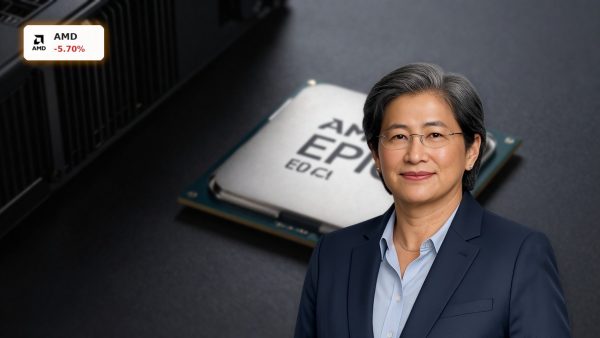
Is the AMD OpenAI sell-off a short-term scare or the first real stress test for the AI chip boom?

Why is Advanced Micro Devices under pressure?
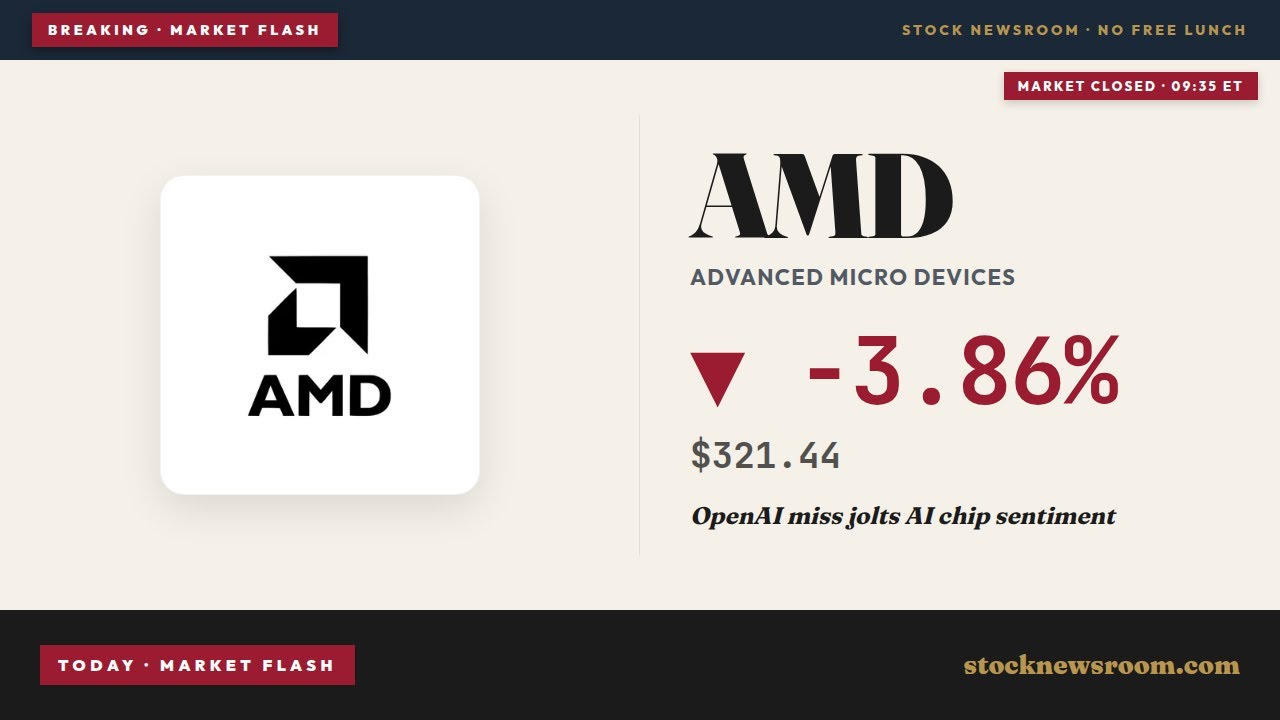
Wall Street is repricing AI optimism this morning after a report that OpenAI recently fell short of its own internal goals for revenue and new user growth. That headline has hit key OpenAI partners across the AI infrastructure stack, including hyperscale cloud providers and chip suppliers. Advanced Micro Devices, Inc. is down about 3.8% from Monday’s close and another 7% in early trading indications, putting the stock on track for one of its steeper intraday drops this quarter if the weakness holds after the opening bell in New York (09:30 ET).
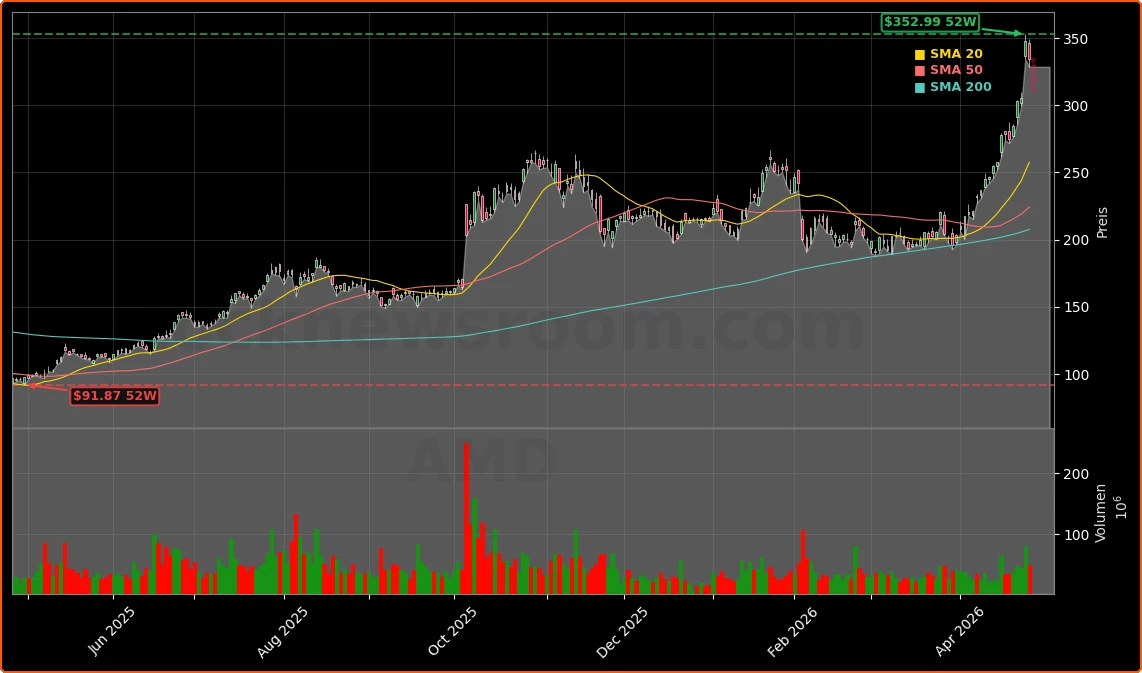
AMD has been one of the market’s purest AI infrastructure plays, benefiting from surging demand for data‑center GPUs and high‑end server CPUs. Over the past year, the stock has rocketed higher as investors crowded into AI beneficiaries, sending valuation metrics to demanding levels. Recent commentary pointed out that AMD is now trading at a forward 2026 P/E multiple above 50, leaving little margin for disappointment if AI workloads or infrastructure spending slow, even temporarily.
How does the AMD OpenAI link hit sentiment?
The AMD OpenAI connection has become a key narrative for the stock. AMD supplies Instinct accelerators and EPYC server CPUs to major AI developers and cloud operators, and OpenAI is widely seen as one of its flagship AI customers alongside Meta, Oracle, and other hyperscalers. Markets have started to use partners like AMD, NVIDIA, Oracle, Microsoft, SoftBank, and CoreWeave as liquid proxies for OpenAI’s growth prospects.
That is why the latest OpenAI update is hitting AMD especially hard in pre‑market trade. If OpenAI is growing more slowly than hoped, investors worry that some AI data‑center build‑outs could be delayed or re‑scoped, at least on the margin. Those concerns are being amplified today by the sheer scale of AMD’s recent rally: the stock has climbed roughly 65% in a month and sits not far below its 52‑week highs, making it vulnerable to any wobble in the AI story.
Still, the AMD OpenAI relationship is only one part of a broader multiyear demand picture. AMD’s Instinct GPU roadmap – spanning MI300, MI350, MI450, the MI400 family through 2026, and MI500 into 2027 – is aimed at a diversified base of hyperscalers and enterprise AI customers. That diversification could soften the impact if one high‑profile customer like OpenAI temporarily reins in capex.
Are AI chip peers sending the same signal?
AMD is not falling in isolation. Other AI‑linked names tied to OpenAI and generative AI workloads are also under pressure before the US open. Oracle shares are indicated lower by more than 6%, while reports show OpenAI‑focused infrastructure players such as CoreWeave and SoftBank sliding between 6% and 11% in overseas trading. NVIDIA is down modestly, reflecting its status as the dominant AI GPU supplier but also a stock that already embeds high expectations.
Chipmakers closely associated with AI data‑center demand are giving back some recent gains. Broadcom, Arm, and Intel have all rallied sharply in recent weeks as investors embraced the idea of a structural CPU and networking shortage driven by agentic AI and increasingly complex workloads. Intel’s dramatic rebound – up nearly 100% since late March – has turned it into a fresh market darling, with television personalities like Jim Cramer arguing that analysts will be forced to upgrade the stock as CPU demand surges.
That same CPU narrative has supported AMD as well. Its EPYC processors have been winning share in the data center, and rising CPU attach rates for AI clusters are a major earnings lever. If anything, the OpenAI-driven pullback may test whether investors now see AI CPUs as a separate, more resilient leg of the story compared with the hotter, more cyclical GPU narrative.
Does the AMD OpenAI story change the bull case?
Fundamentally, the AMD OpenAI exposure underscores both risk and opportunity. On the risk side, today’s drop shows how tightly the stock is tethered to sentiment around a small group of marquee AI platforms. When a single company like OpenAI misses internal goals, the reaction can wipe billions off AI suppliers’ market caps in minutes. With AMD’s valuation stretching into premium territory, that sensitivity is unlikely to fade.
On the opportunity side, third‑party research has highlighted a growing CPU shortage in AI data centers that could favor AMD. Detailed analysis of hyperscaler capex suggests that constrained Nvidia GPU supply and mounting China‑related risks may push more operators toward flexible, CPU‑heavy architectures. In that scenario, AMD’s EPYC line – used alongside GPUs to orchestrate and manage AI workloads – could enjoy an extended upgrade cycle, partly independent of near‑term AMD OpenAI spending swings.
For now, major Wall Street banks have largely remained constructive on AMD’s long‑term AI positioning, even as they warn about volatility. Brokers such as Goldman Sachs and Morgan Stanley have previously emphasized the company’s execution in data centers and its visibility through multiyear engagements with hyperscalers. Any fresh rating changes or target revisions in response to today’s OpenAI news will be closely watched when US research desks update clients.
How does this affect US portfolios today?
For US investors heavily tilted toward AI winners, the AMD move is an immediate stress test. The stock is a major component of many technology and semiconductor ETFs that track the NASDAQ and broader S&P 500 tech complex, so a sharp drop in AMD can ripple through passive portfolios. Retail investors who chased the recent spike are now confronting the downside of sentiment‑driven trades in crowded AI names.
Portfolio managers will be assessing whether to treat the AMD OpenAI scare as a buying opportunity or an early warning sign. One key factor will be upcoming earnings from big cloud platforms, which will offer fresh guidance on 2026 AI capex plans. If hyperscalers reaffirm or raise spending guidance despite OpenAI’s wobble, today’s selloff could fade quickly. If they signal more caution, richly valued AI hardware names, including AMD, Tesla’s AI infrastructure ambitions, and ecosystem players like Apple, may face a broader de‑rating.
Related Coverage
Investors who want to dig deeper into AMD’s recent rally and its shifting relationship with Intel’s AI push can read “AMD Upgrade +13.9% Surge After Intel AI Shock”. That analysis looks at how Wall Street upgrades and Intel’s surprise resurgence in AI CPUs helped ignite AMD’s latest leg higher and what that tug‑of‑war could mean for future returns.
Overall, the AMD OpenAI shock is a reminder that AI euphoria comes with real volatility. For long‑term investors, the core question is whether structural demand for AI compute and data‑center CPUs outweighs short‑term jitters tied to a single platform’s growth hiccup. The next few weeks of earnings and capex updates will show whether AMD’s AI thesis remains on track or needs to be repriced, but patient investors may find opportunity in days when sentiment swings too far, too fast.