
Can Baker Hughes sustain its massive AI-driven order momentum, or is the market overestimating the impact of its latest strategic pivot?

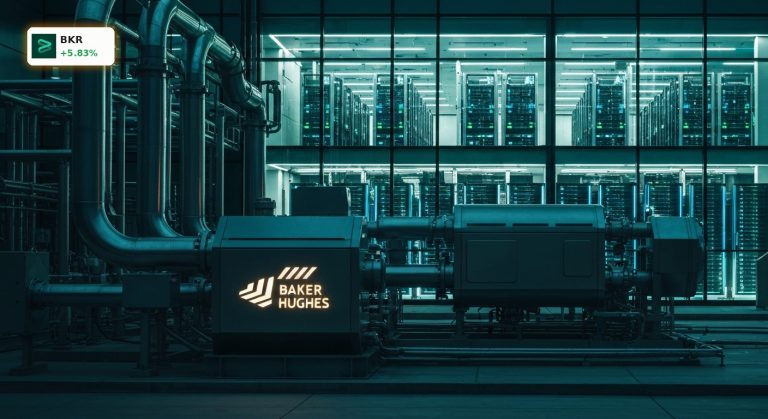
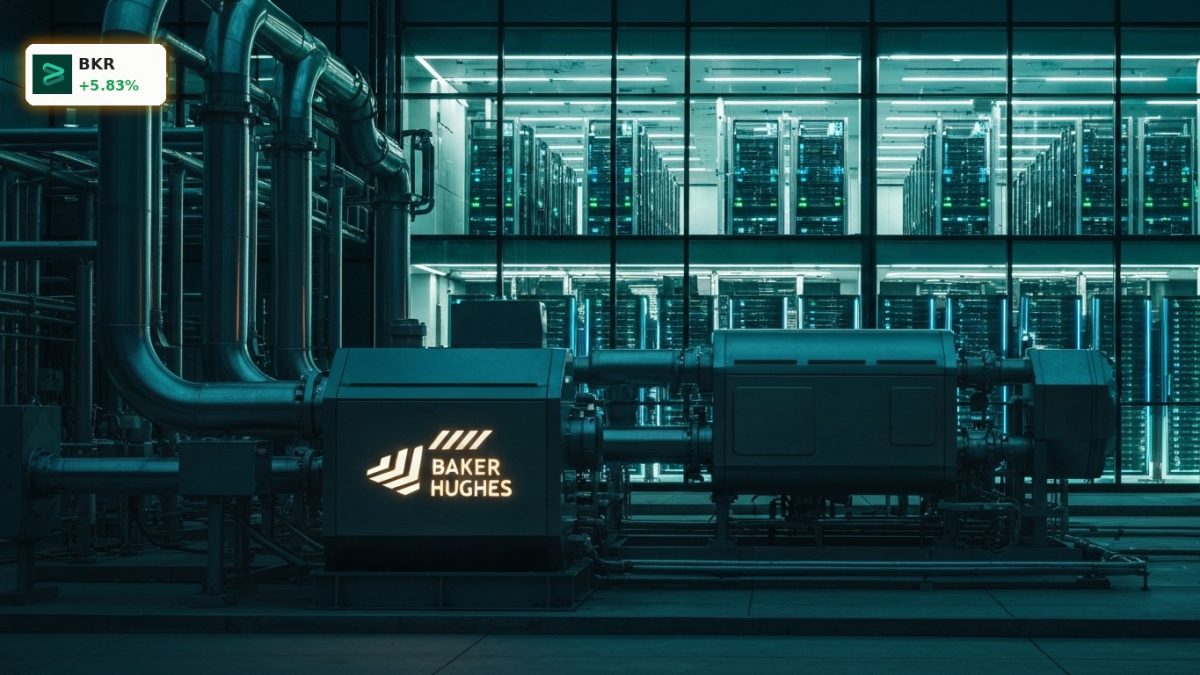
Investors rushed to buy the stock, which posted its largest intraday gain in over a year, peaking near 9.5% before closing strong. The market reaction underscores growing optimism about the company’s strategic pivot toward broader industrial energy solutions.
What Drove the Baker Hughes Earnings Outperformance?
The industrial energy giant posted an adjusted earnings per share (EPS) of $0.64, substantially beating the consensus analyst estimate of $0.50. While Q2 revenue of $6.74 billion was down slightly by 2% year-over-year, it comfortably cleared the $6.52 billion expected by Wall Street. The primary catalyst behind the positive Baker Hughes Earnings surprise was a massive 49% surge in new order contracts, which soared to $10.5 billion.
A significant portion of this momentum came from the Industrial and Energy Technology (IET) segment, where orders doubled year-over-year. Investors focused heavily on the Baker Hughes Earnings details regarding the company’s power systems division. Driven by artificial intelligence and data center infrastructure needs, power systems orders reached $2.6 billion in the quarter, with data centers alone accounting for $2.2 billion of that total.
Furthermore, the company successfully navigated geopolitical tensions in the Middle East. Analysts at Citigroup highlighted the earnings beat and the company’s ability to manage revenue headwinds from regional conflicts as a “beat on all cylinders.” Piper Sandler also noted that the impact of the Middle East disruptions on overall margins was far lower than previously feared, contributing to the overall strength of the Baker Hughes Earnings.
How is the Chart Acquisition Expanding the Portfolio?
A key focus of the post-earnings conference call was the integration of Chart, which Baker Hughes Company recently added to its portfolio. Chief Executive Lorenzo Simonelli emphasized that commercial synergies with Chart will be a major driver of long-term shareholder value. The combination allows the company to offer integrated, end-to-end solutions spanning gas processing, cryogenic storage, thermal management, and power generation.
This expanded capability is already opening doors in high-growth sectors. In the data center market, where AI-driven workloads require massive power and advanced cooling, the combined entity can deliver highly efficient tri-generation systems. Beyond data centers, the company is targeting gas infrastructure, hydrogen, and carbon dioxide management. Analysts analyzing the Baker Hughes Earnings call noted that underappreciated sectors like geothermal energy, space exploration, and mining could provide additional long-term upside as the integration progresses.
To support this rapid expansion, the company is executing a disciplined capacity expansion plan through 2029. Management expects its power systems capacity to reach $5 billion in annualized revenue by 2029, representing a threefold increase from last year’s levels. This expansion will be funded through a phased capital expenditure program between 2026 and 2028, with payback periods estimated at under two years.
What is the Outlook for Baker Hughes Company?
Supported by record order momentum, Baker Hughes Company raised its full-year 2026 guidance. The company now expects full-year revenue of $27.35 billion and adjusted EBITDA of $4.85 billion, modestly exceeding previous forecasts. Additionally, full-year IET orders guidance was raised to a range of $17.5 billion to $19.5 billion, marking a second consecutive year of record-breaking bookings.
The Oilfield Services and Equipment (OFSE) segment is also showing strong resilience. Despite localized volatility, international OFSE revenue outside the Middle East grew by double digits sequentially, supported by robust activity in Latin America, Europe, and Sub-Saharan Africa. Large competitors like Chevron and ExxonMobil continue to invest heavily in upstream and infrastructure projects, ensuring a steady pipeline of demand for the company’s specialized services.
Our second quarter performance demonstrates the continued progress of Bakers’ strategy and our transformation into a leading industrialized energy solutions company.— Lorenzo Simonelli
Ultimately, the latest Baker Hughes Earnings show a company successfully transitioning from a traditional oilfield services provider into a diversified industrial energy technology powerhouse. With a record backlog of over $37 billion providing clear revenue visibility into 2027 and beyond, the company is exceptionally well-positioned to reward long-term investors. As Wall Street continues to digest these strong figures, the stock’s upward trajectory reflects growing confidence in its structural growth story.