Can a fresh WTI Crude Iran Conflict shock push inflation fears back to center stage just as markets were pricing in calm?

What Does the WTI Crude Iran Conflict Mean for U.S. Inflation?
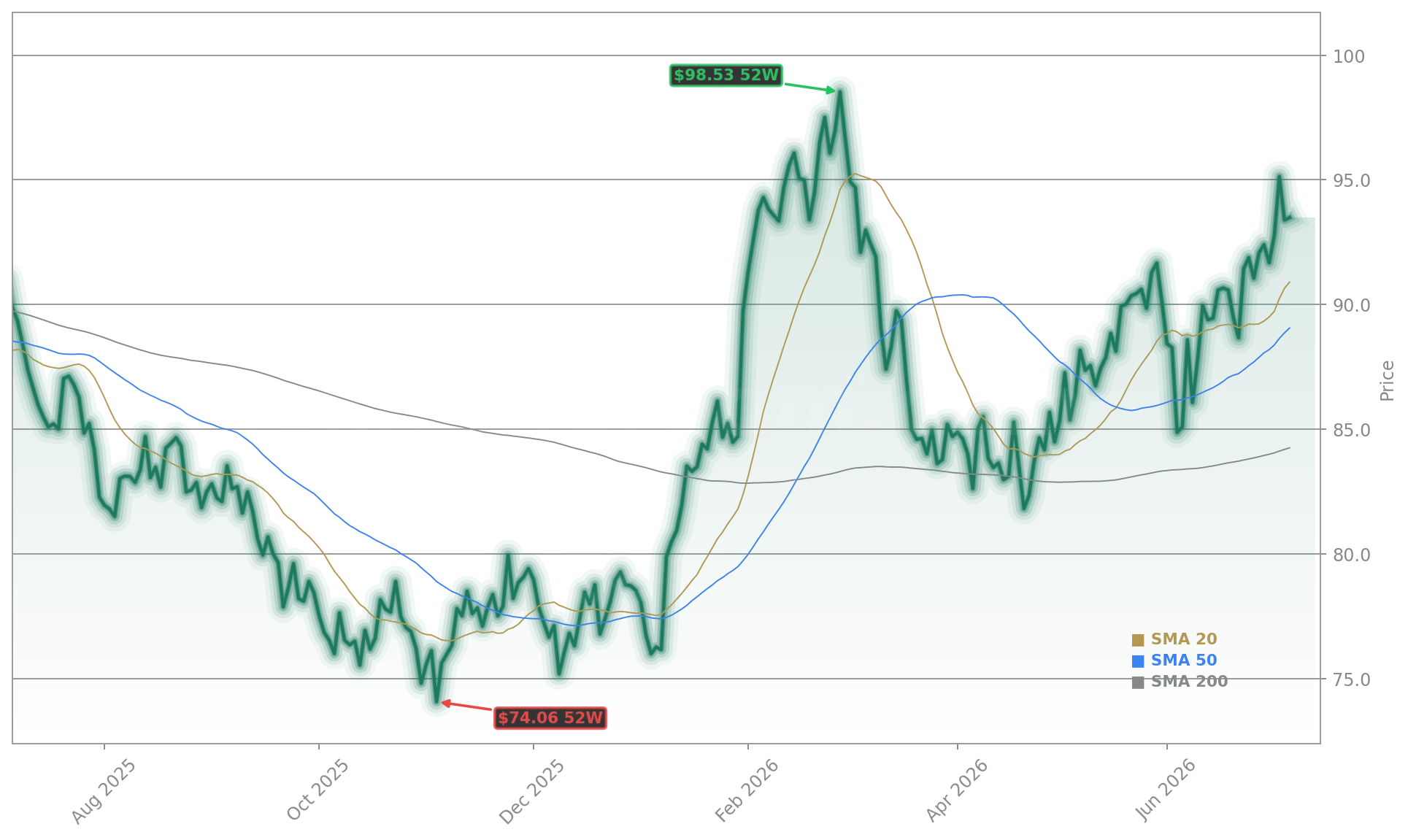
The WTI Crude Iran Conflict has re-ignited core inflation risks just as the Federal Reserve prepares for its July 23 policy meeting. WTI’s jump to $75.94 — up from $72.31 — pushes gasoline futures higher and threatens to reverse recent disinflation progress. According to the U.S. Bureau of Labor Statistics, energy costs now account for over 40% of the 4.2% year-over-year CPI increase. With crude crack spreads widening and forward curves shifting into backwardation, traders are paying premiums for near-term supply — a classic signal of tightening physical markets. UBS equity analyst Dominic Ellis warned that “markets were too quick to buy into the de-escalation narrative,” adding that “a slightly higher range for oil in the near term” is now priced in. That dynamic directly pressures consumer staples, airlines, and logistics firms — including Tesla, whose energy cost exposure is rising ahead of Q3 fleet electrification milestones.
How Are Oil Majors Reacting to the WTI Crude Iran Conflict?
Chevron and Exxon Mobil are gaining traction as defensive energy plays, with both stocks rising over 2% in pre-market trading. Chevron (CVX) benefits from its integrated refining margins, while Exxon Mobil (XOM) is leveraging its global LNG infrastructure to capture premium pricing in Asia. Meanwhile, ConocoPhillips (COP) and Occidental Petroleum (OXY) are seeing renewed investor interest — not for production growth, but for their relative insulation from Middle East supply chain risks. Citigroup upgraded ConocoPhillips to “Buy” with a $128 price target, citing “strong free cash flow generation amid elevated near-term oil pricing.” The WTI Crude Iran Conflict has also boosted demand for oilfield services, lifting Halliburton (HAL) and Baker Hughes (BKR) futures by 1.8% and 1.4%, respectively.
Why Did Wall Street Sell Off So Sharply?
Futures on the S&P 500 dropped 0.8%, and Nasdaq 100 futures fell 1.3% — with NVIDIA and Apple leading losses. Higher WTI prices amplify input costs across semiconductor manufacturing, cloud infrastructure, and consumer electronics supply chains. More critically, rising oil prices revived inflation expectations: odds of a December Fed rate hike jumped from 48% to 57%, per CME Group data. That shift pressured rate-sensitive growth stocks, especially those with high EV exposure. Lufthansa’s shares fell 5% after Citigroup downgraded the carrier to “Sell,” citing “elevated fuel cost volatility” — a direct consequence of the WTI Crude Iran Conflict. The sell-off wasn’t broad-based: defensive sectors like utilities and consumer staples held up, while energy stocks rose 3.2% — the strongest sector on the S&P 500.
Is the Strait of Hormuz Really at Risk Again?
Yes — and the market knows it. Kpler’s Michelle Brouhard stated, “Every renewed attack on commercial shipping further erodes confidence in the Strait’s reopening, making each future recovery more fragile than the last.” Vessel transits via Hormuz have dropped sharply on the East-West corridor, while insurance costs and freight rates remain elevated. Bloomberg data shows 63 million barrels of Iranian crude are currently stranded on tankers — some without clear destination — following the U.S. waiver revocation. With U.S. crude inventories rising unexpectedly last week (+2.998 million barrels), the near-term price surge is purely geopolitical — not supply-driven. But as RBC Capital Markets notes in its latest commodities report, “Hormuz risk is binary: either the waterway functions, or it doesn’t. There is no middle ground for global oil flows.”
What’s Next for WTI and U.S. Energy Policy?
Markets were too quick to buy into the de-escalation narrative in my view, and while there has been evidence of progress and of a rebound in vessel flows via the Strait of Hormuz, the latest developments may lead to more realistic expectations on the return to normalcy.— Dominic Ellis, UBS equity analyst
WTI is likely to trade in a $73–$82 range over the next 30 days, according to Goldman Sachs’ updated forecast. The firm raised its Q3 2026 WTI price target to $79, citing “tightening spare capacity and fragile diplomacy.” Domestically, the DOE’s upward revision of 2026 U.S. production to 13.78 million bpd offers a modest counterweight — but cannot offset a sustained Hormuz disruption. Meanwhile, the renewed WTI Crude Iran Conflict is accelerating demand for alternatives: used Tesla EV prices rose 12% year-over-year, per Cox Automotive, as $3.80/gallon gasoline renews cost-of-ownership calculus. For U.S. investors, the takeaway is clear: geopolitical risk is no longer a footnote — it’s a portfolio driver.