If Hormuz is reopening, why is WTI Crude Oil Hormuz still sliding and flashing fresh warning signs for inflation?

What Does the WTI Crude Oil Hormuz Reopening Really Mean?
WTI Crude Oil (WTIUSD) dropped to $76.11 — its lowest level since early March — after Vice President J.D. Vance confirmed that more than 12 million barrels had safely crossed the Strait of Hormuz overnight. Three VLCCs and two Suezmax vessels used the Omani coastal route, protected by U.S. naval forces, while at least three Indian-linked tankers reportedly took Iranian-approved corridors. Yet as Bloomberg Oil Reporter Nicholas Law noted, ‘physical flows clearly didn’t agree’ with the rhetoric: Iranian state media simultaneously broadcast emergency channel warnings urging vessels not to enter. Shipping executive Khaled Hashim of Precious Shipping bluntly stated: ‘It’s open because the media says it is — but not open according to our ship staff.’ This duality explains why WTI remains volatile despite the headline progress.
Why Is U.S. Shale No Longer a Safety Net?
Exxon Mobil and Chevron face mounting pressure as U.S. shale’s marginal production gains plateau. Analyst David McElveney — widely cited by Citigroup and RBC Capital Markets — emphasizes that ‘the best fields are rolling over,’ meaning production growth has stalled just as global demand rebounds. With U.S. crude output near record highs but decline rates accelerating in the Permian and Bakken, supply-side resilience is eroding. That structural reality — not just geopolitics — underpins McElveney’s long-term bullish view: he would turn explicitly bullish only if WTI falls into the low-to-mid $60s, calling that range ‘an excellent entry point.’ For Wall Street, this means energy stocks like NVIDIA-linked data-center power demand and Tesla-driven EV adoption are now competing with tightening oil supply fundamentals.
How Does This Impact Inflation and the Fed?
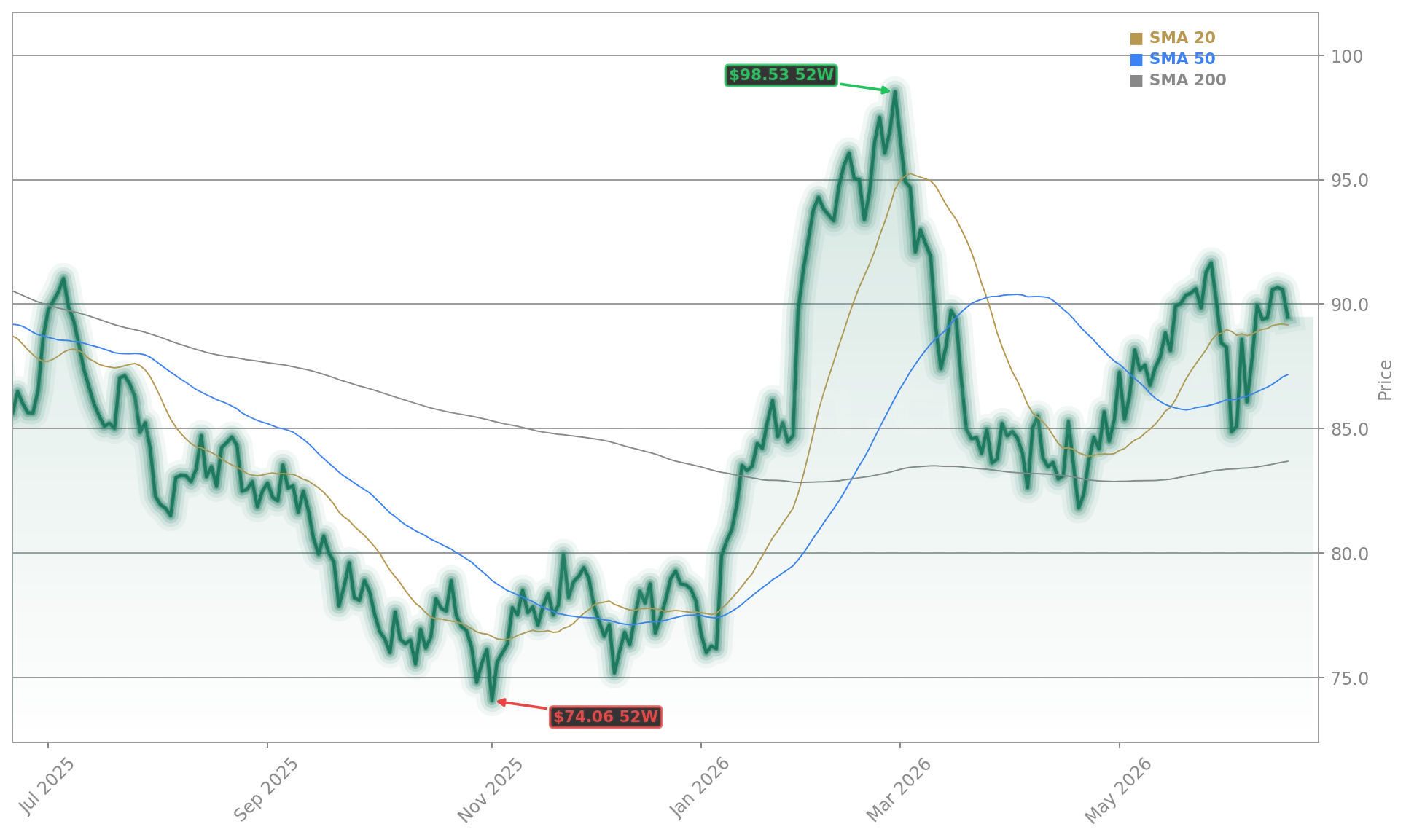
WTI Crude Oil Hormuz volatility directly feeds into the Federal Reserve’s inflation calculus. Oil at $76.11 is well below the $88–$89 peak seen in May, but still significantly above the $62–$63 pre-conflict baseline. As Morgan Stanley analysts stressed in their June 20 report, ‘A sustained drop below $75 would take 2–4 months to meaningfully ease CPI — not an instant fix.’ That lag matters: with core PCE still running at 3.2%, the Fed remains hawkish despite falling oil. Brent’s forward curve — $75 for August, $70 for February 2027 — suggests normalization *if* the 60-day MOU holds. But Goldman Sachs warns that ‘any breakdown in U.S.-Iran talks would trigger an immediate 10–15% repricing,’ spiking two-year yields and pressuring growth-sensitive sectors like technology and real estate.
Are Energy Stocks a Hedge or a Headwind?
It’s open because the media says it is — but not open according to our ship staff.— Khaled Hashim, Managing Director, Precious Shipping
Despite the recent pullback, the energy sector remains one of the strongest performers year-to-date on the S&P 500 — up 14.3% versus the index’s 6.8% gain. Midstream MLPs and second-tier producers like Pioneer Natural Resources (PXD) and Devon Energy (DVN) have outperformed majors, reflecting investor bets on sustained $70–$80 oil. Yet the rally faces headwinds: Qatar’s Ras Laffan explosion — which halted LNG exports — and aluminum supply shocks (the Middle East supplies 20% of non-China aluminum) remind markets that energy volatility ripples across industrials, materials, and even tech hardware supply chains. For portfolios holding Apple, higher energy costs still threaten manufacturing margins and logistics costs — especially as shipping premiums remain elevated despite Hormuz progress.