
Can Broadcom’s explosive custom chip partnerships protect it from the brutal semiconductor sell-off dragging down its stock?

How is Broadcom AI Revenue Outperforming Competitors?
In the recently reported second quarter of fiscal 2026, Broadcom delivered stellar financial results that highlighted the immense scaling of its hardware division. The company’s quarterly **Broadcom AI revenue** reached an impressive $10.80 billion, representing an explosive 143% increase year-over-year. This momentum is projected to accelerate even further in the coming months. CEO Hock Tan guided the third quarter to hit $16.0 billion in **Broadcom AI revenue**, which would represent a staggering year-over-year growth rate of over 200%.
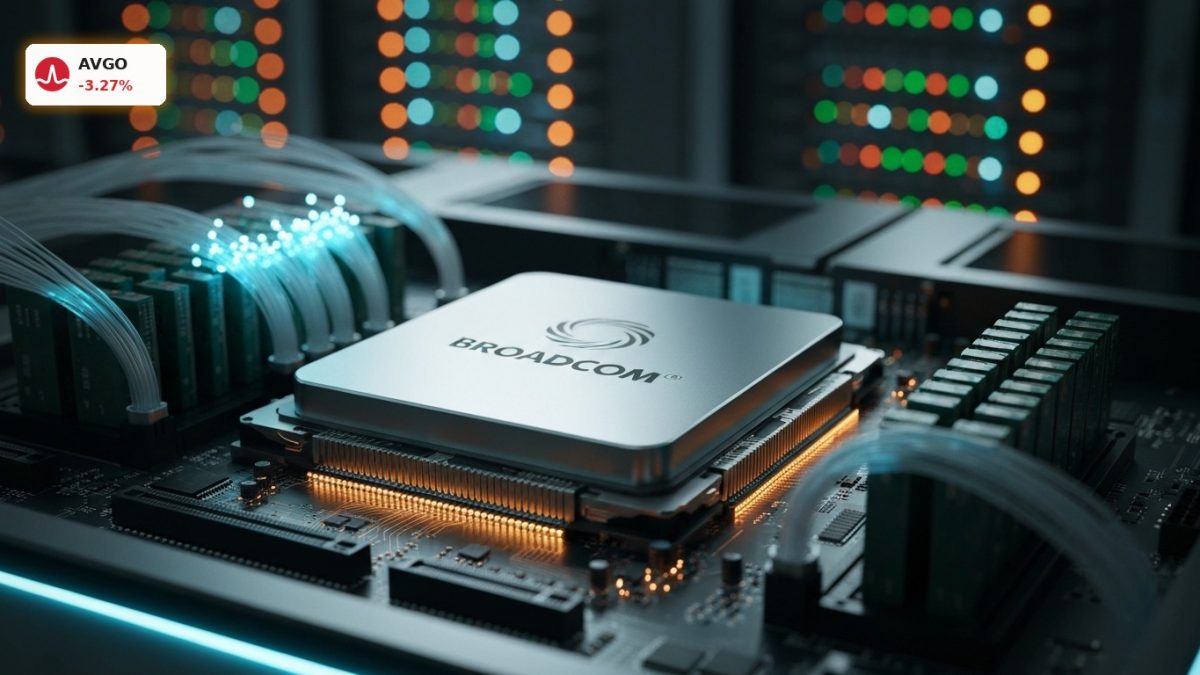
Despite these blockbuster figures, Broadcom’s stock fell 3.27% to close at $380.62 on Friday. Wall Street reacted to a broader semiconductor sell-off and slightly softer guidance for non-AI divisions, a pattern that has recently plagued other chipmakers. However, the fundamental demand for custom silicon remains robust. Total revenue for the second quarter landed at $22.19 billion, up 47.9% year-over-year, supported by non-GAAP earnings per share of $2.44. This marked the eighth consecutive quarter that the company beat consensus expectations. Furthermore, Broadcom generated a massive $10.26 billion in free cash flow during the quarter, representing 46% of its total revenue.
Why is Broadcom Different From Nvidia?
While NVIDIA dominates the market for general-purpose graphics processing units (GPUs), Broadcom has carved out a highly profitable and defensible niche. Instead of competing head-on with Nvidia, Broadcom partners directly with major cloud hyperscalers to design custom application-specific integrated circuits (ASICs). These specialized chips are custom-built for specific workloads, making them far more cost-effective and energy-efficient for large-scale data centers.
A prime example of this strategy is Broadcom’s massive partnership with Apple, which is reportedly structured as a custom AI chip deal worth over $30 billion running through 2031. By securing long-term, multi-billion-dollar contracts with the world’s largest tech companies, Broadcom secures highly predictable, multi-year revenue streams. This custom chip strategy, combined with a highly profitable infrastructure software segment bolstered by the VMware acquisition, provides a diversified business model that pure-play GPU manufacturers cannot easily replicate.
What is the Outlook for Semiconductor Stocks?
The broader semiconductor landscape is undergoing a significant architectural evolution. While Broadcom dominates custom ASICs and networking, other players are attempting to solve different bottlenecks. For instance, Citrini Research recently highlighted how Qualcomm is attempting to bypass the expensive High-Bandwidth Memory (HBM) “memory wall” by placing compute components directly beneath LPDDR memory. While Qualcomm targets over $15 billion in data center revenue by fiscal 2029, Broadcom is already operating at a massive scale today, with plans to generate $100 billion or more in cumulative AI semiconductor revenue by 2027.
Wall Street analysts remain overwhelmingly bullish on Broadcom’s long-term prospects. Out of 44 analysts tracking the stock, there are currently zero sell ratings, with a consensus price target sitting at $525. This target implies a significant upside of nearly 38% from the current trading price of $380.62.
Related Coverage
For investors tracking these market shifts, our coverage on the Broadcom AI Boom analyzes how explosive chip orders are balancing out margin pressures. Additionally, the recent tech sector correction is detailed in our report on Micron Memory Chips, which highlights the broader cyclical risks facing hardware manufacturers.
The momentum continues and in Q3 we expect semiconductor revenue from AI to grow over 200 percent year-over-year to $16.0 billion.— Hock Tan
In conclusion, the massive scale of **Broadcom AI revenue** solidifies the company’s status as an indispensable pillar of the global artificial intelligence infrastructure build-out. For forward-looking investors, Broadcom’s combination of custom silicon dominance, robust cash flows, and a reliable dividend makes it a compelling cornerstone for any tech-focused portfolio. As hyperscalers continue to scale their custom chip deployments, Broadcom is exceptionally well-positioned to lead the next phase of enterprise AI expansion.