
Did Broadcom Earnings reveal the first real crack in Wall Street’s AI spending narrative?

Why did Broadcom Earnings trigger a Nasdaq selloff?
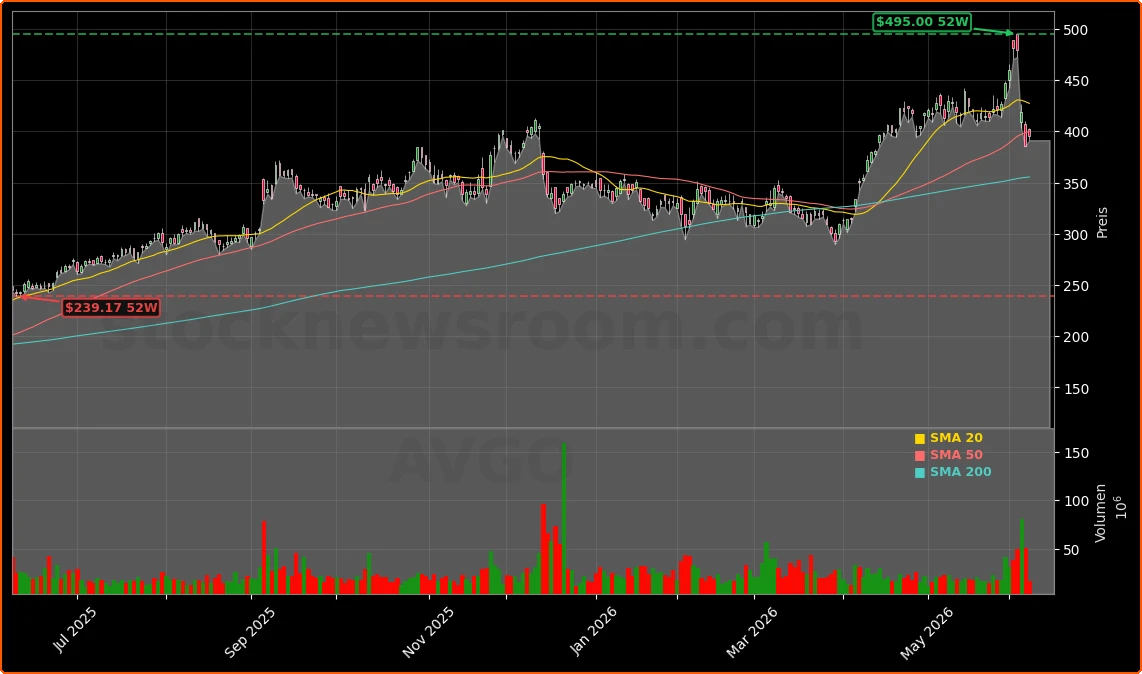
It wasn’t the numbers—it was the narrative. Broadcom Inc. delivered what should have been a victory lap: $22.187 billion in Q2 revenue, $2.44 non-GAAP EPS, and $10.8 billion in AI semiconductor revenue, up 143% year over year. Yet Wall Street’s reaction was swift and severe. Shares plunged nearly 8% on Friday, June 5—capping a 14% weekly decline—after CEO Hock Tan guided Q3 AI semiconductor revenue to $16.0 billion, below the $17.2 billion whisper number. The market interpreted the shortfall not as a modest deceleration, but as the first quantitative crack in the ‘uncapped hyperscaler demand’ thesis. That read-through hit NVIDIA, Meta, and Intel hard, dragging the SOX semiconductor index down nearly 10% on Friday alone and contributing to the Nasdaq’s 4.7% weekly drop—the worst since April 2025.
What does Google’s ‘multiple supplier’ comment really mean?
Tan’s offhand remark that Google may diversify its custom-silicon suppliers ignited disproportionate concern. While Broadcom remains Google’s primary TPU partner—with supply agreements extending to 2031—investors fixated on the implication of reduced exclusivity. HSBC analyst Frank Lee quickly dismissed fears of lost business, raising Broadcom’s price target to $600 and reaffirming its leadership in ASIC revenue growth. Citigroup’s Asiya Merchant also maintained a Buy rating, citing deepening multi-year deployment agreements with Anthropic, OpenAI, and Meta. Still, the comment resonated: if even Alphabet—the most committed TPU user—considers redundancy, the entire custom AI silicon moat looks less impregnable. That uncertainty hit Broadcom hardest, given its outsized 5% weight in the Technology Select Sector ETF (XLK) and ~39% exposure to semiconductors within the fund.
How is Broadcom expanding beyond chips?
On the same day the market digested the earnings fallout, Broadcom announced a strategic pivot into AI-enabled infrastructure security—releasing the largest set of Spring security updates in the framework’s 23-year history. The move extends its clean-room build architecture to Java dependencies across the full Spring Boot bill of materials, covering over 100,000 validated dependency builds. As Purnima Padmanabhan, VP of Broadcom’s Tanzu Division, stated: “Because we maintain Spring and are the sole committers, we can better secure it at the source.” This positions Broadcom not just as a chip supplier, but as a steward of mission-critical enterprise software supply chains—a high-margin, recurring-revenue extension of its infrastructure software business. It also directly addresses AI’s dark side: security advisories surged over 1700% from March to April 2026, making rapid patching a new competitive battleground.
Is the AI capex story still intact?
Yes—but the pricing has reset. Broadcom reaffirmed its full-year FY2026 AI semiconductor revenue target of $56 billion and reiterated “excess of $100 billion” for FY2027. Customer commitments remain staggering: Meta’s 3-gigawatt MTIA XPUs through 2028, OpenAI’s 10-gigawatt agreement through 2029, and Anthropic’s 6-gigawatt rollout starting in 2027. Mizuho projects Broadcom’s TPU shipments could hit 35 million units by 2028—8x its 2026 estimate—backing a $170 billion AI revenue forecast for that year. Meanwhile, UBS trimmed its price target to $485 but maintained a Buy rating, citing “solid execution and durable infrastructure positioning.” The real risk isn’t demand—it’s whether the market will pay 34x forward earnings for a company whose growth is now being scrutinized for pacing, not just magnitude.
Broadcom Earnings have exposed a new market regime: one where AI infrastructure stocks trade on near-term order visibility, not just long-term TAM expansion. For U.S. investors, the key questions are no longer whether AI will grow—but how hyperscalers allocate capex across vendors, geographies, and compute layers. Broadcom remains the most direct play on custom AI silicon and networking, with robust free cash flow and a diversified software base. The recent dip reflects valuation discipline—not broken fundamentals. The next quarterly earnings will show whether the $16 billion AI guide holds—or whether Broadcom’s history of under-promising and over-delivering reasserts itself. For long-term portfolios, this is not an exit signal—it’s a re-entry opportunity.
Because we maintain Spring and are the sole committers, we can better secure it at the source for everyone who depends on it. This investment is about two things we will never separate: the health of the Spring community and the security of our customers who trust Spring to run their business.— Purnima Padmanabhan, Vice President and General Manager, Tanzu Division, Broadcom
Related Coverage: Did Broadcom’s massive AI growth just hit the first valuation wall investors were not prepared to forgive? Broadcom Earnings $16B Warning Sends AVGO Down After Hours. The selloff also triggered ripple effects across the AI value chain—24/7 Wall St. noted how junior copper miners like COPJ fell 11% on the same day, reflecting how tightly AI infrastructure demand is now linked to commodity markets. Meanwhile, Yahoo Finance reported Broadcom’s new financing platform for Anthropic and OpenAI, signaling a shift from chip supplier to AI infrastructure financier.