
Did Broadcom’s strong quarter really disappoint investors, or has the AI trade simply become too expensive to impress?

Why Did Broadcom Earnings Trigger a Sell-Off?
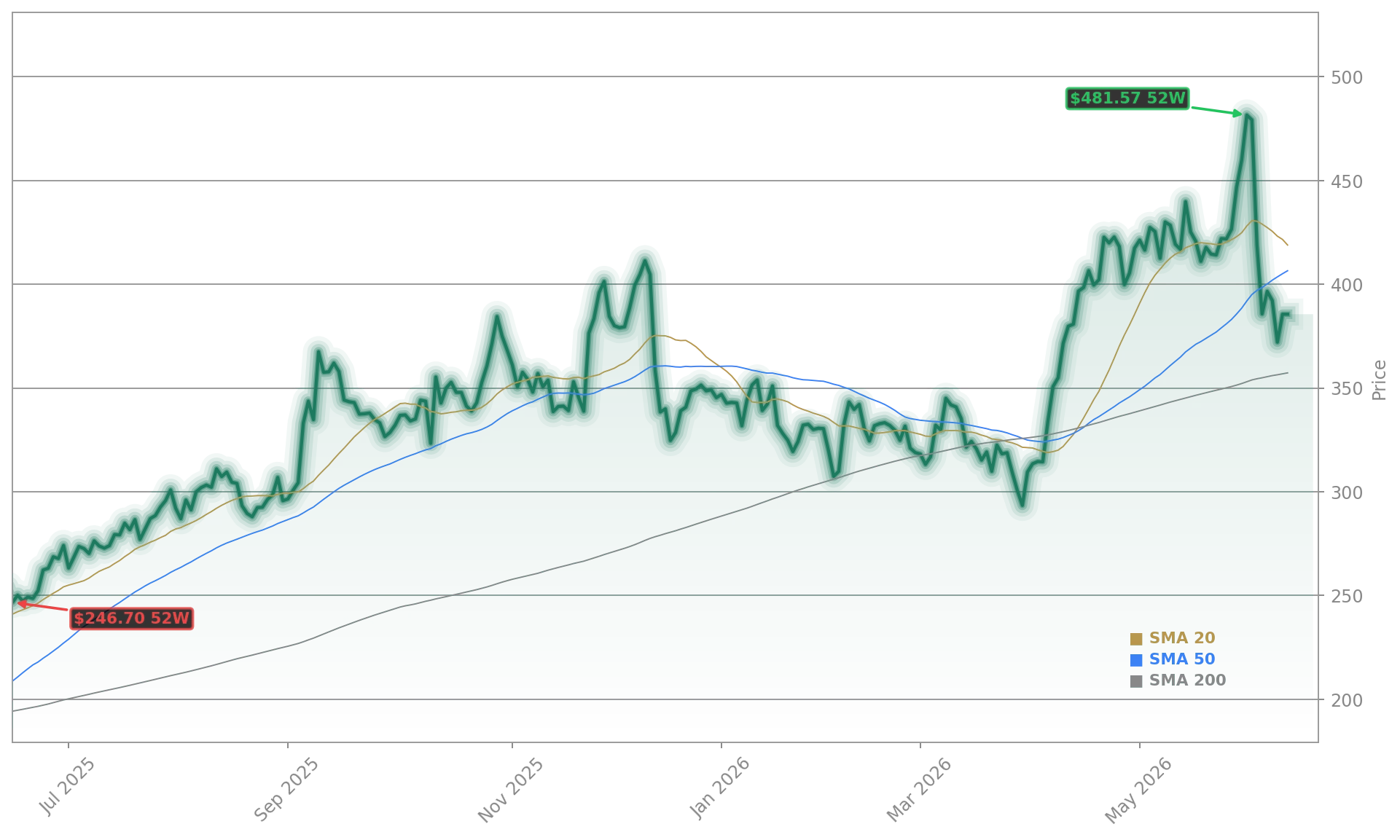
Despite beating EPS estimates by 1.7% and delivering $10.8 billion in AI semiconductor revenue — $300 million above guidance — Broadcom Inc. shares dropped to $443.88 in after-hours trading, a 7.38% decline from the $479.23 close. The reaction highlights how deeply the AI infrastructure narrative has reshaped valuation discipline: with the stock up 95% over the past year and trading near all-time highs, even a robust beat was interpreted as ‘not enough.’ Options markets had priced in an 8–9% move, but the magnitude of the sell-off suggests positioning was heavily skewed toward upside. Traders focused less on the $22.19 billion revenue — which narrowly missed the $22.27 billion consensus — and more on the Q3 AI revenue target of $16 billion, a 200% YoY increase that fell short of HSBC’s $17.2 billion forecast and Oppenheimer’s $17.5 billion call.
How Does Broadcom Compare to NVIDIA and Marvell?
While NVIDIA remains the AI compute standard-bearer, Broadcom Inc. is rapidly emerging as the indispensable infrastructure enabler — designing custom ASICs for Google, Meta, Anthropic, and OpenAI. Its $16 billion Q3 AI semiconductor revenue target represents more than triple the $5.1 billion it generated in Q3 2025. That pace outstrips even Marvell Technology (MRVL), whose recent 9.85% premarket surge followed Jensen Huang’s ‘next trillion-dollar company’ remark — a nod to interconnects, not accelerators. Unlike Marvell, Broadcom combines ASIC design with networking silicon and VMware software, giving it broader data center exposure. Yet valuation pressure is mounting: at 23.5x forward 2027 EPS, Broadcom trades at a premium to both Marvell and Advanced Micro Devices (AMD), though below NVIDIA’s 38x multiple.
What Do Analysts Say About the Guidance?
HSBC raised its price target to $600 from $450 — the most aggressive move — citing a fundamental reassessment of Broadcom’s custom AI chip ramp, lifting its FY2027 ASIC revenue forecast to $100.2 billion, 26% above Street consensus. Oppenheimer maintained its Outperform rating and lifted its Q2 AI revenue estimate to $11.5 billion, underscoring how far expectations had stretched. Morgan Stanley affirmed its Overweight rating, noting ‘structural visibility from multi-year hyperscaler contracts,’ while J.P. Morgan upgraded its rating to Overweight, citing ‘unmatched execution on capacity and customer lock-in.’ Crucially, all four banks emphasized that Broadcom’s $100 billion AI revenue target for 2027 hinges on secured CoWoS packaging capacity — 480,000 wafers in FY2027 — from Amkor and ASE, validating HSBC’s supply-chain thesis.
Is the AI Infrastructure Rally Sustainable?
Broadcom Inc. now sits among the top 10 global assets by market value — directly displacing Bitcoin — with AI infrastructure companies commanding 70% of that elite tier. That concentration poses systemic risk: Broadcom, NVIDIA, and Taiwan Semiconductor collectively drive over 40% of the S&P 500’s YTD gains. A slowdown in hyperscaler capex — like Alphabet’s recently announced $190 billion 2026 AI spend — could trigger sharp de-rating. Yet Broadcom’s $650 million quarterly dividend, now $0.65 per share, and $10.26 billion in free cash flow signal financial resilience. With VMware ARR up 19% YoY and AI networking now 40% of AI revenue, the company is diversifying beyond silicon — a critical hedge against chip cycle volatility.
What’s Next for Broadcom Stock?
The immediate test is the Q3 earnings report in early September — and whether Broadcom Inc. clears the $16 billion AI semiconductor revenue bar while reaffirming its $100 billion FY2027 target. With shares down 7.4% post-earnings but still up 39% YTD, technical support rests near $440 — a level that, if breached, could trigger algorithmic selling toward $400. However, the long-term thesis remains intact: Broadcom is the only company shipping custom AI chips to six hyperscalers simultaneously, backed by decade-long agreements with Google and Meta. As HSBC noted, ‘This isn’t cyclical demand — it’s infrastructure build-out with multi-year visibility.’
Q2 semiconductor revenue from AI of $10.8 billion grew 143% year-over-year, above our forecast, driven by increasing demand for custom AI accelerators and AI networking. The momentum continues and in Q3 we expect semiconductor revenue from AI to grow over 200 percent year-over-year to $16 billion.— Hock Tan, President and CEO of Broadcom Inc.
Related Coverage: Broadcom’s Q2 results mark a pivotal moment in the AI infrastructure cycle — not just for its own valuation, but for how Wall Street prices the entire semiconductor stack. For deeper analysis on whether this earnings beat signals sustainable momentum or peak AI speculation, see Broadcom Earnings +4.7% as AI Boom Faces a Key Test.