
Can Thomas Siebel’s return and a cash-rich balance sheet offset another year of shrinking revenue at C3.ai?

What Did C3.ai Earnings Reveal?
C3.ai, Inc. reported fiscal Q4 2026 revenue of $51.6 million — $1.4 million above the $50.2 million consensus — driven by $48.4 million in subscription revenue (94% of total) and $3.2 million in professional services. Non-GAAP gross margin held at 37%, but GAAP gross margin collapsed to 17% from 59% year-over-year, reflecting cost absorption in legacy implementations. The non-GAAP operating loss narrowed to $54.4 million, down from $88.3 million in Q4 2025, aided by a $33.9 million reduction in non-GAAP operating expenses. Free cash flow remained deeply negative at $54.8 million, though cash, cash equivalents, and marketable securities climbed to $673 million after CEO Siebel’s $69 million share purchase at $11.16 per share — a rare insider capital infusion amid a year of net selling.
Why Did Thomas Siebel Resume the CEO Role?
Thomas Siebel stepped back into the CEO role after nine months under Stephen Ehikian, citing ‘entirely unacceptable, to the point of surreal’ sales execution. In his first post-earnings remarks, Siebel declared, ‘The performance of this company has been staggeringly disappointing,’ acknowledging valuation pressure and market skepticism. His return coincided with a full reorganization of sales, product, and federal divisions — replacing narrow regional coverage (100–150 accounts) with a target of ~1,000 enterprise opportunities. Siebel also emphasized that C3.ai is ‘sufficiently well capitalized’ to avoid near-term financing, a key reassurance given Wall Street’s concerns over cash runway.
How Does C3.ai Earnings Compare to Peers?
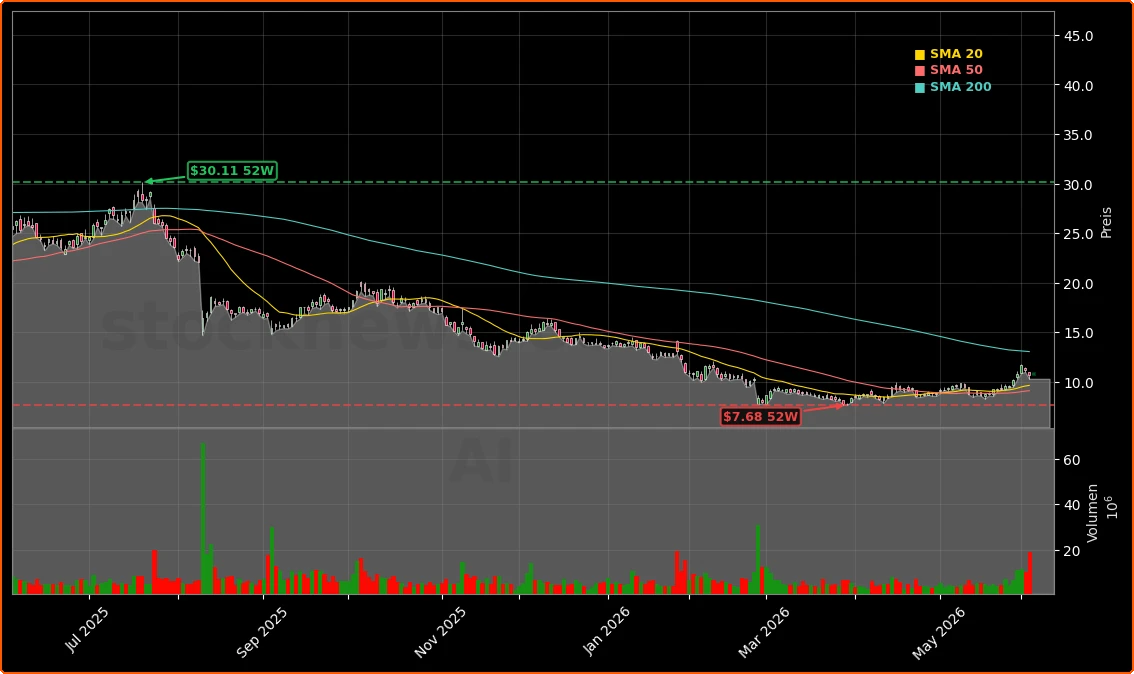
While NVIDIA and Tesla continue to dominate AI infrastructure and edge deployment narratives, C3.ai’s Q4 results land in stark contrast to peers like Palantir (PLTR) and Apple-backed AI tooling firms. Palantir reported 26% YoY commercial revenue growth and 72% gross margins in Q1 2026; C3.ai’s 37% non-GAAP gross margin and 134% federal bookings surge (now 55% of total) highlight divergent go-to-market models. Analysts remain cautious: Wedbush maintains a ‘Buy’ rating, but the broader consensus — per The Globe and Mail — is a ‘Moderate Sell’, with 6 sell and 7 hold ratings from firms including Citigroup and RBC Capital Markets. The average price target stands at $8.82, below the current $10.71 share price.
What’s the Path to Profitability?
Management targets non-GAAP profitability by fiscal 2028, with $130 million in annualized cost reductions already realized toward a $135 million goal. Professional services are expected to shrink to 10%–15% of revenue in fiscal 2027, refocusing on subscription-led growth. However, GAAP gross margin recovery remains elusive — analysts at Morgan Stanley have flagged 40% as a critical inflection point. Federal momentum, anchored by the PANDA contract’s $450 million ceiling through October 2029, offers near-term stability, but commercial traction remains unproven. Sales execution — not product or churn — was cited as the root cause of RPO deterioration, reinforcing that execution, not strategy, is the bottleneck.
C3.ai Earnings: What Does FY27 Guidance Signal?
Fiscal 2027 revenue guidance of $210 million to $240 million implies a 4%–15% decline from FY26’s $246.7 million midpoint — confirming another year of contraction before stabilization. Q1 FY27 is guided to $50 million–$54 million, with non-GAAP operating loss narrowing to $40.5 million–$48.5 million. While the guidance range reflects cost discipline, it also underscores that growth remains secondary to efficiency. The company’s stated focus on ‘agentic AI’ tools across sales, marketing, and services signals a bet on internal productivity — not just external product wins — to drive margin expansion and scalability.
Related coverage includes C3.ai AI Strategy Warning: Is the 2026 Pullback a Chance?, which explores whether the stock’s 55% one-year decline reflects overreaction or justified skepticism amid Wall Street’s AI rotation. That analysis notes C3.ai’s unique position in defense and intelligence AI — a niche increasingly insulated from commercial budget cuts — and questions whether federal momentum can catalyze broader enterprise adoption before FY28.
The performance of this company has been staggeringly disappointing.— Thomas M. Siebel, CEO and Founder, C3.ai, Inc.
C3.ai Earnings mark a pivotal reset — not a turnaround. The company has stabilized operations, cut costs aggressively, and reinstalled its founder as CEO with skin in the game. For investors, the critical question isn’t whether C3.ai can survive, but whether it can convert federal wins and broader account coverage into sustainable commercial growth. The next quarterly earnings will test whether sales execution has truly improved — and whether Wall Street’s $8.82 consensus target finally aligns with reality.