Did CMS just hand Clover Health the kind of rating upgrade that can change its growth story overnight?

What triggered the Clover Health Star Rating upgrade?
The Clover Health Star Rating revision followed a decisive legal win: on May 29, 2026, the U.S. District Court for the Southern District of Georgia granted partial summary judgment in Clover Insurance Co. v. U.S. Department of Health and Human Services, invalidating CMS’s original 3.5-star designation for Clover’s PPO plan. The court ordered CMS to recalculate the rating using methodology consistent with Medicare statute and prior precedent. On June 9, CMS complied — awarding 4.5 stars and instructing Clover to submit revised bids for Payment Year 2027. This outcome directly contrasts with peers like UnitedHealth Group, whose 2026 Star Ratings were finalized without litigation, and underscores how regulatory clarity can rapidly reprice risk in the Medicare Advantage space.
How does the 4.5-star rating affect Clover Health Investments Corp. financially?
A 4.5-star rating unlocks significant financial upside: CMS ties bonus payments, marketing advantages, and enrollment eligibility to Star Ratings. Plans rated 4 stars or higher qualify for quality bonus payments — estimated at 2–5% of base capitation — and gain preferential placement in Medicare Plan Finder. With Contract H5141 representing >97% of Clover’s membership, the upgrade could add $30–$50 million in annual revenue — a material catalyst for a company still navigating path-to-profitability concerns. Notably, Clover’s HMO plan (Contract H8010) retains its 4.0-star rating, unaffected by the litigation. Analysts at RBC Capital Markets have flagged the rating upgrade as a near-term EPS catalyst, though they maintain a ‘Sector Perform’ rating pending Q2 2026 margin data.
Why did Wall Street react so strongly — and is it justified?
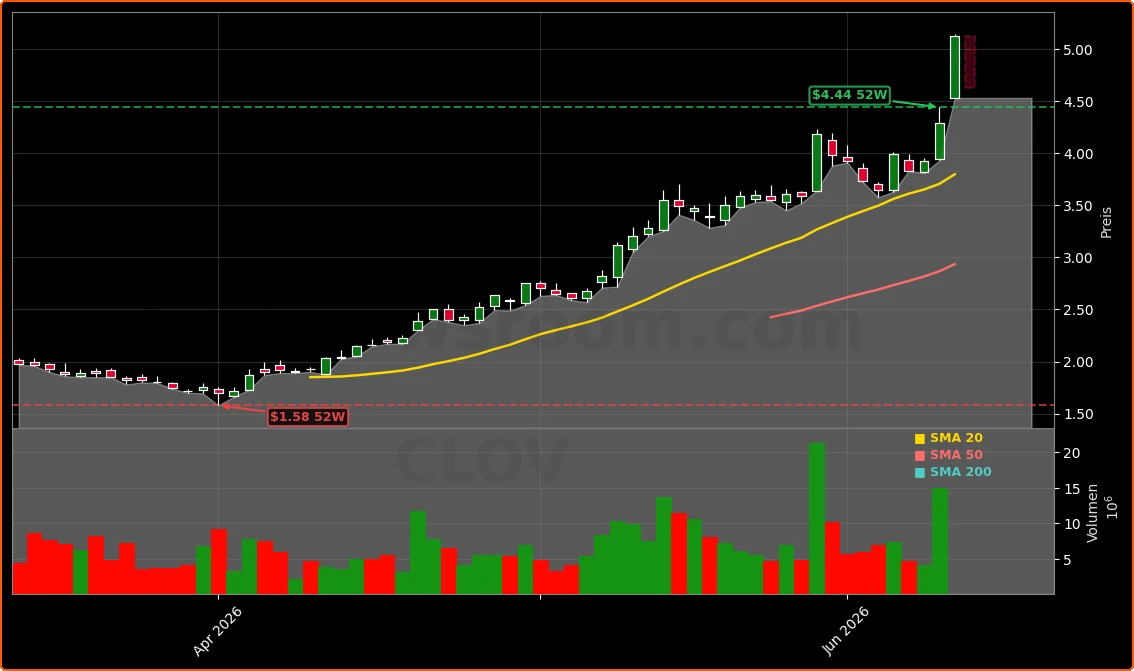
Investors priced in a 19.35% intraday surge — the largest single-day gain since January 2026 — reflecting both relief and recalibration. The stock has doubled year-to-date despite insider selling by CEO Conrad Wai ($879,000 in late May) and directors Carladenise Edwards and Brady Priest. This divergence highlights Wall Street’s prioritization of regulatory certainty over governance noise in high-beta healthcare names. For context, the NASDAQ Health Care Index rose just 0.3% on June 10, while broader markets declined — underscoring Clover’s idiosyncratic momentum. Traders are now comparing Clover’s re-rating to prior Medicare Advantage winners like Humana, which saw sustained outperformance after Star Rating upgrades in 2023–2024.
How does Clover Health Star Rating compare to sector peers?
Clover’s new 4.5-star PPO rating now sits above the 2026 industry median of 4.1 stars for MA-PD plans, per CMS data. It trails only elite performers like UnitedHealth Group’s 4.7-star flagship plan but surpasses key competitors including CVS Health’s Aetna (4.3) and Cigna’s HealthSpring (4.2). Crucially, Clover achieved this without the scale advantages of its peers — its 400,000+ members remain dwarfed by UnitedHealth’s 8 million MA enrollees. That scalability gap remains a concern for long-term investors, but the Clover Health Star Rating win validates its clinical and operational model. Goldman Sachs analysts noted in a June 9 research note that ‘Clover’s recalibration strengthens its case for sustainable quality-driven growth — a narrative increasingly critical amid CMS’s 2027 payment rule revisions.’
What’s next for Clover Health Investments Corp.?
Clover’s recalibration strengthens its case for sustainable quality-driven growth — a narrative increasingly critical amid CMS’s 2027 payment rule revisions.— Goldman Sachs analysts
Clover must now submit revised bids for Payment Year 2027 by CMS’s July 15 deadline — a process that will determine premium pricing and benefit design for 2027. The company also faces Q2 2026 earnings on August 7, where analysts expect improved EBITDA margins amid the Star Rating tailwind. With its 52-week high at $5.80 and current price at $5.12, the stock trades just 12% below that peak — a level not seen since March 2026. Technical indicators show strong accumulation, and short interest has declined 22% over the past 30 days, per NASDAQ data. For investors, the upgraded Clover Health Star Rating isn’t just a quality signal — it’s a valuation inflection point.