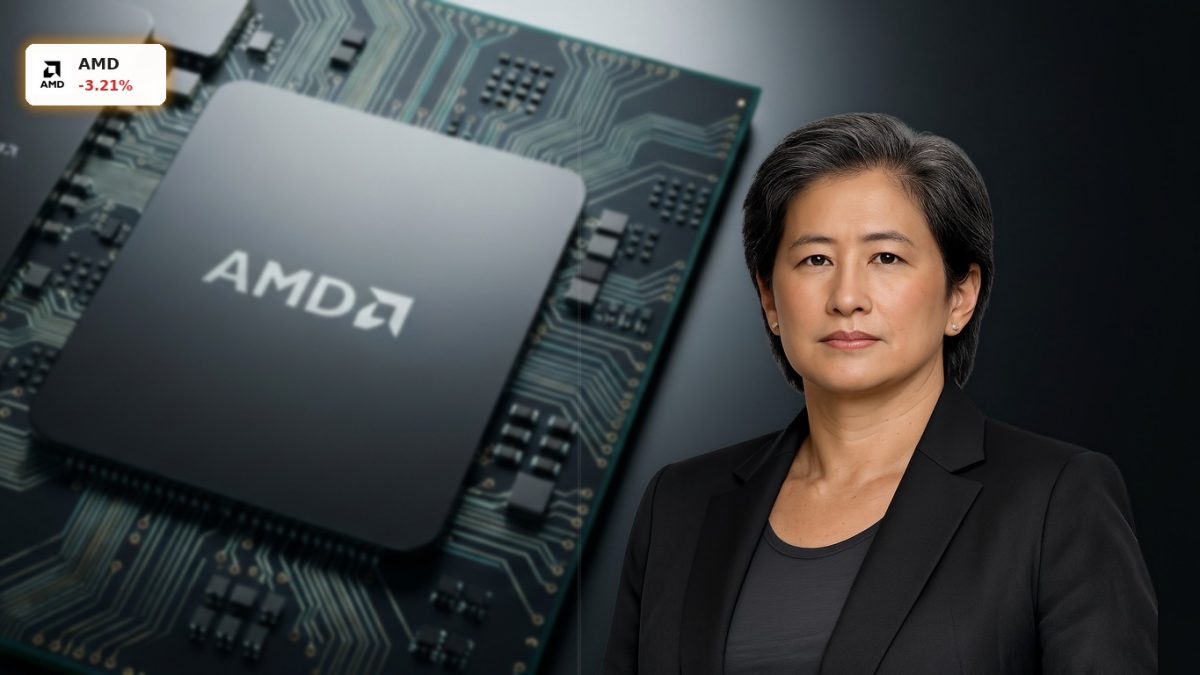

Can AMD’s ambitious multi-billion dollar AI expansion plans overcome the sudden market sell-off and outpace Nvidia?

How Does the AMD AI Strategy Challenge Rivals?
The updated AMD AI Strategy focuses heavily on capturing a massive share of the artificial intelligence infrastructure market. During the event, CEO Dr. Lisa Su raised the company’s estimated total addressable market (TAM) to $2 trillion by 2030, a significant jump from prior forecasts. AMD showcased its new Helios rack-scale AI platform, which integrates the next-generation Instinct MI450 Series GPUs and the 6th Gen EPYC “Venice” CPUs.
This dual-threat capability gives AMD a unique edge. While NVIDIA remains the dominant force in GPUs, AMD is the only U.S.-listed player offering both leading server CPUs and high-performance accelerators at scale. This combination is particularly crucial for agentic AI, where workloads constantly loop between GPU reasoning and CPU tool execution. By optimizing both sides of the hardware equation, the company is proving that its product pipeline is built for the next phase of physical and frontier AI.
Which Partners Support Advanced Micro Devices?
A key pillar of the AMD AI Strategy is its deep integration with leading AI developers and hyperscalers. AMD announced a monumental multi-year collaboration and strategic investment of up to $5 billion in Anthropic. This partnership will see Anthropic deploy up to 2 gigawatts of Instinct MI450 GPUs in Helios systems starting in early 2027, while optimizing its Claude AI models for AMD’s ROCm open-source software stack.
This massive deal follows similar high-capacity agreements. AMD has already committed substantial infrastructure to Meta Platforms and OpenAI, representing a significant portion of its long-term capacity. Additionally, Microsoft announced plans to deploy Helios systems across its Azure AI services starting in late 2026. These partnerships demonstrate that the industry is actively seeking a viable second source for high-end AI silicon, directly benefiting AMD’s market share expansion.
What Are Analysts Saying About the Stock?
Following these announcements, major investment banks rushed to adjust their models, leading to a wave of price target upgrades. UBS analyst Timothy Arcuri reiterated a buy rating and raised his price target to $730 from $700, noting that AMD remains a top pick. Wedbush analyst Matt Bryson kept an outperform rating and lifted his target to $600 from $450, citing improved supply chain conditions and a stronger data center growth trajectory.
Similarly, BofA Securities analyst Vivek Arya increased his price target to $620, while Roth Capital raised its target to $650. Wells Fargo analyst Aaron Rakers maintained a $615 target with high conviction, projecting data center GPU revenue to reach $40.6 billion by 2027. Even conservative assessments, like RBC Capital analyst Srini Pajjuri keeping a sector perform rating and $540 target, acknowledged that the Anthropic deal strengthens AMD’s long-term earnings potential.
Related Coverage
AMD is partnering across the ecosystem to deliver leadership compute and open platforms that give customers the performance, flexibility and choice to scale AI from the data center to the edge.— Dr. Lisa Su
For more insights into how these major cloud agreements impact the market, read about the AMD Microsoft Partnership Drives Stock +5% as Helios AI Launches, which highlights the initial market reaction to the Helios platform. Additionally, to understand broader technology trends amid recent market volatility, explore IonQ Growth Slows? Stock Drops -3.2% Despite 755% Revenue Surge to see how other tech sectors are performing.