
Can a fresh Wall Street buy call finally reset the narrative around UnitedHealth after months of Medicare pressure?

What triggered the UnitedHealth Upgrade?
Bank of America analyst Kevin Fischbeck initiated the UnitedHealth Upgrade on June 4, 2026, shifting the rating from Neutral to Buy and lifting the price target from $420 to $450. The firm cited improving healthcare cost trends, stronger-than-expected Q1 2026 earnings, and UnitedHealth’s unique positioning in Medicare Advantage — where it continues to outpace competitors despite flat 2027 reimbursement rates from CMS. Fischbeck emphasized that UnitedHealth’s scale, vertical integration, and advanced analytics allow it to absorb margin pressure more effectively than rivals like Humana (HUM) or CVS Health (CVS), both of which face steeper Medicare headwinds in 2026.
How does UnitedHealth compare to healthcare peers?
While the broader healthcare sector remains under scrutiny for regulatory risk and Medicare uncertainty, UnitedHealth Group Incorporated stands apart. Truist recently raised its price target to $440 — reinforcing the bullish consensus — whereas CVS Health trades near a 52-week low amid pharmacy benefit manager (PBM) margin compression. Meanwhile, CVS Health’s dividend yield is higher, but its 3-year dividend growth rate lags far behind UnitedHealth’s 16-year streak of annual increases. In contrast, UnitedHealth’s $2.32 quarterly payout — up 5% year-over-year — reflects durable cash flow generation. Its inclusion in the Schwab U.S. Dividend Equity ETF (SCHD) during March 2026’s reconstitution further validates its status as a core dividend growth holding for institutional investors.
What operational wins support the UnitedHealth Upgrade?
Beyond financials, UnitedHealth Group Incorporated is executing on strategic initiatives that directly address investor concerns. At its June 2026 shareholder meeting, the board re-elected key directors including Dr. Scott Gottlieb and Charles Baker — affirming continuity in leadership. More concretely, UnitedHealthcare announced it will eliminate nearly two-thirds of prior authorization requirements for members under 18 by year-end — a move praised by The Globe and Mail for reducing administrative friction and improving pediatric access. The company also implemented a two-year equity retention rule for executives, aligning leadership incentives with long-term shareholder value. These steps strengthen governance and operational credibility — factors Bank of America explicitly cited in its UnitedHealth Upgrade rationale.
Is the valuation justified amid Medicare pressure?
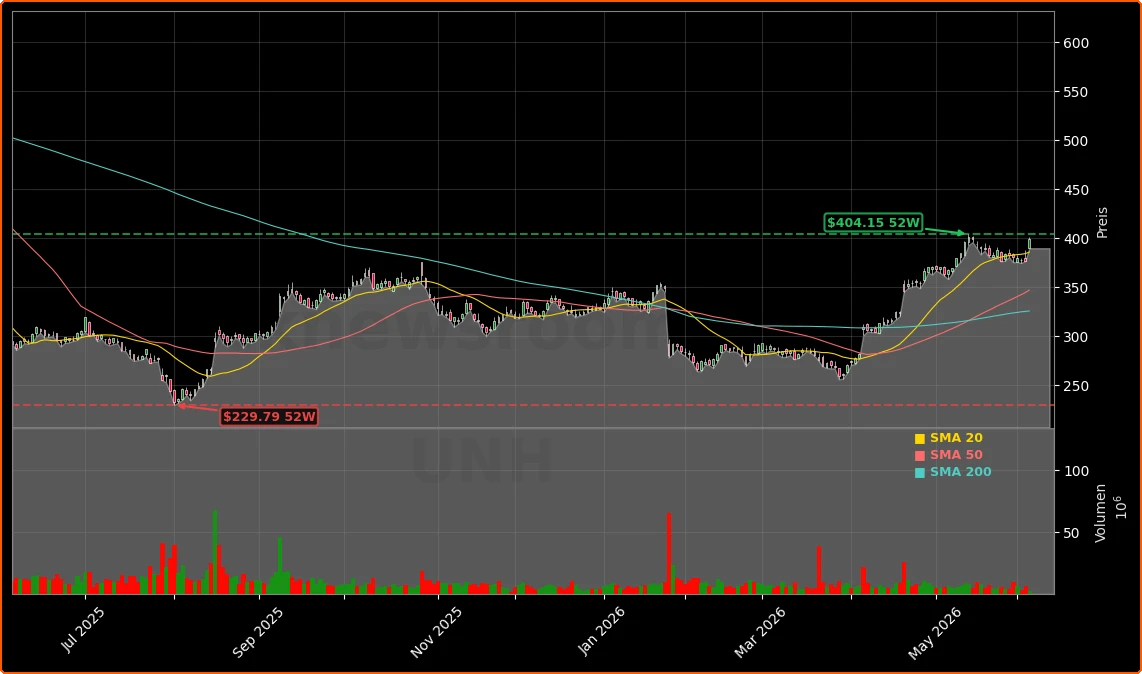
Yes — but selectively. While the Center for Medicare & Medicaid Services’ flat 2027 reimbursement increase poses near-term risk, UnitedHealth’s Q1 2026 revenue hit $111.7 billion, and management reaffirmed its full-year adjusted EPS guidance of at least $18.25. That guidance implies ~6% growth over 2025 — outpacing sector averages. GuruFocus notes UnitedHealth’s GF Score™ of 81, reflecting strong financial health, though cautions about its elevated P/E ratio and recent insider selling. Still, with the stock trading well below its 52-week high of $452.30 (as of May 2026), the $450 target remains within technical reach — especially as NASDAQ healthcare stocks rally on AI-driven efficiency gains, a trend also visible at NVIDIA and Apple.
UnitedHealth Group Incorporated remains a cornerstone of the S&P 500 and a critical barometer for U.S. healthcare profitability. Its UnitedHealth Upgrade reflects not just earnings resilience, but confidence in its ability to lead industry evolution — from AI-powered claims processing to patient-centered care redesign. For investors focused on quality, cash flow, and consistent capital return, this UnitedHealth Upgrade marks a timely signal. The next quarterly earnings report — due in mid-July — will test whether the momentum holds through Q2. For long-term portfolios, UnitedHealth Group Incorporated continues to deliver both stability and strategic optionality.
UnitedHealth is positioned well to keep earnings growing over the next several years.— Kevin Fischbeck, Bank of America
Related Coverage: UnitedHealth’s Q1 earnings beat was driven by surging AI investments and improved medical cost trends — read the full analysis in UnitedHealth Earnings Q1 Beat as AI Spend Surges.