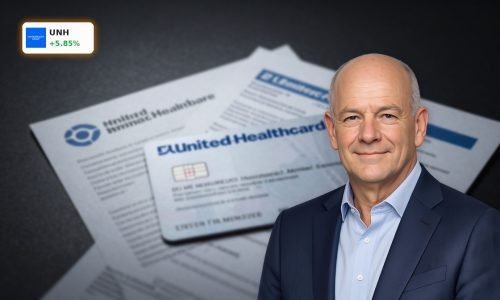

Will UnitedHealth’s massive $1.5 billion artificial intelligence push permanently shield the healthcare giant from rising industry inflation?

How did the UnitedHealth Earnings report beat expectations?
The second-quarter financial results of UnitedHealth Group (UNH) showed a significant rebound. The company reported adjusted earnings per share (EPS) of $6.38, representing a massive 55% year-over-year increase that easily surpassed the consensus estimate of analysts. Total revenue remained stable at $112 billion, while operational earnings reached $8 billion. This strong profitability was heavily supported by the company’s Medicare Advantage segment, which drove the bulk of the quarterly upside.
A critical metric for health insurers is the medical care ratio, which represents the percentage of premiums paid out for medical claims. During the second quarter, UnitedHealth Group reported a highly improved medical care ratio of 86.7%, down from 89.4% in the prior year. Chief Financial Officer Wayne Devit cautioned that this improvement reflects the company’s disciplined pricing power and internal cost controls rather than a broader easing of industry-wide healthcare inflation.
What is driving the upgraded 2026 outlook?
Backed by the strong momentum of these UnitedHealth Earnings, the company officially upgraded its full-year 2026 adjusted outlook. Management now projects adjusted EPS to land between $19.50 and $20, up significantly from its prior guidance of $18.25. The company also increased its full-year operating earnings outlook for its insurance arm, UnitedHealthcare, to at least $12 billion, and for its health services division, Optum Health, to at least $2.2 billion.
In addition to raising profit targets, the company is dramatically increasing its capital return program. UnitedHealth Group now expects to complete at least $5 billion in share repurchases in 2026, doubling its initial guidance of $2.5 billion. The board also increased the annualized dividend to $9.28 per share, underlining the exceptional cash generation of the business, which recorded $11 billion in operating cash flow during the quarter.
How is AI transforming UnitedHealth Group?
A central pillar of the company’s turnaround strategy is a massive $1.5 billion investment in artificial intelligence. Chief Executive Officer Stephen Hemsley highlighted that the company is utilizing AI to streamline operations, reduce administrative complexity, and automate prior authorization processes. The company expects a 2-to-1 return on these tech investments, which are already showing real-world results.
For instance, Optum Health has implemented AI-based ambient listening technology for 70% of its employed clinicians, with plans to exceed 90% by year-end. This technology has successfully reduced cognitive burnout among clinical staff by 90%. Additionally, the Optum Insight division has deployed AI-driven platforms that have achieved a 96% first-pass approval rate for digital prior authorizations, saving thousands of administrative hours and accelerating patient care delivery.
How did Wall Street analysts react to the news?
The financial community reacted with widespread optimism to the updated UnitedHealth Earnings. Following the release, Robert W. Baird upgraded UnitedHealth Group from Underperform to Neutral, raising its price target to $453. Meanwhile, CFRA maintained its positive stance, raising its 12-month price target on the stock to $500 from $440, citing the company’s superior scale and pricing power.
In the market, UnitedHealth Group shares rose by 1.94% to close at $426.65, after initially surging as much as 7.5% to hit a 15-month high during intraday trading. The stock acted as a major anchor for the price-weighted Dow Jones Industrial Average on an otherwise mixed day for Wall Street equities.
Related Coverage
This positive earnings surprise comes at a critical time for the healthcare giant. Just days ago, investors were on edge as the UnitedHealth Earnings: Stock Drops -1.6% as FTC Regulatory Pressure Mounts report highlighted how intense regulatory scrutiny could threaten the company’s pharmacy benefit manager business. Meanwhile, the broader market has faced tech-driven volatility, as seen in the semiconductor space where the ASML Stock Drops 6% as Weak Bookings Shadow Earnings Beat report triggered a wider sell-off across the NASDAQ and S&P 500.
We are really thinking of AI in terms of reimagining our entire enterprise, virtually everything that we do. We see it basically as the operating infrastructure of the future.— Stephen Hemsley
In conclusion, the latest UnitedHealth Earnings demonstrate that the company remains a dominant force in the healthcare sector, successfully navigating elevated medical costs through pricing discipline and technological innovation. For long-term investors, the combination of raised guidance, aggressive share buybacks, and pioneering AI implementation makes UnitedHealth Group a highly resilient defensive holding. The next quarterly reports will determine if this operational turnaround can maintain its impressive momentum through the second half of the year.