Can the latest CVS Health Earnings beat and upgraded outlook finally turn this battered healthcare giant into a convincing comeback story?

How did CVS Health Earnings move the stock today?
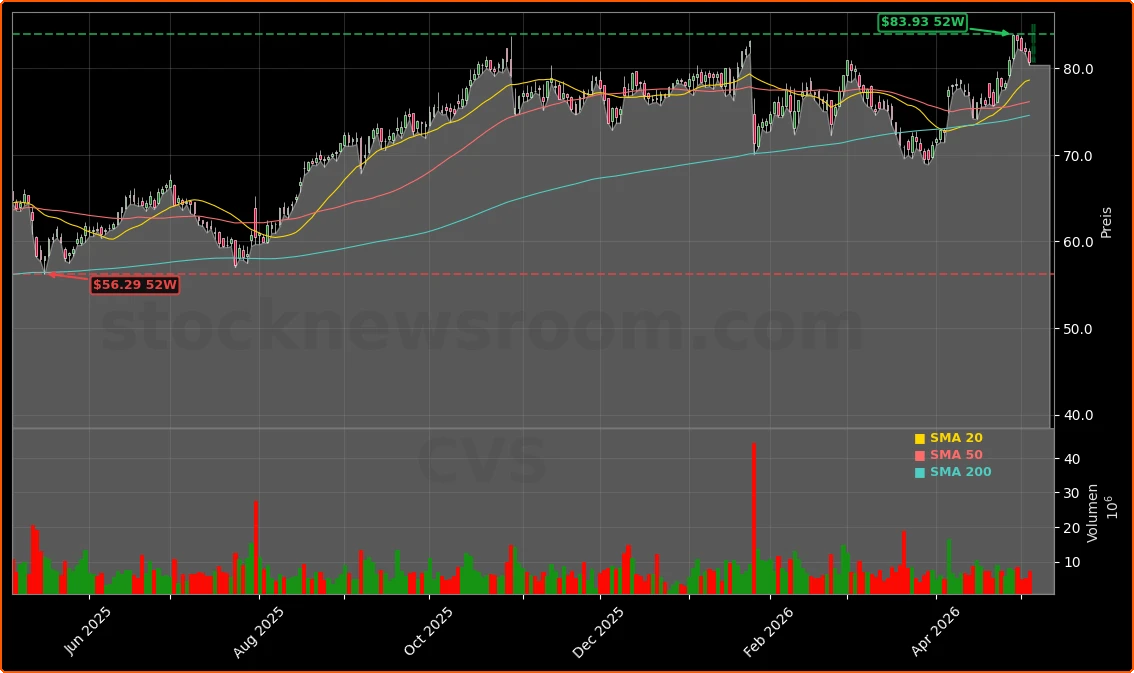
CVS Health Corporation (CVS) shares were up about 5.5% in early Wall Street trading on Wednesday, with the stock indicated around $85.13 in pre-market action at 8:00 a.m. ET. That bounce follows a 1.61% decline on Tuesday to $80.69, which marked the fourth straight daily loss for the stock even as the S&P 500 and Dow gained. The latest CVS Health Earnings report appears to have broken that losing streak, as investors reassess the company’s profitability trajectory and upgraded guidance for 2026.
From a broader market perspective, CVS remains well below its 52‑week high, so the move is more of a recovery rally than a breakout to new records. Still, a more than 40% climb off its 52‑week low has already turned the name back into a credible healthcare value play for portfolios seeking income and lower volatility compared with high‑beta technology leaders like NVIDIA and Tesla.
What is behind the CVS Health Earnings beat?
For Q1 2026, CVS posted adjusted earnings per share of $2.57, easily topping analyst expectations of roughly $2.20. Revenue rose 6.2% year over year to $100.43 billion, also above consensus estimates near $95 billion. Net income under GAAP climbed to $2.94 billion, or $2.30 per share, up from $1.78 billion, or $1.41 per share, a year earlier.
The beat was broad-based. The Health Care Benefits segment, anchored by the Aetna insurance arm, generated about $35.97 billion in revenue, up around 3% from Q1 2025 and ahead of Wall Street’s roughly $33.3 billion target. Health services revenue, which includes the Caremark pharmacy benefit manager, increased 11% to $48.24 billion. Pharmacy and consumer wellness sales were essentially flat year over year at $31.99 billion, but still edged past expectations.
Management emphasized that these results reflect continued progress in a multi‑year turnaround plan, which includes roughly $2 billion in cost cuts, store rationalizations, leadership changes, and tighter discipline in Medicare Advantage pricing and benefits.
How strong is Aetna’s improvement for CVS Health Earnings?
The key driver of confidence in the latest CVS Health Earnings release is the improvement in the Aetna insurance business, which had been pressured by elevated medical costs. The segment’s medical benefit ratio (also called medical loss ratio) fell to 84.6% from 87.3% a year earlier, well below analyst expectations near the mid‑86% range. A lower ratio means CVS is spending a smaller share of premium revenue on claims, boosting profitability.
CVS attributed part of the year‑over‑year improvement to the absence of a premium deficiency reserve that weighed on results in the prior year. More broadly, the company is managing higher utilization in Medicare Advantage by trimming membership where necessary, exiting unprofitable markets, and adjusting benefits and pricing for 2027 in response to government reimbursement levels that still lag internal cost estimates.
While membership has edged down, the mix has become more profitable. That dynamic differentiates CVS from some peers in Medicare Advantage, even as major insurers across the sector work through similar cost and pricing mismatches.
What guidance did CVS raise for 2026?
On the back of the strong quarter, CVS lifted its full‑year 2026 outlook. Management now expects adjusted EPS of $7.30 to $7.50, up from the prior range of $7.00 to $7.20. That places the new guidance comfortably above the roughly $7.16 per share many on Wall Street had penciled in ahead of the report. GAAP diluted EPS guidance was increased to $6.24 to $6.44, versus the earlier $5.94 to $6.14 outlook.
The company also nudged up its revenue and cash-flow targets. CVS now projects at least $405 billion in full‑year revenue, compared with a previous floor of $400 billion. Expected cash flow from operations has been raised to at least $9.5 billion, from at least $9.0 billion. Management continues to highlight its integrated model — combining insurance, pharmacy services, and retail access — as a competitive advantage in steering patients toward cost‑effective care while maintaining margins.
How does CVS compare to other healthcare giants?
The first quarter has generally been solid for large U.S. health insurers and diversified healthcare conglomerates, including names like UnitedHealth and Humana. CVS’s performance and improved Aetna metrics place it in the stronger camp on medical cost control, an area that has rattled investors over the past two years.
For U.S. equity portfolios, CVS offers a different profile than high‑growth technology bellwethers like Apple. Its earnings streams are more regulated and less cyclical, but they can be hit by policy changes and reimbursement pressures. The raised outlook suggests management is regaining credibility after several 2024 missteps and a CEO transition, even as executives continue to describe their stance as conservatively optimistic rather than aggressively bullish.
Strategically, CVS is leaning into biosimilars through its Caremark unit, including plans to remove high‑cost brands such as Johnson & Johnson’s Stelara from key formularies in favor of lower‑priced interchangeable alternatives. That move is intended to generate savings for clients and members while helping to offset persistent cost inflation elsewhere in the system.
For now, no major Wall Street bank has dramatically reset its rating on CVS in response to the latest figures, but the combination of a consistent multi‑quarter earnings beat, rising guidance, and ongoing cost discipline is likely to feature prominently in upcoming updates from firms such as Goldman Sachs, Morgan Stanley, and RBC Capital Markets as they reassess their price targets.
“We continue to deliver what people want most from healthcare: a connected, convenient and affordable experience,” CVS CEO David Joyner said, pointing to disciplined execution across the enterprise.— David Joyner, CEO of CVS Health Corporation
Overall, the latest CVS Health Earnings underscore that the company’s integrated healthcare model is stabilizing after a challenging period, even as management remains cautious about macroeconomic headwinds and elevated medical trends.