
Is Wall Street finally repricing Alphabet as an AI infrastructure powerhouse rather than just an ad-driven search giant?

How is Alphabet’s stock reflecting Google AI Strategy?
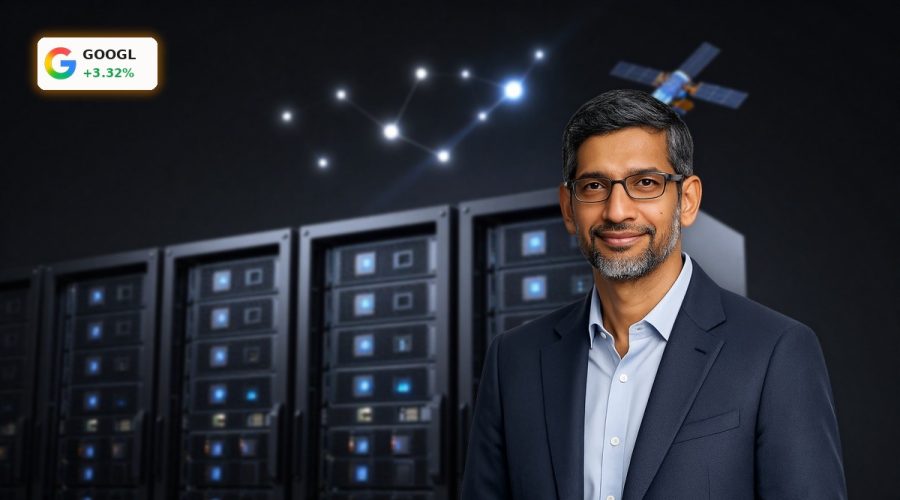
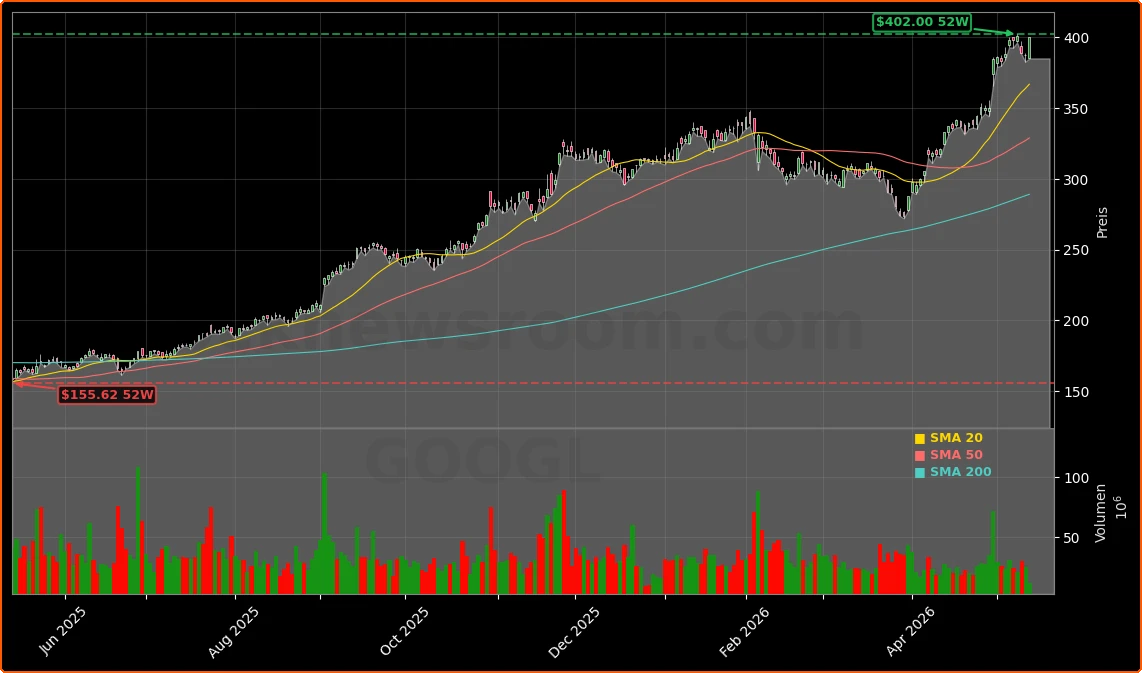
Alphabet Inc. (Google) shares traded around $400.21 on Wednesday, up roughly 3.32% from the previous close of $389.69, leaving the stock close to its all‑time highs. Communication Services remains one of the leading sectors in the S&P 500, and Alphabet’s AI narrative is a major driver. After years of being valued primarily as an ad and search giant, Wall Street is increasingly treating Alphabet as a full‑stack AI and cloud infrastructure leader.
Recent Q1 2026 numbers underscored that shift: revenue grew about 22% year over year to nearly $110 billion, while EPS of $5.11 almost doubled consensus estimates. Google Cloud revenue jumped 63% to roughly $20 billion with a $460 billion backlog, showing that the Google AI Strategy is directly converting into long‑dated enterprise contracts. Against that backdrop, Alphabet has climbed more than 150% over the past twelve months and significantly outpaced Apple in 2026, even as it still trades at a lower earnings multiple.
Where do Anthropic and cloud fit into Google AI Strategy?
A central pillar of the Google AI Strategy is owning the AI infrastructure layer through Google Cloud Platform (GCP). Alphabet has already invested heavily in Anthropic, the Claude AI developer that is now seeking to raise about $30 billion at a valuation near $900 billion, excluding new funds. Earlier this year, Google committed roughly $10 billion to Anthropic at a $35 billion valuation, with an additional $3 billion tied to performance milestones, while Amazon is layering in up to $7 billion.
For Alphabet, deepening ties with Anthropic serves multiple goals: locking in a marquee AI lab to GCP, validating its custom tensor processing units (TPUs) as an alternative to NVIDIA GPUs for some workloads, and reinforcing GCP’s position in multi‑cloud strategies alongside Microsoft Azure and Amazon Web Services. Market surveys of enterprise buyers show OpenAI, Anthropic and NVIDIA as early AI winners, but they also highlight that Anthropic’s traction is increasingly tied to GCP’s specialized AI stack. If recent rumors of Anthropic committing well over $100 billion in cloud spend to GCP over several years are borne out, that would further solidify Alphabet’s infrastructure moat.
How does Android Gemini expand Google AI Strategy to consumers?
On the consumer side, the Google AI Strategy is pivoting around Gemini as the company’s universal assistant. Just ahead of its I/O developer conference, Google unveiled an expansive Gemini rollout for Android 17. The update will embed a feature set called “Gemini Intelligence” directly into the operating system, allowing the assistant to act autonomously across apps, interpret on‑screen content, and execute multi‑step tasks such as planning events or shopping — while still requiring user approval before final actions.
Android lead Sameer Samat described this as a fundamental shift in how people interact with smartphones, saying that every aspect of the OS has to change. New tools like “Rambler,” a speech‑to‑text assistant that strips filler words and supports multilingual dictation in a single message, are intended to make Gemini feel more like an always‑on co‑pilot than a traditional chatbot. The features will first appear on Samsung’s next foldables and Google’s Pixel 11 line this summer, then roll out to more Android devices, including wearables, laptops, cars and smart glasses. This aggressive integration is also a defensive move as Apple readies its “Apple Intelligence” suite and a revamped Siri that will itself rely on Gemini models under a newly announced partnership with Alphabet.
Why are SpaceX talks and orbital data centers relevant?
The most eye‑catching frontier in the Google AI Strategy may be infrastructure beyond Earth. Google is in discussions with Elon Musk’s SpaceX about using its rockets to launch small data center modules into orbit as part of a broader “Project Suncatcher” initiative to test space‑based computing. Google already owns about 6.1% of SpaceX and has an executive, Don Harrison, on its board, while also talking to other launch providers to avoid single‑vendor risk.
Orbital data centers are still experimental, but they aim to exploit abundant solar power and cold vacuum for cooling — two constraints that now dominate AI infrastructure on the ground. As U.S. policymakers, including Senator Elizabeth Warren, step up scrutiny of how AI data centers strain electric grids and raise residential power costs, space‑based computing offers an intriguing, if long‑dated, alternative. For investors, the talks with SpaceX underline just how far Alphabet is willing to push to secure power and compute capacity as hyperscalers collectively plan to spend nearly $700 billion on AI infrastructure in 2026 alone.
How does Alphabet stack up against US tech rivals?
Across Wall Street, Alphabet is increasingly mentioned as a key name for the “second wave” of AI investing, in which value shifts from chipmakers to platforms that can monetize AI at scale. Early AI ETFs were dominated by NVIDIA, but new fund launches are boosting exposure to Alphabet as investors look for recurring revenue from AI‑enhanced search, YouTube, subscriptions and cloud workloads. Combined hyperscaler capex from Alphabet, Amazon, Meta Platforms and Microsoft is projected to approach $725 billion by 2026, creating a multi‑year demand floor for AI chips, power contracts and data center build‑outs.
At the same time, regulators and energy‑policy debates are a real overhang. Senator Warren has opened an investigation into whether utilities are unfairly passing AI‑driven grid upgrade costs onto households instead of trillion‑dollar tech companies such as Alphabet, Amazon, Microsoft and Meta. Any shift in cost allocation or new climate‑driven restrictions on data center locations could affect returns on Alphabet’s planned $175–$185 billion capex program for 2026 and beyond. Still, many institutional investors view those risks as manageable given Alphabet’s high margins, low leverage and diversified revenue base.
Related Coverage
Investors who want a deeper dive into how current earnings reflect the Google AI Strategy can review our earlier analysis in “Alphabet Earnings Boom As AI And Google Cloud Drive Growth”. That piece breaks down how Gemini‑driven cloud momentum and soaring backlog are feeding through to the income statement, and what rising capex means for long‑term free cash flow.
Overall, the Google AI Strategy now spans core infrastructure, consumer platforms and even potential orbital data centers, positioning Alphabet Inc. (Google) as one of the most diversified AI plays on the NASDAQ. For U.S. investors, the combination of strong cloud growth, Android Gemini integration and deep partnerships with players like Anthropic and SpaceX keeps Alphabet central to any long‑term AI allocation. The next major updates at I/O and subsequent earnings will show how effectively the company converts this strategy into sustained profit and market share gains.