Are Alphabet’s record earnings and massive AI capex turning Google into the ultimate long‑duration AI infrastructure play or a risky bet?

How strong were Alphabet Earnings this quarter?
Alphabet Inc. (Google) delivered one of the most striking quarters of the current reporting season. Total revenue jumped 22% year over year to about $109.9 billion, while earnings per share surged 82% to $5.11. That figure blew away Wall Street forecasts of roughly $2.6–$2.7 per share, helped by a $37.7 billion unrealized gain on equity stakes such as SpaceX. Even stripping out that mark‑to‑market effect, underlying operating momentum was clearly stronger than analysts had modeled.
Google Search, still the profit engine, accelerated to 19% growth and generated around $60.4 billion in quarterly revenue despite fears that generative AI might cannibalize query volumes. CEO Sundar Pichai said search queries hit an all‑time high as users embraced AI Overviews and Gemini‑powered features. YouTube ad revenue climbed 11% to $9.9 billion, while subscription and device revenue rose 19% to $12.4 billion, powered by YouTube Premium, Music, cloud storage and Gemini subscriptions.
Across Wall Street, the reaction to Alphabet Earnings has been overwhelmingly positive. The company now carries 55 buy and just seven hold ratings, with no major sell recommendations. The average 12‑month price target of about $400 is already close to the current GOOGL quote, but bullish houses, including firms like Goldman Sachs and Morgan Stanley, see upside scenarios out toward $450–$460 if AI execution stays on track.
Is Google Cloud now the main growth engine?
The star of this Alphabet Earnings report was again Google Cloud. Segment revenue surged 63% year over year to $20 billion, an acceleration from 48% growth in Q4 and the fourth straight quarter of faster expansion. Cloud now represents roughly 18% of group sales and is increasingly the swing factor for Alphabet’s valuation versus peers like Amazon Web Services and Microsoft Azure.
Crucially for investors focused on profitability, Google Cloud’s operating income more than tripled to $6.6 billion, underscoring strong operating leverage as AI workloads scale. Management highlighted that revenue from products built directly on Gemini and other AI models grew roughly 800% year over year, while Gemini Enterprise paid active users rose 40% sequentially. The cloud backlog nearly doubled quarter on quarter to more than $460 billion, now also including direct sales of Google’s custom Tensor Processing Units (TPUs) into customer data centers.
This performance has shifted the competitive narrative. Where Meta lacks a cloud infrastructure business to monetize AI demand, Alphabet, Amazon and Microsoft can convert AI capex into external, recurring revenue streams. That full‑stack approach—own data centers, own custom chips, own cloud platform, own foundation models and end‑user products—echoes what NVIDIA has achieved on the hardware side of the AI trade and is a key reason Alphabet is currently the largest point contributor to the S&P 500’s gains in 2026.
How risky is Alphabet’s record AI capex plan?
The flip side of this cloud boom is an unprecedented spending cycle. In Q1 2026, Alphabet reported capital expenditures of about $35.7 billion, largely for AI data centers, networking and TPUs. Management raised full‑year 2026 capex guidance to a staggering $180–$190 billion, up from an already eye‑popping $175–$185 billion, and signaled that 2027 spending will be “significantly higher” again.
That level of investment is compressing near‑term free cash flow. Free cash flow dropped from $18.9 billion a year ago to around $10.1 billion, even as earnings surged, which explains why some large institutions such as Boston Trust Walden and AE Wealth Management trimmed positions in recent months. At the same time, investors like Berkshire Hathaway have built a multibillion‑dollar stake, effectively treating Alphabet as a long‑duration AI utility with a deep infrastructure moat.
Wall Street is split on how much risk this capex introduces. Bulls argue that Alphabet’s vertically integrated AI stack delivers better returns on each dollar spent than rivals, making aggressive investment the rational strategy while demand is “compute‑constrained.” Skeptics worry about cyclicality in AI infrastructure, regulatory attention and rising energy and emissions footprints as Google adds large natural‑gas‑backed data centers to support its AI ambitions.
What do Alphabet Earnings mean for Big Tech portfolios?
For U.S. investors heavily exposed to the “Magnificent Seven” cohort—Alphabet, Apple, Amazon, Microsoft, Tesla, NVIDIA and Meta—the new Alphabet Earnings report reinforces a key portfolio theme: not all AI spending is equal. Amazon and Alphabet are showing that hyperscale capex can translate quickly into external, high‑margin revenue, while some peers face more skepticism about monetization.
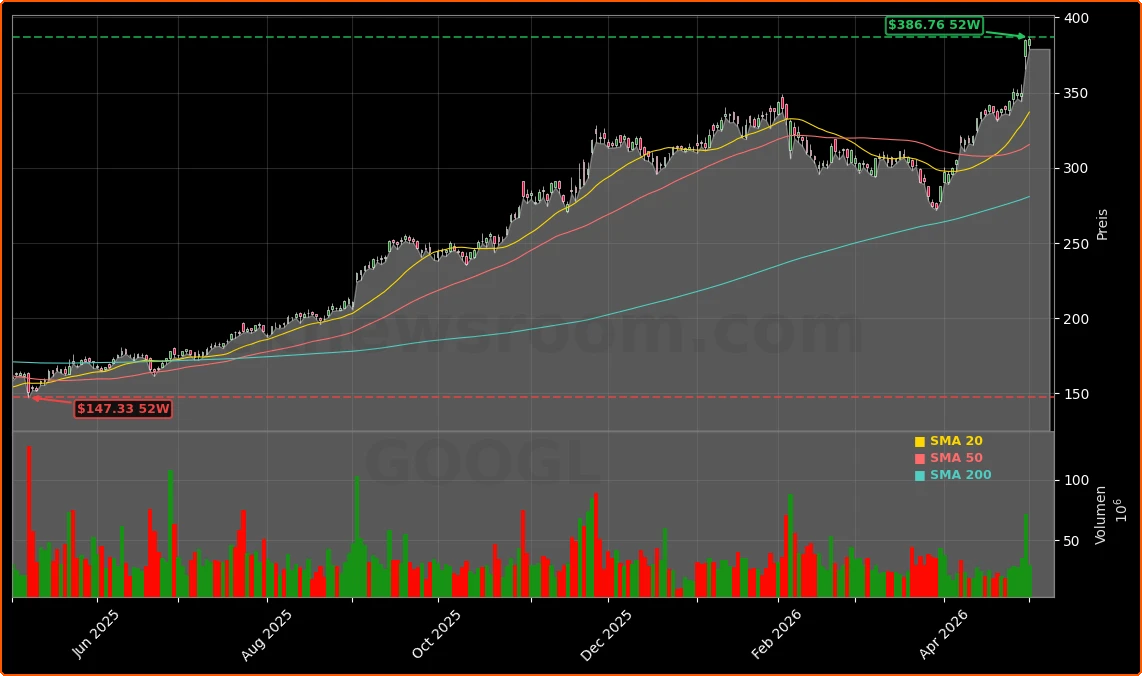
Alphabet now trades at roughly 33–35x forward 2026 earnings estimates, a premium to the broader S&P 500 but in line with high‑growth AI leaders. After a roughly 150% rally from early‑2025 lows and gains of more than 20% year to date, the stock is no longer cheap in absolute terms. Yet with Google Cloud running at an $80‑billion‑plus annualized rate and Waymo already delivering about 500,000 fully autonomous rides per week across 10–11 cities—well ahead of early‑stage robotaxi rivals such as Tesla—many growth managers still see Alphabet as a core AI holding rather than a trade.
Risk‑aware investors may rotate some capital into more defensive beneficiaries of the AI build‑out, such as utilities partnering with Google to provide power‑efficient data center capacity. Others may simply rebalance within Big Tech, trimming index‑weight overexposure while keeping Alphabet as a cornerstone AI infrastructure play.
Related Coverage
For a deeper dive into how this quarter fits into the broader AI story, see “Alphabet Earnings Q1 Surge: AI Cloud Boom Sends Shares Higher”. That analysis explores whether the latest results mark the beginning of a multi‑year AI super‑cycle or a one‑off spike driven by pent‑up demand and aggressive spending.
In sum, Alphabet Earnings underscore how decisively the company has shifted from ad‑only giant to AI infrastructure powerhouse. For Wall Street portfolios, the stock remains a high‑conviction way to play the full AI stack, even as record capex and a richer valuation demand closer scrutiny. The next few quarters will show whether cloud growth, Gemini monetization and Waymo scaling can keep justifying Alphabet’s AI spending spree and sustain its leadership across the NASDAQ and the S&P 500.